 Skagit County
 Concrete's Weather Is Harder on Siding Than Most Homeowners Realize
Concrete sits up the Skagit River in the foothills of the North Cascades, tucked between steep timbered slopes and a river valley that holds onto moisture longer than the flatter parts of Skagit County. Homes here deal with a long wet season, heavy tree cover that shades siding and keeps it from drying out, and the kind of driving rain that comes sideways off the valley rather than falling straight down. That combination is exactly what wears out exterior siding faster than the manufacturer's brochure ever suggests.
Add in the broader Skagit County climate — the damp, salt-influenced marine air that moves up the river corridor from Puget Sound, plus a moss season that can stretch from October well into May — and you've got a set of conditions that punishes the wrong siding material year after year. Homes with poor ventilation behind the siding, or siding that wasn't installed with the right flashing and clearances, show it first: staining, soft spots, and paint that won't hold.
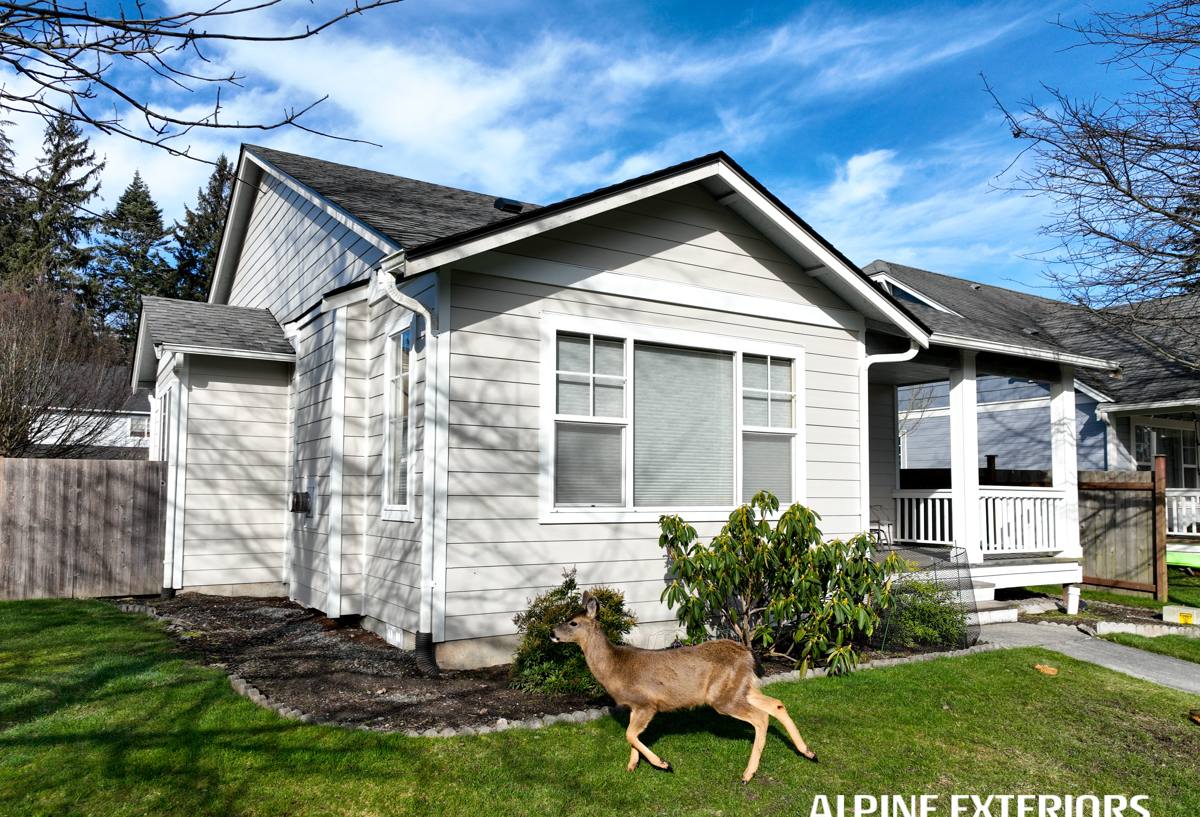
What Long-Term Moisture Exposure Does to a House
It's rarely one dramatic event. It's the slow accumulation of small failures.
- Wood-based and engineered wood siding absorbs moisture at cut edges, seams, and fastener points, and swells before it ever visibly rots.
- Moss and algae take hold on siding that stays damp under tree canopy, especially on north-facing walls that see less sun.
- Caulk and paint film break down faster under repeated wet-dry cycling, exposing the substrate underneath.
- Poorly flashed windows and trim let water track behind the siding, where damage goes unseen until it reaches sheathing or framing.
None of this means Concrete homes are doomed to constant repairs. It means the material and the installation both have to be matched to the environment, not just picked for upfront cost.
Why We Standardized on James Hardie Fiber Cement
We install James Hardie siding exclusively. Not because it's the cheapest option on the market, and not because it's the easiest to install — in a lot of ways it's more demanding to work with than the alternatives. We install it because it's the product that holds up best against the specific conditions Skagit County throws at a house.
Fiber cement is non-combustible, which matters more each year as wildfire smoke seasons and ember exposure become a bigger part of Pacific Northwest summers. It doesn't absorb water the way wood-based products do, so it isn't prone to the swelling, delamination, or rot that shows up on engineered wood siding after a few wet winters. Hardie's ColorPlus factory-applied finish is baked on under controlled conditions rather than field-painted, which gives it better fade and moisture resistance than a coat applied on site in variable weather — a real advantage in a valley where a clear painting window is never guaranteed.
Hardie also builds region-specific product lines engineered for different climate zones (their HZ5 line, for example, is formulated for wetter, colder regions like ours), and backs installations with a strong transferable warranty when the work is done to their specification. That warranty is only as good as the installation behind it, which is why correct installation — proper clearances, fastening, flashing, and joint treatment — matters as much as the product itself.
Why We Don't Install LP SmartSide, Vinyl, or Other Composite Sidings
We get asked about these regularly, and it's a fair question. Each has a legitimate place in the market.
LP SmartSide is an engineered wood product, and like any wood-based siding, it is more vulnerable to moisture intrusion at cut edges and fastener penetrations than fiber cement. It performs fine when installation is meticulous and maintenance stays current, but it gives homeowners less margin for error in a climate that doesn't offer many dry stretches to catch up on caulking and touch-up paint.
Vinyl siding is inexpensive and low-maintenance in a basic sense, but it's a thin material that can warp in heat, crack in cold, and it isn't rigid enough to resist impact the way fiber cement is. It also relies heavily on trim and J-channel details that, done poorly, create easy paths for water to get behind the wall.
Cemplank and Allura are fiber cement competitors to Hardie, and the raw material category is sound. Our decision to standardize on one brand comes down to consistency of factory finish, product engineering documented for our climate zone, warranty structure, and the fact that a crew that installs one system exclusively gets better at it than a crew that switches between five. Primed spruce and cedar are traditional, attractive materials, but they require an ongoing maintenance commitment — painting, sealing, and inspection — that most homeowners underestimate until the first missed cycle costs them a repair bill.
We'd rather tell a homeowner honestly why we don't install a product than sell them something we don't believe will perform on their house for the next several decades.
How the Project Works, Start to Finish
Assessment and Estimate
We walk the exterior, check existing siding condition, look at trim, flashing, and any signs of past moisture intrusion, and talk through what's driving the replacement — age, damage, an upcoming remodel, or just wanting something that won't need attention for the next 30 years.
Prep and Moisture Barrier
Old siding comes off, and we inspect the sheathing underneath before anything new goes up. Any water-damaged sheathing gets addressed before the weather barrier and flashing are installed. This step gets skipped by corner-cutting crews and it's the single biggest predictor of how a siding job performs ten years out.
Installation
Hardie panels, lap siding, or shingle siding go up per manufacturer spec — correct nailing patterns, proper clearances from grade and roofline, sealed and flashed penetrations, and factory-finished joints treated the right way.
Final Walkthrough
We go over the finished work with the homeowner, confirm everything meets spec, and make sure trim, caulking, and touch-up details are complete.
The Full Exterior: Siding, Roofing, Windows, and Decks
Siding doesn't work in isolation. A roof with failing flashing will send water down behind good siding just as easily as bad siding lets it in directly. Old windows leak air and moisture at the frame long before the glass itself fails. A deck built without proper ledger flashing rots the wall it's attached to. We handle all four because on most homes, the real problem — and the real fix — spans more than one system.
For Concrete homes specifically, that often means looking at roof and siding condition together, since the same tree cover and moisture exposure that ages siding also shortens roof life and feeds moss growth across both surfaces.
What Drives the Cost of a Siding Project
| Factor | Why It Matters |
|---|---|
| House size and wall complexity | More corners, gables, and dormers mean more cutting, flashing, and labor time |
| Current siding removal | Tear-off and disposal of old material adds cost versus new construction |
| Sheathing repair | Hidden water damage found during tear-off can add scope once uncovered |
| Siding profile chosen | Lap, panel, and shingle styles differ in material and labor cost |
| Trim and accent work | Window trim, corner boards, and accent bands add detail and labor |
| Access and site conditions | Steep lots, tree cover, and limited access common in the Concrete area can affect staging and labor time |
We give straight, itemized estimates so homeowners can see exactly what's driving the number, not a single lump figure.
What to Look for in a Local Siding Contractor
Skagit County has no shortage of contractors willing to bid a siding job. The difference shows up years later, not on the day the crew leaves.
- Ask whether the crew installs one siding system consistently or bounces between several — specialization usually means better execution.
- Ask what happens if they find water-damaged sheathing during tear-off, and how that's handled in the estimate.
- Confirm the manufacturer warranty terms and whether the installer is a certified or preferred installer for that product.
- Ask about flashing details around windows, doors, and roof intersections specifically — this is where most siding failures actually start.
- Check that they're licensed and insured, and ask for references from jobs at least a few years old, not just recent ones.
- Get a written, itemized estimate rather than a single verbal number.
A crew that's worked throughout Skagit County knows how the valley's moisture and shade patterns behave differently from a job in a drier, more open part of the county, and that knowledge shows up in the details of the install.
Let's Look at Your House
If your siding in the Concrete area is showing moss, staining, soft spots, or just age, we'll come take a look and give you a straightforward assessment of what's going on and what it would take to fix it right. There's no pressure and no obligation — just a clear look at your options, including whether James Hardie siding makes sense for your home. Fill out the form below to schedule a free estimate.