 Skagit County
 Why Anacortes Decks Wear Differently
Anacortes sits right on the water, and that changes how a deck ages compared to one twenty miles inland. Salt-laden air corrodes exposed fasteners and hardware faster than plain moisture does. Wind-driven rain off Rosario Strait and Guemes Channel gets pushed sideways under railings and into ledger connections that a calmer climate would never test. And the long gray stretch from fall through spring keeps deck surfaces damp for weeks at a time, which is exactly what moss and algae need to take hold. Add in the tree cover common around many Anacortes properties, and you get a steady supply of organic debris settling into board gaps and holding moisture against the wood.
None of this means a deck in Anacortes is doomed — it means the repair and maintenance approach has to account for the coastal environment instead of treating every deck the same way a builder would in a dry inland town. That's the difference between a repair that holds for a season and one that holds for years.
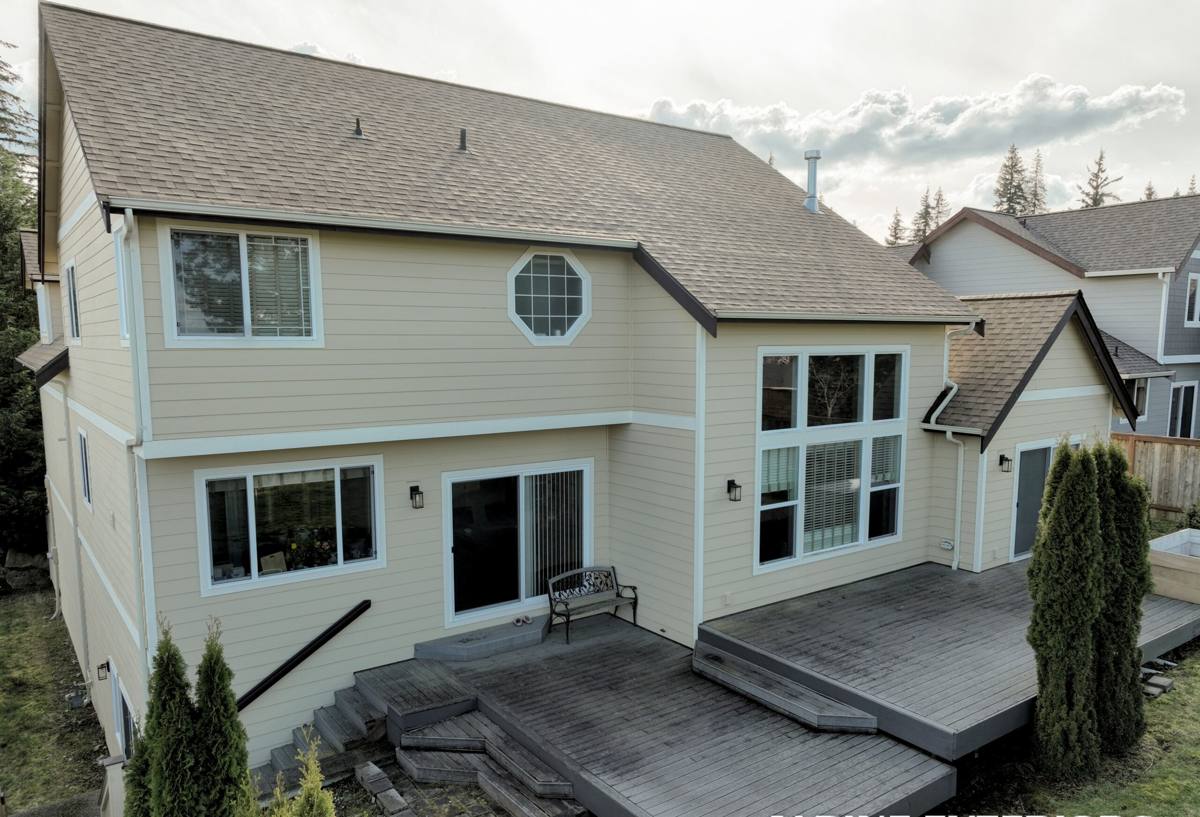
The Damage Patterns We See Most in This Area
Moss and Algae Buildup
Moss on a deck isn't just cosmetic. Once it establishes on a walking surface or between boards, it holds water against the wood around the clock, well past the point where the surface would otherwise dry out. Over a season or two, that constant dampness softens fibers, breaks down finish, and creates the ideal environment for rot to start underneath a surface that still looks intact from a few feet away.
Fastener and Hardware Corrosion
Salt air accelerates corrosion on screws, nails, joist hangers, and structural bolts — especially on decks facing open water or exposed to prevailing wind. Corroded fasteners lose holding strength gradually, so a board or railing section can feel solid right up until it isn't. This is one of the reasons we check hardware condition on every repair, not just the wood.
Ledger Board and Flashing Failures
The ledger board — where the deck attaches to the house — is the single most common source of serious structural problems we find, in Anacortes and everywhere else. Driving rain finds any gap in flashing or fasteners and works its way behind the ledger, where it's hidden from view and slow to dry. By the time staining or soft wood shows up on the surface, the framing behind it may already be compromised.
Board Cupping, Splitting, and Surface Rot
Repeated wet-dry cycling through a coastal winter and dry summer causes wood to cup, crack, and eventually split along the grain. Composite and PVC decking resist this kind of damage but aren't immune to problems at fastener points, picture-frame edges, or areas where debris traps moisture against a board for extended periods.
What a Proper Deck Repair Actually Involves
A repair that only replaces what's visible from the top often misses what's happening underneath. Our process is built around finding the actual extent of the problem before we touch a board.
- Full structural inspection of ledger connections, joists, beams, and posts — not just the decking surface
- Probing suspect areas with an awl or screwdriver to find soft wood that isn't visible yet
- Checking flashing at the house connection and correcting any gaps that allow water intrusion
- Inspecting all hardware for corrosion, not just checking that fasteners are present
- Verifying proper drainage and slope away from the house so water doesn't pool against ledger or framing
- Confirming railing posts and guard connections meet current structural expectations, since older decks were often built to looser standards
- Replacing only what's actually compromised, with matched or appropriate materials, rather than defaulting to a full rebuild when it isn't needed
That last point matters. Plenty of Anacortes decks need targeted repair, not full replacement — a rotted ledger section, a handful of failed boards, corroded hardware on an otherwise sound frame. Part of doing this job honestly is telling a homeowner when repair is enough and when it genuinely isn't.
Repair vs. Replacement: How We Decide
| Factor | Favors Repair | Favors Replacement |
|---|---|---|
| Structural framing condition | Joists and beams sound, damage isolated | Widespread rot in joists, beams, or posts |
| Ledger board condition | Localized flashing fix resolves the issue | Ledger itself is rotted or improperly attached |
| Age of decking material | Under 10-15 years, isolated board failures | Decking near end of expected service life throughout |
| Hardware condition | Corrosion limited to specific connections | Widespread corrosion across fasteners and hangers |
| Code compliance | Structure meets or can be brought to current standards | Original build doesn't meet current guard, footing, or connection code |
We walk through this with the homeowner directly during the assessment, showing what we found rather than just handing over a number.
Materials We Use and Why
For structural repairs — ledgers, joists, beams, posts — we use pressure-treated lumber rated for ground contact where applicable, along with corrosion-resistant, code-approved hardware. In a salt-air environment like Anacortes, using standard interior-grade fasteners on exterior structural connections is a shortcut that shows up as failure within a few years, so we specify hardware rated for coastal or treated-lumber exposure.
For decking surface replacement, we'll discuss wood versus composite versus PVC based on the homeowner's budget, maintenance appetite, and how the deck is used. Wood costs less upfront but needs regular refinishing and is more susceptible to the moss and moisture issues common in this area. Composite and PVC cost more initially but resist moisture damage and don't need staining or sealing — a real advantage given how much of the year Anacortes spends under cloud cover and rain. We don't push one material as universally correct; we lay out the real maintenance and cost trade-offs and let the homeowner decide what fits their situation.
Our Repair Process, Step by Step
- On-site assessment — we inspect the full structure, not just the areas the homeowner flagged, since hidden damage is common
- Written scope and estimate — a clear explanation of what's damaged, what needs replacing, and what the repair will involve, with no vague allowances
- Material selection — matching or upgrading materials appropriately for the coastal exposure and the homeowner's preferences
- Removal of compromised material — cutting back to solid, sound wood rather than patching over questionable sections
- Structural repair — framing, ledger, and flashing work done first, since everything else depends on this being right
- Surface and hardware installation — decking, railings, and fasteners installed to current standards
- Final walkthrough — reviewing the completed work with the homeowner before we consider the job done
Maintenance That Keeps Repairs From Repeating
A good repair should last, but a few habits go a long way in a climate like this one:
- Sweep leaves and debris off the deck regularly through fall and winter so moisture doesn't sit trapped between boards
- Rinse off moss and algae buildup before it has a chance to establish, especially in shaded corners
- Keep gutters and downspouts clear so roof runoff isn't dumping extra water onto or near the deck structure
- Check railings and stair connections periodically for looseness, which can signal developing hardware corrosion
- Re-seal or re-stain wood decking on the schedule the product calls for — skipping a cycle in this climate adds up fast
Why Hire a Crew That Already Works in Anacortes
A contractor who mainly works dry, inland jobs may not think twice about ledger flashing detail or fastener grade, because in that environment those shortcuts rarely cause visible problems for years. On the water in Skagit County, they show up much sooner. Working repeatedly on Anacortes and the surrounding coastal areas means we've seen how salt air, wind-driven rain, and moss actually play out on real decks over time, not just in a spec sheet. That local pattern recognition is part of what makes an assessment accurate instead of a guess.
We're also straightforward about scope. If a deck needs a full rebuild, we'll say so and explain why. If it just needs targeted structural and surface repair, we won't talk a homeowner into more work than the deck requires.
Get an Honest Assessment
If your deck in Anacortes has soft spots, visible moss, loose railings, or you're just not sure how much life it has left, we're happy to take a look. We'll give you a straight answer about what's actually going on and what it will take to fix it right — no pressure, no inflated scope. Reach out using the form below to schedule a free estimate.