 Skagit County
 Siding in Cedardale, Skagit County
Cedardale sits in the part of Skagit County where farmland, timber, and saltwater all meet. Homes here get a mix of exposures that few other places see in one address: open moisture off the water, wind funneling through low-lying fields, and enough tree cover in the older neighborhoods to keep everything shaded and damp for long stretches of the year. That combination is hard on exterior building materials, and it's why the siding decisions homeowners make out here matter more than they would in a drier inland climate.
We work on homes throughout this corridor of Skagit County, and the same patterns show up again and again: soft or delaminating siding on the north and west-facing walls, moss creeping up from the foundation line, and trim that's rotted out behind gutters and downspouts. None of that is bad luck. It's what happens when a siding product isn't built for this specific climate, or when it was installed without the flashing and clearance details that matter here.
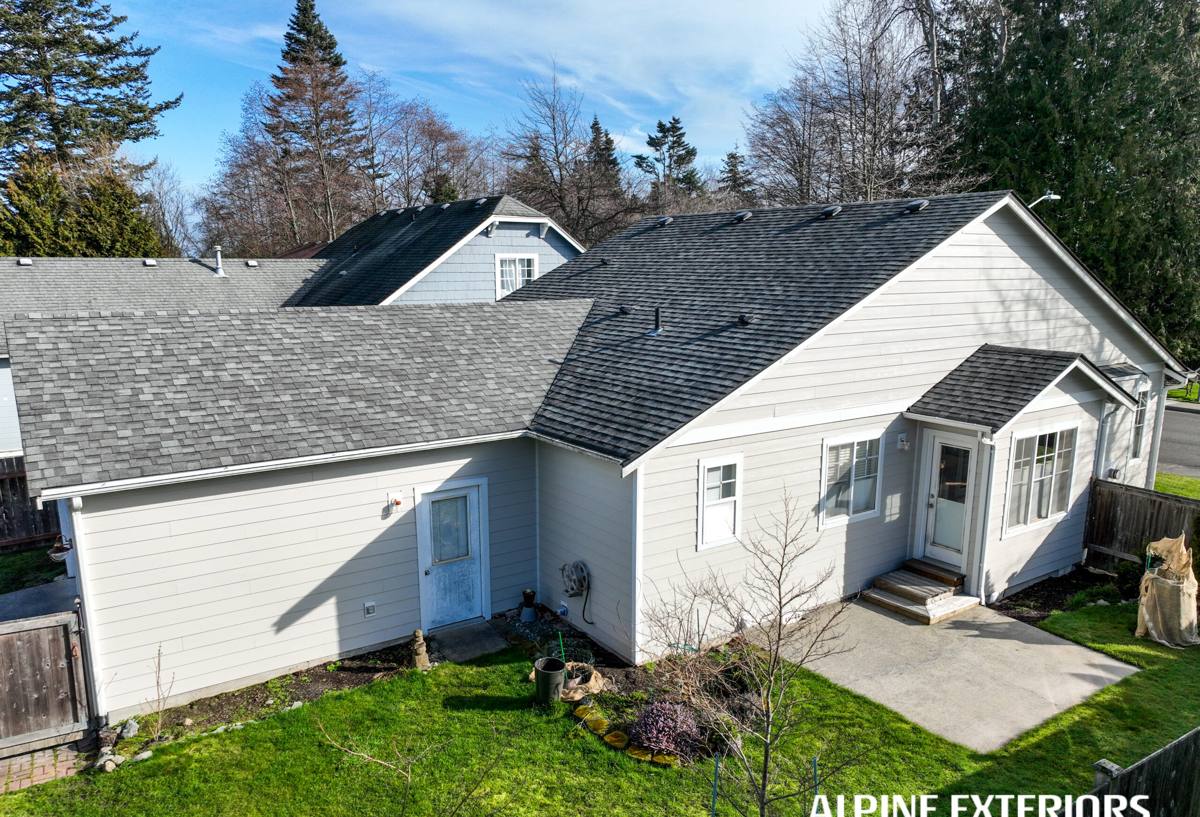
What the Skagit County Climate Actually Does to a House
Salt Air and Slow Corrosion
Proximity to Puget Sound and the surrounding bays means a steady, low-level dose of salt-laden moisture in the air. It doesn't announce itself the way a storm does. Instead it works slowly, into fasteners, trim edges, and any place where a coating has thinned or a seam has opened up. Over years, that slow corrosion is what turns a small gap into a real repair.
Driving Rain
Storms coming off the water bring rain that moves sideways as much as it falls straight down. Wind-driven rain finds every weak lap joint, every under-caulked window trim, and every place where house wrap wasn't lapped correctly behind the cladding. A siding system's water-shedding design matters as much as the material itself.
The Long Moss Season
Skagit County's wet season runs long, and shaded, north-facing walls can stay damp for weeks at a time. That's exactly the environment moss and algae need to take hold. On porous or absorbent siding materials, moss isn't just cosmetic — it holds moisture against the wall and accelerates whatever decay process is already underway.
Why We Install Only James Hardie Fiber Cement
We made a decision a long time ago to stop installing vinyl, LP SmartSide, primed spruce, cedar, and other fiber cement brands like Cemplank or Allura. That's not a marketing position — it's a practical one, built from what we see when we tear old siding off houses in this climate.
- Vinyl expands, contracts, and can warp or crack in wind and temperature swings, and it doesn't stop moisture from reaching what's behind it.
- Wood-based products (LP SmartSide, primed spruce, cedar) are organic materials at their core. Even with engineered coatings or resin treatments, they are more vulnerable to moisture absorption, swelling, and rot in a climate that stays wet for months at a stretch.
- Other fiber cement brands are a reasonable category of product, but we've standardized on one manufacturer, one factory finish process, and one warranty structure so we can stand behind the whole job — material and installation — without gaps in accountability.
James Hardie fiber cement is non-combustible, dimensionally stable, and manufactured with regional climate zones in mind. Their HZ5 product line is engineered specifically for the cold, wet Pacific Northwest, with moisture management built into the formulation rather than added as an afterthought. It doesn't feed moss the way wood-based products can, and it holds a factory-applied ColorPlus finish far longer than field-applied paint on wood or vinyl's baked-in color.
Comparing Common Siding Options in This Climate
| Material | Moisture behavior | Salt air / coastal durability | Maintenance burden |
|---|---|---|---|
| James Hardie fiber cement | Engineered moisture resistance, HZ5 formulation | Strong; factory finish resists fading and corrosion at seams | Low; occasional wash, no repainting cycle |
| Vinyl | Sheds water but doesn't manage what gets behind it | Can become brittle; seams and fasteners are weak points | Low upfront, but limited repair options if damaged |
| LP SmartSide / wood-based | Absorbs moisture at cut edges and joints over time | More vulnerable in prolonged damp conditions | Moderate to high; coating and joint maintenance needed |
| Cedar / primed spruce | Natural material, absorbs and releases moisture | Requires diligent sealing and upkeep near salt air | High; repainting or restaining on a recurring cycle |
What Correct Installation Looks Like Out Here
Material choice is half the equation. The other half is installation, and this is where a lot of siding failures actually originate — not in the product, but in how it went up. In a climate like Skagit County's, the details that matter most are the ones you can't see once the job is finished.
- Proper weather-resistive barrier installation, lapped correctly with flashing at every window, door, and penetration
- Correct fastener placement and spacing per Hardie's engineering specifications, not generic carpentry practice
- Adequate clearance between siding and grade, decks, roof lines, and other transitions where water collects
- Caulking and sealant only where Hardie's install guide calls for it — over-caulking traps moisture just as often as under-caulking lets it in
- Field-cut edges sealed properly to protect the factory finish at cuts and corners
A Hardie board installed against the manufacturer's specifications will outperform almost anything else on the market. The same board installed with shortcuts can fail early, and worse, that kind of failure often voids the warranty that was supposed to protect the homeowner in the first place.
Roofing, Windows, and Decks: Treating the Whole Exterior
Siding doesn't function in isolation. Water that gets past a roof edge, a window flashing detail, or a deck ledger connection will find its way into wall assemblies no matter how good the siding is. We handle roofing, windows, and decks alongside siding for exactly this reason — a home's exterior envelope has to be addressed as one connected system, especially in a climate that gives water this many chances to find a way in.
Roofing
Roof-to-wall transitions are one of the most common failure points we find in this region. Step flashing, kick-out flashing at roof-to-siding intersections, and gutter placement all affect how much water ends up running down a wall rather than off the roof.
Windows
Window flashing integration with new siding is one of the most important — and most often skipped — steps in a re-side. Done right, it directs water out and away from the wall cavity. Done wrong, it channels water directly behind the new siding.
Decks
Deck ledger boards attached directly to a wall are a frequent source of hidden rot, especially on shaded, damp elevations. When we're already opening up a wall for siding work, it's the right time to address ledger flashing and any deck-related water intrusion at the same time.
Signs a Cedardale Home Needs an Exterior Evaluation
- Moss or algae growth that returns quickly after cleaning, especially on north-facing walls
- Soft spots, bubbling, or visible swelling in siding boards or trim
- Peeling or chalky paint on wood-based siding that keeps recurring within a few years
- Staining or streaking below window sills or along butt joints
- Visible gaps at trim, corners, or J-channel where caulking has failed
- Rising utility bills that may point to compromised insulation behind failing siding
What a Project Looks Like: Cost Factors
Every home is different, but the same handful of factors drive most of the cost variation we see on siding projects in this area.
| Factor | Why it matters here |
|---|---|
| Extent of existing damage | Hidden rot behind old wood or vinyl siding often isn't visible until removal begins |
| Home size and wall complexity | Dormers, multiple stories, and cut-up wall planes add labor time |
| Hardie product line and profile | Lap, shingle, and panel styles carry different material and install costs |
| Trim and accessory scope | Window and corner trim replacement is often bundled with a re-side for a clean result |
| Access and site conditions | Tree cover, drainage, and driveway access affect setup and staging |
Why a Local Crew Matters
Skagit County's microclimates change block by block — a home a few miles from open water faces a different exposure than one tucked into tree cover further inland. A crew that works this specific area regularly knows which walls in a given neighborhood take the worst weather, where moss problems tend to start, and how local permitting and inspection expectations run in the county. That local knowledge shapes real decisions on the job: where to add extra flashing, which elevations need the most attention to detail, and what actually holds up here versus what looks fine on a spec sheet.
We're not a national franchise cycling through crews. We install one product system, we know how it performs specifically in this climate, and we stand behind the work because we're the ones who'll be back in this county for years to come.
Get a Straightforward Estimate
If your home in Cedardale or elsewhere in Skagit County is showing signs of moss buildup, soft siding, or ongoing maintenance headaches, it's worth having someone take an honest look before the damage spreads. We offer free, no-pressure estimates for siding, roofing, windows, and decks — come find out what your home actually needs, with no obligation attached.