 Skagit County
 Anacortes Siding Answers to the Water, Not Just the Weather
Anacortes sits surrounded by saltwater, and that changes what a house needs from its exterior. It isn't just rain siding has to shed here — it's salt-laden air moving off Rosario Strait and Guemes Channel, settling on siding, trim, and fasteners day after day. Add in the long, low-sun stretches of a Pacific Northwest fall and winter, and you get months where north- and west-facing walls barely dry out between storms. That combination of salt exposure and near-constant dampness is a different problem than siding faces twenty miles inland in Skagit County, and it's worth choosing a product and an installer who account for it.
Homeowners in Anacortes tend to notice the same three problems over and over on aging siding: chalky or pitted paint from salt residue, dark green-black streaking and moss growth on shaded elevations, and soft or delaminating material at the bottom courses where splash-back and standing moisture do the most damage. None of these are cosmetic quirks — they're early signs that a siding system wasn't built, or installed, for this specific climate.
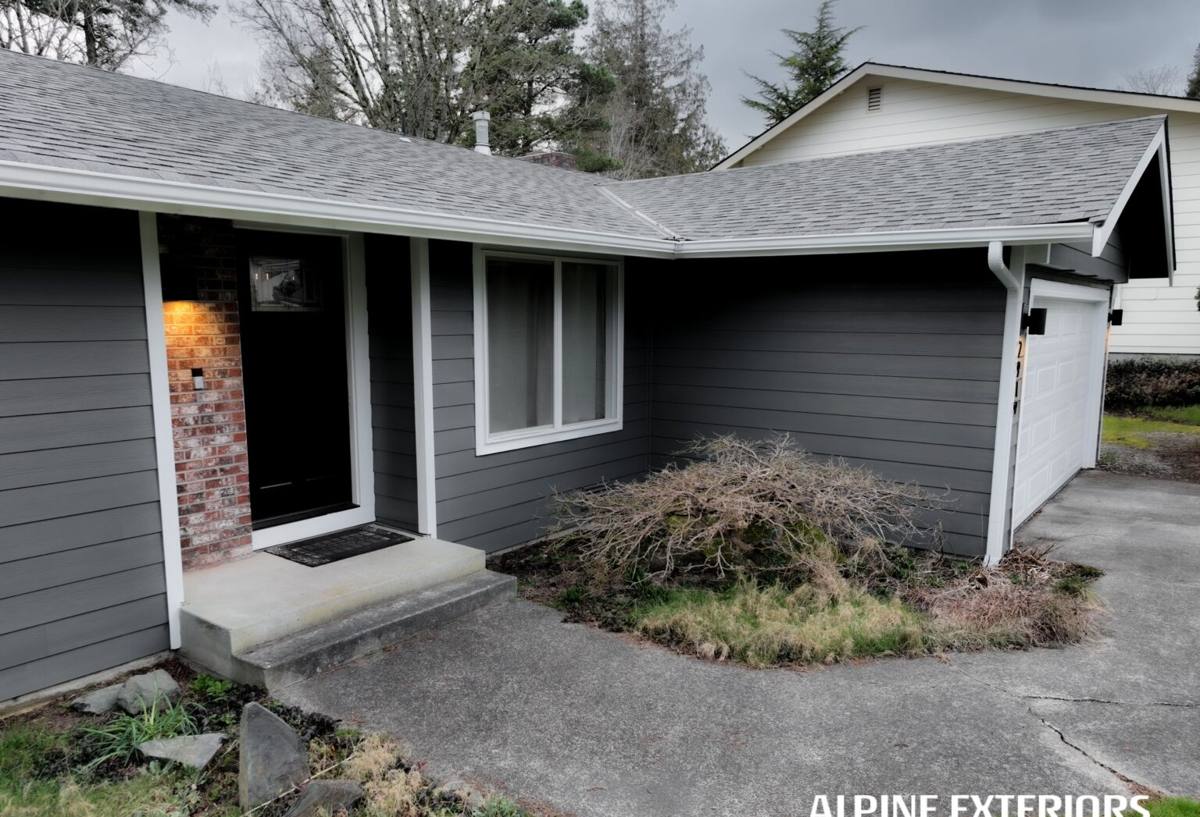
Why We Install James Hardie and Nothing Else
We made a decision as a company to install James Hardie fiber cement exclusively — no vinyl, no LP SmartSide, no cedar, no primed spruce. That's not a marketing position, it's a maintenance-and-longevity position based on what actually holds up in marine, moss-heavy environments like Anacortes and the rest of Skagit County.
Fiber cement doesn't feed moss or rot
Hardie siding is cement, sand, and cellulose fiber — there's no organic wood content for moss, algae, or fungal decay to take hold of the way they do on cedar or engineered wood products. In a climate where north-facing walls can stay damp for weeks at a stretch, that single material difference removes an entire category of long-term problems.
It doesn't move the way vinyl and wood do
Salt air and temperature swings cause a lot of expansion and contraction in lighter siding materials. Vinyl can warp, gap, or rattle loose over time, and wood-based products swell and shrink with moisture cycling, which stresses paint and seams. Hardie's fiber cement composition is dimensionally stable, so seams, caulk lines, and fastener holes stay tighter for longer.
It's non-combustible
Fiber cement doesn't contribute fuel to a fire the way wood-based sidings can. That's a genuine safety advantage independent of climate, and one more reason it's the only product we put our name behind.
The James Hardie Product Line for This Climate
James Hardie engineers its siding by climate zone, and homes in Anacortes fall into the HZ5 category built for wetter, harsher weather regions. Practically, that means the board formulation is tuned to resist moisture intrusion and freeze-thaw stress better than a generic, one-size-fits-all fiber cement product. On top of that, most homeowners choose Hardie's ColorPlus finish — a factory-applied, baked-on finish that's more UV- and fade-resistant than field-applied paint, and it means the color coat isn't something our crew has to get right on-site in variable weather.
For Anacortes specifically, we generally steer clients toward lap siding profiles with tighter reveal spacing on street-facing elevations for a clean look, and we pay particular attention to trim and soffit detailing on the sides of the house that catch the most wind-driven rain and salt spray — usually west and southwest exposures, given prevailing storm direction in this part of the Sound.
What a Correct Installation Actually Involves
Fiber cement siding is only as good as the install behind it. James Hardie publishes detailed installation requirements, and most of the "Hardie failures" homeowners hear about trace back to a crew skipping steps, not the product itself. A correct install on an Anacortes home includes:
- A continuous weather-resistive barrier behind the siding, lapped correctly at seams so water sheds outward, not inward
- Proper flashing at every window, door, and roof-to-wall intersection — the details that matter most in wind-driven rain
- A minimum clearance between the bottom of the siding and grade, decks, or roof lines, so splash-back and standing water don't sit against the board
- Correct fastener type, spacing, and embedment depth — under- or over-driven nails are one of the most common causes of early failure
- Gapped butt joints and proper caulking per Hardie's published specifications, allowing for material movement without letting water in
- Factory-cut or properly sealed field cuts, since exposed raw edges are a moisture entry point
None of this is exotic — it's just detail work that has to happen in order, every time, especially on a home that's going to spend the next several decades in salt air and heavy winter rain.
Our Process, Start to Finish
- On-site assessment. We walk the exterior, check current siding and trim condition, identify problem elevations (usually the sides taking the most wind and moisture), and look at flashing and drainage details before anything is quoted.
- Plan and product selection. We go over profile, reveal, and ColorPlus color options, and confirm the HZ5 product spec fits the home's exposure.
- Prep and moisture check. Old siding comes off, sheathing gets inspected for hidden rot or moisture damage (common on older Anacortes homes near the water), and any needed repairs happen before new siding goes up.
- Weather barrier and flashing. This stage is the one most likely to get rushed on a bad job — we don't rush it.
- Siding installation. Installed to Hardie's fastening and clearance specifications, with careful attention to butt joint gapping and trim details.
- Caulk, touch-up, and final inspection. We walk the finished job with the homeowner before calling it done.
What Drives Project Cost
Every home is different, but the same handful of factors tend to move the price up or down on a Hardie project in this area. This isn't a quote — it's meant to help you understand what you're paying for.
| Factor | Why it matters |
|---|---|
| Removal of existing siding | Tear-off, disposal, and sheathing repair add labor before new siding can go up |
| Home size and number of stories | More square footage and taller walls mean more material, more staging, and more labor time |
| Trim and detail work | Corner boards, window trim, and fascia detailing take more time than flat wall runs |
| Exposure and accessibility | Waterfront or wind-exposed sides often need extra flashing attention and scaffolding |
| Siding profile and finish | Lap width, reveal, and ColorPlus color selections vary in material cost |
| Hidden moisture damage | Rotted sheathing found during tear-off adds repair scope that can't be fully known until the old siding is off |
Signs Your Siding Is Already Losing the Fight
A lot of Anacortes homeowners call us after noticing one of these — worth checking your own exterior before winter storm season sets in again:
- Moss or dark streaking that keeps coming back on the same wall no matter how often it's cleaned
- Soft, spongy, or bubbling siding near the bottom courses or below windows
- Paint that's chalking, peeling, or fading unevenly, especially on salt-exposed sides
- Visible gaps, warping, or cupping in existing lap siding
- Musty smell or discoloration on interior walls that share an exterior wall with a problem area
- Caulk that's cracked, shrunk, or missing at seams and trim joints
Living With Hardie Siding in This Climate
One of the practical advantages of fiber cement in a place like Anacortes is how little upkeep it actually needs compared to wood or engineered wood siding. It won't need repainting on the schedule wood does, and it doesn't provide the organic surface moss needs to establish itself. That said, a long moss season and salt air don't disappear just because the siding changed — a periodic gentle rinse to clear salt residue and organic buildup, especially on shaded north walls, keeps ColorPlus finishes looking sharp for the long haul. Keeping gutters clear and vegetation trimmed back from walls also goes a long way toward keeping moisture and moss pressure down.
Warranty and What It Actually Covers
James Hardie backs its siding with a non-prorated limited warranty on the substrate, and ColorPlus finishes carry their own separate finish warranty covering fade and chipping. Both are transferable if you sell the home, which matters in a market like Anacortes where waterfront and near-waterfront properties change hands regularly. The warranty is only as good as the installation behind it, though — improper flashing or fastening can void coverage on a failure that was really an install problem, which is part of why we're deliberate about following Hardie's installation requirements exactly rather than treating them as suggestions.
Why It Matters That We Already Work in Anacortes
A crew that's put up Hardie siding on other homes in this specific part of Skagit County already knows which elevations take the worst of the wind-driven rain off the water, how local building department inspections tend to go, and what moisture problems show up most often in homes of a given age near the shoreline. That local pattern recognition shows up in small decisions — extra flashing attention on a west wall, a closer look at sheathing near ground level — that a crew unfamiliar with this specific coastal exposure might not think to make.
If you're weighing a siding replacement or just want a straight answer on whether your current siding still has years left in it, we're happy to walk the exterior with you and give a free, no-pressure estimate — no obligation, just an honest look at where things stand.