 Skagit County
 Metal Roofing Built for Edison's Coastal-Farmland Climate
Edison sits in the low-lying farmland between the Skagit River delta and the salt water of Samish Bay and Padilla Bay, and that location shapes what a roof has to survive out here. Salt-laden air moves in off the water most of the year, driving rain comes in sideways during winter storms, and the shade from surrounding trees and near-constant dampness keep moss and algae growing on roofs longer than in drier parts of the state. A roofing material that holds up fine in Seattle or on the east side of the Cascades can wear out faster in Edison if it isn't matched to these conditions.
Metal roofing, installed correctly, handles this combination better than most other residential roofing materials. But "metal roofing" covers a wide range of products, gauges, coatings, and installation methods, and not all of them hold up the same way this close to salt water. This page covers what actually matters for a metal roof on an Edison home: the material choices, the installation details that make or break long-term performance, and what to expect from the process.
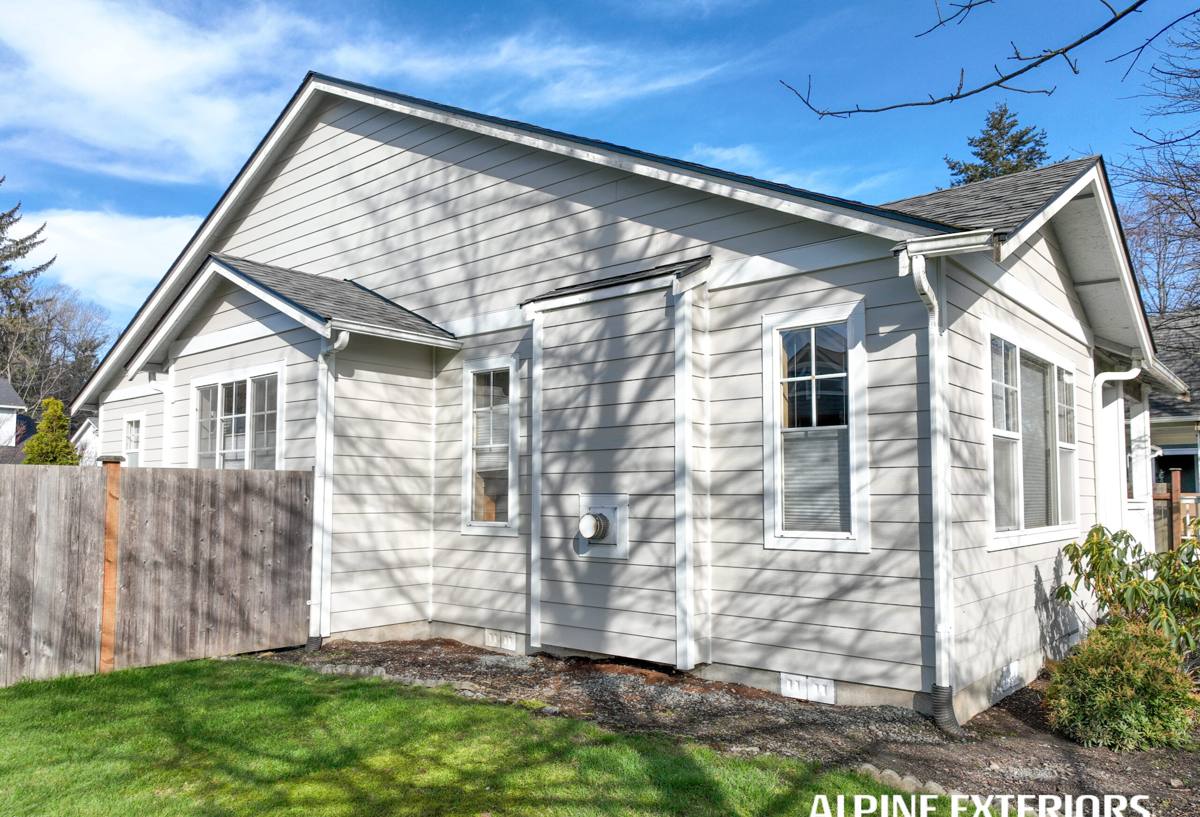
What Salt Air and Driving Rain Do to a Roof Over Time
Salt Air and Corrosion
Airborne salt is corrosive to unprotected or poorly coated metal. It settles on roof surfaces, fasteners, and flashing, and over years it can attack any exposed steel edge, scratch, or cut fastener thread. This doesn't mean metal roofing is a poor choice near the water — it's the opposite, when the right alloy and coating are used. It does mean the material spec and fastener choice matter more in Edison than they would fifteen miles inland.
Driving, Wind-Driven Rain
Skagit County storms often come with wind, and wind-driven rain doesn't just fall straight down onto a roof — it pushes sideways and can work its way under panels, around penetrations, and behind poorly lapped flashing. A metal roof sheds bulk water well, but the seams, laps, and flashing details are where a roof either stays dry or starts leaking. This is an installation issue more than a material issue.
Moss and Algae
Shade, moisture, and mild temperatures are exactly what moss and algae need to establish themselves, and Edison's tree cover and damp air give them a long growing season. Moss holds moisture against a roof surface, which is hard on shingles and can eventually work into seams and fasteners on any roofing material if left unchecked. Metal roofing gives moss less to grab onto than a shingle surface does, which is one of the practical reasons homeowners here switch to it.
Choosing the Right Metal and Finish for This Location
Not every metal roofing product is suited to a home this close to salt water. The base metal, the coating, and even the fastener material all affect how well a roof holds up over the decades it's expected to last.
| Option | Corrosion Resistance Near Salt Water | Typical Cost Range | Best Fit |
|---|---|---|---|
| Galvalume steel (standard coating) | Good on the field of the roof; cut edges and scratches need attention | Lower | Homes set back from direct water exposure |
| Steel with a premium coastal-grade coating | Higher — coating is formulated to resist salt exposure | Mid | Homes with regular salt air exposure, most of Edison |
| Aluminum | Excellent — does not rust, handles salt air very well | Higher | Homes directly exposed to bay winds or with a history of corrosion issues |
The cost ranges above are broad and depend on roof size, complexity, and panel profile — they're a starting point for comparison, not a quote. We'll walk through the actual numbers for your roof during an estimate.
Standing Seam vs. Exposed-Fastener Panels
The other major decision is panel type. Both are metal roofing, but they behave differently over time, especially in a climate with this much rain and salt exposure.
Standing seam panels use hidden, raised seams with no exposed fasteners on the roof field — the panels attach with concealed clips that let the metal expand and contract with temperature changes. This is our standard recommendation for Edison homes. There's no fastener head exposed to weather or corrosion, and the seams are mechanically locked or seamed, which handles wind-driven rain better over the long run.
Exposed-fastener panels attach directly through the panel with screws that have rubber washers. They cost less upfront, but every one of those screw penetrations is a potential point of failure once the washers age and shrink — which happens faster with the temperature swings and UV exposure our climate produces. Washers typically need replacement well before the panel itself wears out, and that's ongoing maintenance many homeowners don't want to sign up for.
We'll install exposed-fastener systems when a project calls for it — outbuildings, budget-driven projects, agricultural structures — but for a primary residence in Edison, standing seam is our professional standard, and we'll explain the trade-off honestly if you're deciding between the two.
What a Correct Metal Roofing Installation Includes
The panels themselves get most of the attention, but the parts of the job that determine whether a metal roof stays watertight for decades are mostly things you won't see once it's finished.
- Solid, code-compliant decking underneath — rotten or spongy sheathing gets replaced, not roofed over
- A synthetic or high-temp underlayment rated for the panel type, providing a secondary water barrier
- Properly lapped and sealed flashing at every valley, wall intersection, chimney, and vent penetration
- Fasteners and clips matched to the panel metal to prevent galvanic corrosion between dissimilar metals
- Correct panel overlap and seam direction relative to prevailing wind and water flow off the roof
- Proper ventilation at the ridge and eaves so moisture doesn't get trapped under the panels
Skipping any one of these doesn't show up as a problem on installation day — it shows up as a leak or a corrosion spot three, five, or ten years later. This is where the difference between a rushed metal roofing job and a correct one really lives.
Our Process for an Edison Metal Roofing Project
- On-site inspection. We look at your existing roof, decking condition, ventilation, and any trouble spots — moss buildup, past leaks, flashing condition — before recommending anything.
- Material and panel recommendation. Based on your home's exposure to wind and salt air, tree cover, and budget, we recommend a metal type, coating, and panel style, and explain the trade-offs of each.
- Written estimate. You get a clear breakdown of materials, labor, and any decking repair or ventilation work identified during the inspection — no surprise add-ons mid-project.
- Tear-off and deck prep. Old roofing comes off, decking is inspected and repaired as needed, and any rot is addressed before anything new goes down.
- Underlayment, flashing, and panel installation. Installed in the sequence and detail described above, with attention to every penetration and seam.
- Final walkthrough. We go over the finished roof with you, including what maintenance it needs and what doesn't need to be done.
Maintaining a Metal Roof Through Skagit County's Moss Season
One of the appeals of metal roofing in Edison is how little maintenance it needs compared to shingles, but "little" isn't "none." A yearly look at the roof — either by you from the ground or by us — catches small issues before they become expensive ones.
- Clear debris (needles, leaves, branches) from valleys and around penetrations where it collects and holds moisture
- Check that gutters and downspouts are flowing freely, especially after fall leaf-drop and winter storms
- Watch for moss or algae starting to establish in shaded areas and address it before it spreads
- Have flashing and sealant at penetrations checked periodically — these age faster than the panels themselves
- After any major windstorm, a quick visual check for lifted panels or displaced flashing is worth the time
None of this requires the frequent attention a shingle roof demands in this climate, which is a big part of why metal roofing makes sense for a moss-prone, rain-heavy area like Edison.
Why Local Experience in Edison and Skagit County Matters
A metal roof installed by a crew that hasn't worked in this specific climate can still look fine on the day it's finished. The difference shows up later — in how the flashing details hold up to wind-driven rain, whether the coating was matched to salt air exposure, and whether the panel seams were sealed with this climate in mind rather than a generic spec sheet. We work throughout Skagit County, including Edison, and we bring what we've learned about this area's particular mix of salt air, rain, and moss into every roofing decision, from material selection to flashing detail.
We're also straightforward about cost and trade-offs. If a lower-cost panel system will do the job for your situation, we'll say so. If your home's exposure calls for a premium coating or aluminum panels, we'll explain why rather than just upselling the most expensive option.
If you're weighing a metal roof for your Edison home, we're happy to take a look and walk you through your options honestly. Use the form below to request a free, no-pressure estimate — we'll assess your roof, your home's exposure, and your budget, and give you a straight answer about what makes sense.