 Skagit County
 Alger's Climate Is Harder on Siding Than It Looks
Alger sits in the stretch of Skagit County tucked between I-5 and Samish Bay, shaded by a heavy fir and cedar canopy that keeps the area cool and green — and keeps siding wet longer than homeowners expect. The combination of salt-tinged air drifting off the bay, driving wind-blown rain off the water, and a moss season that can stretch from October through May puts real, ongoing stress on a home's exterior. This isn't a place where you can install siding built for a dry inland climate and expect it to hold up the same way.
Salt air accelerates corrosion on fasteners, trim, and any exposed metal flashing. Driving rain — the kind that comes in sideways during a Pacific storm off the Strait — pushes water into laps, seams, and butt joints that would stay dry in a calmer climate. And the moss and algae that thrive in Alger's shaded, damp microclimate don't just look bad; they hold moisture against the surface of siding for months at a time, which is exactly the condition that rots wood-based products and delaminates poorly-made composites.
None of this means siding is a losing battle in Alger. It means the material and the installation have to be chosen for these specific conditions, not generic ones.
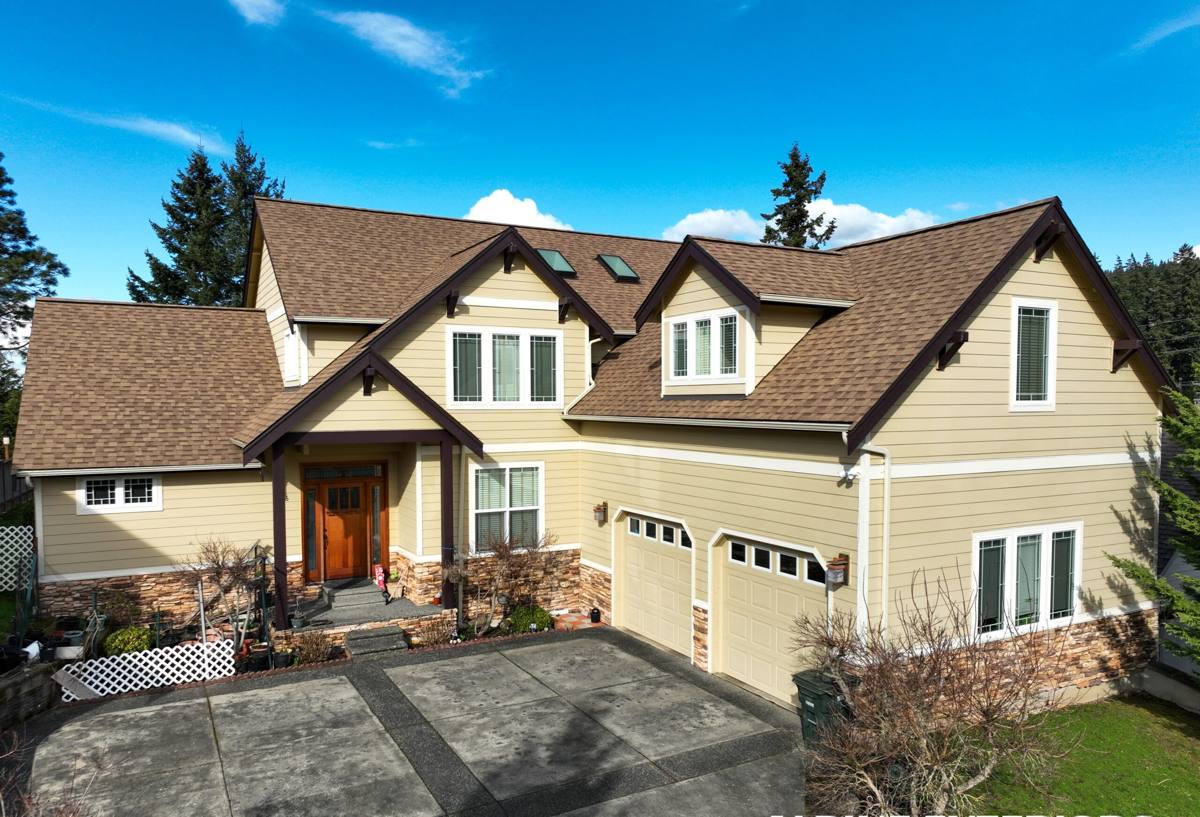
Why We Standardized on James Hardie for Skagit County Homes
We install James Hardie fiber cement siding exclusively. We don't install vinyl, LP SmartSide, Cemplank, Allura, primed spruce, or cedar — not because those products have no merit, but because after years of working on homes in this specific climate, we don't think they hold up as well against Skagit County's wet, salt-influenced weather, and we're not willing to put our name on an install we don't believe in.
Vinyl expands and contracts with temperature swings and can warp or crack over time, and it doesn't hold paint if a homeowner ever wants to change color. LP SmartSide and similar engineered wood products use a wood-strand core that, if moisture gets past the coating at a cut edge or fastener point, can swell and deteriorate — a real risk in a place with this much sustained dampness. Cedar is a beautiful, legitimately good product, but it demands re-staining or re-sealing on a schedule most homeowners don't keep up with, and untreated or neglected cedar in a moss-heavy environment can rot faster than people expect. Primed spruce lap siding needs field-painting and diligent caulking to perform at all.
James Hardie fiber cement is non-combustible, dimensionally stable in wet-dry cycling, and comes with a factory-applied ColorPlus finish that doesn't rely on a homeowner's maintenance schedule to keep water out. That's the standard we hold every job to.
The Hardie Product Lines That Make Sense Here
HardiePlank Lap Siding
The most common choice for Alger homes — horizontal lap siding available in several exposure widths and textures (smooth or cedar-textured). It's the workhorse product for most of the county.
HardiePanel Vertical Siding
Used for board-and-batten styling or as an accent on gables and entry features. Popular for homes that want a mix of horizontal and vertical lines.
HardieShingle
Staggered or straight-edge shingle profile for homes going for a Craftsman or cottage look, common in the older neighborhoods around Skagit County.
HardieTrim
Fiber cement trim boards for corners, fascia, and window/door surrounds — matters because mismatched wood trim against fiber cement siding is one of the most common ways moisture gets a foothold at joints.
James Hardie also engineers different formulations for different climate zones. Skagit County's wet, marine climate calls for the moisture- and humidity-focused engineering rather than the freeze-thaw formulation used in colder inland regions — it's built to shed and resist sustained dampness rather than survive hard winter freezes, which matches what Alger actually deals with most of the year.
What a Correct Installation Actually Involves
Fiber cement siding is only as good as the install behind it. In a climate like Alger's, the details that get skipped on a rushed job are exactly the ones that cause problems three or five years later.
| Detail | Correct Approach | Common Shortcut |
|---|---|---|
| Weather-resistive barrier | Continuous, properly lapped house wrap with taped seams behind all siding | Reused or torn existing wrap, gaps left at penetrations |
| Flashing at windows/doors | Integrated flashing with proper shingle-lap sequencing so water sheds outward | Caulk used in place of flashing |
| Fastener placement | Hardie-specified nailing pattern, corrosion-resistant fasteners driven flush (not overdriven) | Standard nails, inconsistent spacing, overdriven heads that crack the board |
| Clearance at grade/decks | Minimum 6" clearance from ground, 1-2" from decks and patios | Siding installed tight to grade or hardscape, trapping moisture |
| Butt joints | Joints backed with flashing tape or z-flashing, staggered course to course | Butt joints caulked only, stacked in a visible line |
| Cut edges | Factory-cut edges preferred; field cuts sealed per manufacturer spec | Raw, unsealed field cuts left exposed |
Every one of these details affects how the wall behind the siding handles driving rain and long stretches of damp weather. Skipping any of them doesn't usually show up as a problem on day one — it shows up as a soft spot, a stain, or a warranty claim down the road.
Our Process, Start to Finish
- On-site assessment — we look at your home's current siding, existing moisture damage, trim condition, and exposure to wind and rain.
- Written estimate — a clear scope covering product line, color, trim details, and any needed sheathing or wrap repair, with no vague allowances.
- Tear-off and inspection — removing old siding lets us actually see the sheathing underneath and catch rot or moisture damage before it's covered up again.
- Weather barrier and flashing — the part of the job that matters most and shows the least once it's done right.
- Hardie installation — installed to manufacturer spec for fastening, clearance, and joint treatment.
- Final trim, caulking, and walkthrough — we go over the finished job with you before calling it done.
Cost Factors for an Alger Siding Project
| Factor | Why It Matters |
|---|---|
| Home size and stories | More square footage and taller walls mean more material, labor, and equipment |
| Existing wall condition | Rot or sheathing damage found during tear-off adds repair scope |
| Product line and profile | HardieShingle and HardiePanel accents typically cost more per square foot than standard lap |
| Trim complexity | Homes with many corners, dormers, or gable detail take more labor than a simple rectangular footprint |
| Color | Standard ColorPlus colors versus custom-matched or premium palette options |
| Access | Tree cover, steep grade, or tight lot lines around Alger properties can affect staging and equipment |
We give real, itemized numbers during the estimate rather than a rough per-square-foot guess — every property's condition is different enough that a generic number isn't useful to you.
Living With Hardie Siding in a Moss-Prone, Salt-Air Environment
ColorPlus finished Hardie siding is low-maintenance, not no-maintenance. In a climate like Alger's, a little seasonal attention keeps it looking and performing the way it should for decades.
- Rinse siding annually (a garden hose is usually enough) to clear pollen, road film, and the beginnings of moss or algae buildup before it takes hold
- Trim back trees and shrubs so foliage isn't holding damp air or shade directly against the siding
- Check caulking at trim joints and penetrations once a year, especially after a hard winter storm season
- Keep gutters clear so overflow isn't running down the wall face and soaking siding repeatedly in the same spot
- Address any impact damage or cracked boards promptly rather than letting exposed edges sit through a wet winter
None of this is heavy upkeep — it's the difference between siding that looks the same in year fifteen as it did in year one, and siding that starts showing streaking and staining because it was never rinsed off.
Why a Crew That Already Works in Alger Makes a Difference
Siding installation isn't identical everywhere. A crew that mostly works drier, inland climates can install Hardie siding correctly on paper and still miss the details that matter specifically here — the extra attention to flashing sequencing for driving rain, the fastener choices that hold up against salt air, the clearance decisions that account for how much shade and dampness a shaded Skagit County lot actually holds onto through the year. A crew that already works Alger and the surrounding county has already seen what goes wrong when those details get skipped, on other homes in this same climate, and builds around it as a matter of habit rather than an afterthought.
That local experience is also why we're comfortable standing behind our workmanship warranty on top of James Hardie's manufacturer warranty — we know what this exterior needs before the first board goes up.
If you're weighing a siding replacement in Alger and want a straight answer about what your home actually needs, we're happy to take a look and put together a free, no-pressure estimate — no obligation, just a clear picture of the work and the cost.