 Skagit County
 Avon Sits in a Tough Spot for Exterior Siding
Avon is a small farming community in the Skagit River floodplain west of Mount Vernon, and that low-lying position in the Skagit Valley puts it right in the path of everything the regional climate throws at a house. Marine air moves inland off the Salish Sea and up the delta, carrying salt-tinged moisture that settles on exterior walls whether or not a home has a water view. Add the valley's long, wet winters and the driving rain that comes with them, and you have conditions that punish any siding material with a weak point in its finish, its fastening, or its water management.
Then there's moss. Skagit County's combination of shade, humidity, and a stretch of the year with barely any real drying window gives moss and algae a long season to work with — on roofs, on fences, and on siding that holds moisture instead of shedding it. A siding job that looks fine at installation can start showing streaking, soft spots, or lifted paint within a few years if it wasn't built for this specific climate. We install James Hardie fiber cement exclusively in Avon and across Skagit County, and this page walks through why, what a correct installation actually involves, and how our process works for homes in this area.
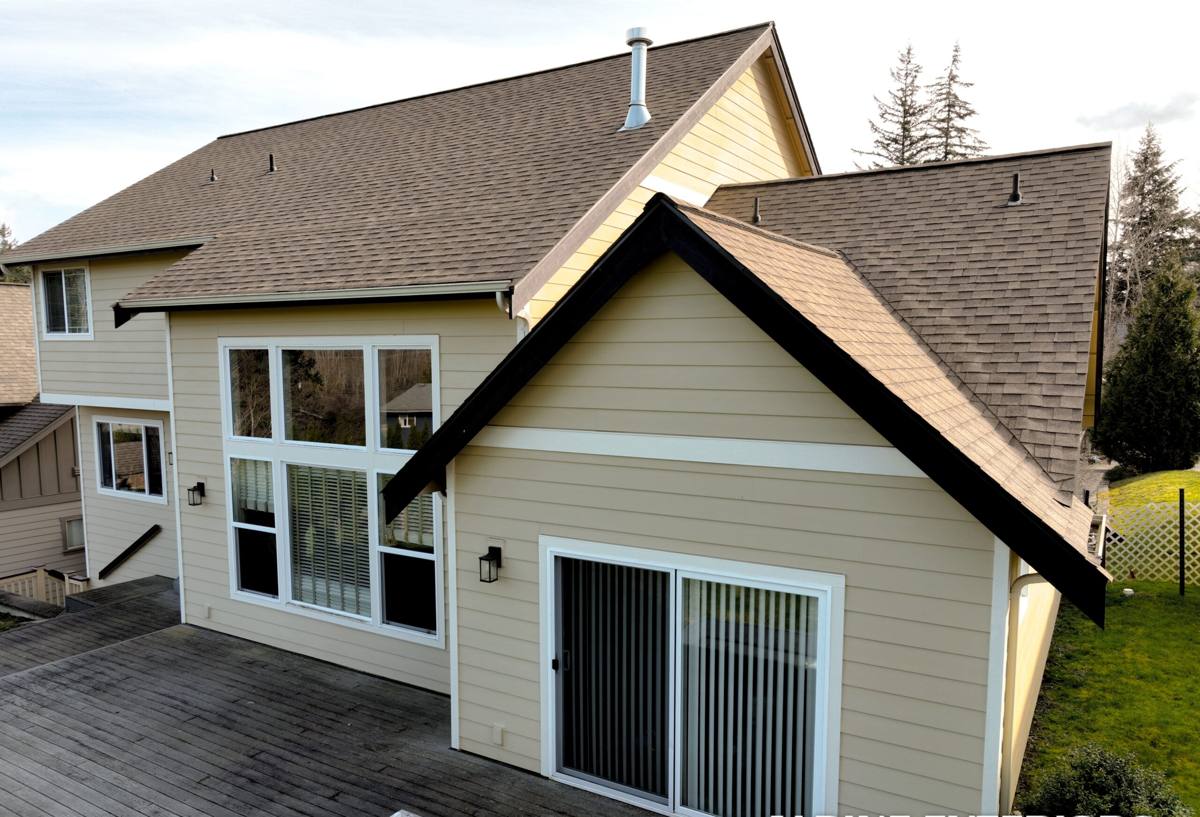
Why We Only Install James Hardie
We don't install vinyl, LP SmartSide, Cemplank, Allura, primed spruce, or cedar. That's not because those products have no legitimate use anywhere — it's because we've drawn a line based on what stands up to this specific climate over decades, not just the first few years. Vinyl expands and contracts with temperature swings and can warp or crack in a hard freeze; engineered wood products depend on an intact factory coating that, once breached at a cut edge or fastener hole, lets moisture into a wood-based core; cedar and primed spruce are handsome but need real upkeep — recoating, caulk maintenance, moisture monitoring — to avoid rot in a climate that rarely gives siding a long chance to dry out.
James Hardie fiber cement is cement, sand, and cellulose fiber — non-combustible, dimensionally stable, and engineered specifically for climates like ours through the HZ5 product line. It doesn't feed moss the way a porous wood-based product can, it holds its factory-applied color far longer than field-painted alternatives, and it comes with a strong transferable warranty backed by a company that's been refining this product for a long time. That's the standard we hold every Avon project to, and it's why we don't offer a cheaper alternative that we wouldn't want to warranty ourselves.
What a Correct Installation Actually Involves
James Hardie siding performs the way it's supposed to only when it's installed to the manufacturer's specifications — and that's true whether the crew is working in a dry climate or a wet one like this one. A lot of the siding problems we get called out to inspect in Skagit County didn't start with bad material; they started with a rushed or shortcut installation that a homeowner had no way to spot at the time.
Water Management and Flashing
Fiber cement is not waterproof siding — it's a durable cladding that's supposed to work as one layer in a water management system that includes a weather-resistant barrier, properly lapped flashing at every window, door, and penetration, and a drainage plane behind the boards so any incidental moisture has somewhere to go besides straight into your wall sheathing. In a climate with as much driving rain as the Skagit Valley sees, skipping or shortcutting this layer is where most premature siding failures actually start, regardless of what brand of board is on the outside.
Fastening, Gaps, and Caulk Joints
James Hardie specifies exact fastener placement, minimum clearances above grade, roof lines, and decks, and specific gaps at butt joints and trim to allow for the board's normal expansion and contraction. Skipping these clearances — nailing too close to an edge, butting boards tight with no gap, or letting siding sit too close to grade or a roof surface — creates entry points for moisture that a correctly installed board never has to deal with. It's detail work that doesn't show up in a driveway walkthrough but shows up in year five or ten.
Matching the Product Line to an Avon Home
James Hardie makes several distinct products, and picking the right one for a given wall, elevation, or architectural style matters as much as the installation itself.
- HardiePlank lap siding — the most common choice for traditional and farmhouse-style homes throughout the valley, available in smooth and cedarmill textures
- HardiePanel vertical siding — often used for board-and-batten sections, accent walls, or gable ends to break up a large elevation
- HardieShingle — a shingle-profile option for homes wanting a more textured, traditional look without the maintenance of real cedar shingle
- HardieTrim — matching trim boards that keep corners, fascia, and window surrounds consistent with the field siding
All of it is manufactured in the HZ5 formulation engineered for regions with freeze-thaw cycles and high moisture exposure, which is the correct specification for Skagit County. Color comes through ColorPlus Technology, a factory-applied finish cured under controlled conditions rather than painted on site — a meaningful advantage in a climate where field paint rarely gets a full, uninterrupted drying window.
How Hardie Compares for a Home Like This
| Factor | James Hardie Fiber Cement | Vinyl | Engineered Wood (LP-type) | Cedar / Primed Wood |
|---|---|---|---|---|
| Moisture & moss resistance | Strong — cement-based, doesn't feed organic growth | Doesn't rot, but seams and panels can trap moisture behind them | Vulnerable once the coating is breached at a cut or fastener | Vulnerable without consistent upkeep and recoating |
| Performance in driving rain | Strong when installed with proper flashing and laps | Adequate, but can flex or gap in wind-driven rain | Weak point at any exposed edge or joint | Depends heavily on coating condition |
| Finish longevity | Factory ColorPlus finish holds color for a long stretch | Color is baked into the material but can fade and chalk | Factory finish, but substrate is more moisture-sensitive | Field-applied finish needs recoating on a regular cycle |
| Maintenance burden | Periodic gentle washing | Low, but damage often means full panel replacement | Moderate to high — caulk and coating checks matter | High — recoating, caulking, moisture monitoring |
| Warranty structure | Strong transferable manufacturer warranty | Varies widely by product grade | Manufacturer-specific, often shorter on the substrate | Typically no manufacturer warranty on the material itself |
None of the alternatives are automatically a bad product everywhere — but weighed against Avon's specific combination of salt-influenced air, sustained rain, and a long moss season, fiber cement installed correctly is the material we're willing to put our name and warranty behind.
Our Process for Avon Projects
- On-site assessment — we look at your current siding, sheathing condition where accessible, trouble spots like moss buildup or soft trim, and the specific exposures of each elevation
- Tear-off and inspection — removing existing siding lets us check the sheathing and weather-resistant barrier underneath before anything new goes up, which is the only way to catch hidden moisture damage
- Water management first — house wrap or equivalent barrier, properly lapped flashing at every window, door, and penetration, before a single piece of Hardie goes on the wall
- Installation to Hardie's specification — correct fastener placement, clearances, and expansion gaps, not shortcuts that only show up years later
- Trim and detail work — corners, fascia, and joints finished so water sheds away from the building rather than pooling or wicking behind a board
- Final walkthrough and cleanup — we review the finished work with you and clear the site of debris and old material
Signs Your Current Siding Is Already Struggling
Skagit Valley homes show wear differently depending on what's on the walls, but a few signs are worth taking seriously before they become structural problems:
- Persistent moss or algae streaking that comes back within weeks of cleaning
- Paint that's peeling, bubbling, or chalking faster than it should
- Soft or spongy spots when you press on siding near the bottom courses or around windows
- Visible warping, buckling, or gaps that have opened up at seams
- A musty smell or visible staining on interior walls that share an exterior wall
Any one of these is worth a look before winter's rain adds to the problem — moisture damage in this climate tends to get worse quietly, behind the wall, long before it's obvious from the curb.
A Practical Maintenance Checklist
- Rinse siding gently once or twice a year to keep moss and pollen from building up, especially on shaded, north-facing walls
- Keep gutters clear so overflow doesn't run down siding repeatedly in the same spot
- Trim back shrubs and trees so siding gets airflow and isn't sitting in constant shade and dampness
- Check caulk joints at trim and penetrations annually and recaulk where it's cracked or pulled away
- Walk the perimeter after major storms and note any new gaps, cracks, or soft spots
- Keep an eye on grade and mulch levels so siding maintains its required clearance above the ground
Why a Crew That Already Works Avon Matters
Skagit County's mix of low-lying floodplain communities, coastal exposure, and inland valley weather means the right installation details can vary block by block, not just town by town. A crew that regularly works Avon and the surrounding Skagit Valley has already seen how the local weather treats different elevations, product lines, and installation details over time — which flashing details matter most on a windward wall, how much clearance to leave near grade in a floodplain lot, where moss tends to take hold first. That local track record is worth more than a low bid from a crew that's never worked this specific stretch of the valley.
It also means someone familiar with your home is reachable if a question comes up years down the line — not a crew that did one job in the area and moved on. We stand behind the installations we do here because we're going to be working in this county long after the job is finished.
If you're weighing a re-side or new construction siding project in Avon, we're happy to walk the property with you, look at your specific exposures, and put together a free, no-pressure estimate.