 Skagit County
 Big Lake homes deal with a version of Skagit County weather that's a little more concentrated than what you'd find on a dry, open lot in town. The lake itself keeps the air heavier and slower to dry out, the tree cover that gives so many of these properties their privacy also holds shade and dampness against the walls it lines, and the same salt-tinged air and driving rain that define the rest of the county still reach in this far from Puget Sound. Add up enough wet seasons in those conditions and a lot of siding starts failing well before a homeowner expects it to. This page covers what siding replacement actually involves for a Big Lake property, and why we build every one of these projects around what this specific setting does to a house.
What the Big Lake Setting Does to Siding
Water doesn't just fall on a Big Lake home from the sky — it sits in the air around it. Homes close to the shoreline pick up ambient humidity off the lake surface itself, on top of the normal rainfall every Skagit County property deals with. That humidity doesn't burn off quickly on shaded, tree-lined lots, which describes a large share of the properties around the lake. The result is siding that spends more hours per week in a damp state than a comparable home on an open, sun-exposed lot a few miles away.
Shade, Tree Cover, and Slow Drying
Mature fir and cedar cover is part of what makes Big Lake attractive, but it also means north-facing and lake-facing walls often go long stretches without direct sun. Wet siding that can't dry out between storms is siding that's working overtime — holding moisture against fasteners, seams, and the wall assembly behind it for longer than it was ever designed to.
A Long Moss Season
That same shade and moisture combination is exactly what moss and algae need to establish themselves, and Big Lake's tree-covered lots see a moss season that runs longer than the county average. Moss on siding isn't just cosmetic — it holds a film of moisture against the surface underneath it, which matters a great deal on any material with an organic core, and even non-organic materials need that buildup cleaned off before it works its way toward fasteners and joints.
Layer on the wind-driven rain that comes through with Pacific storm fronts, and salt-tinged air that reaches inland from Puget Sound during winter weather systems, and you get a climate that tests every seam, joint, and fastener on a house far more than a national spec sheet assumes it will.
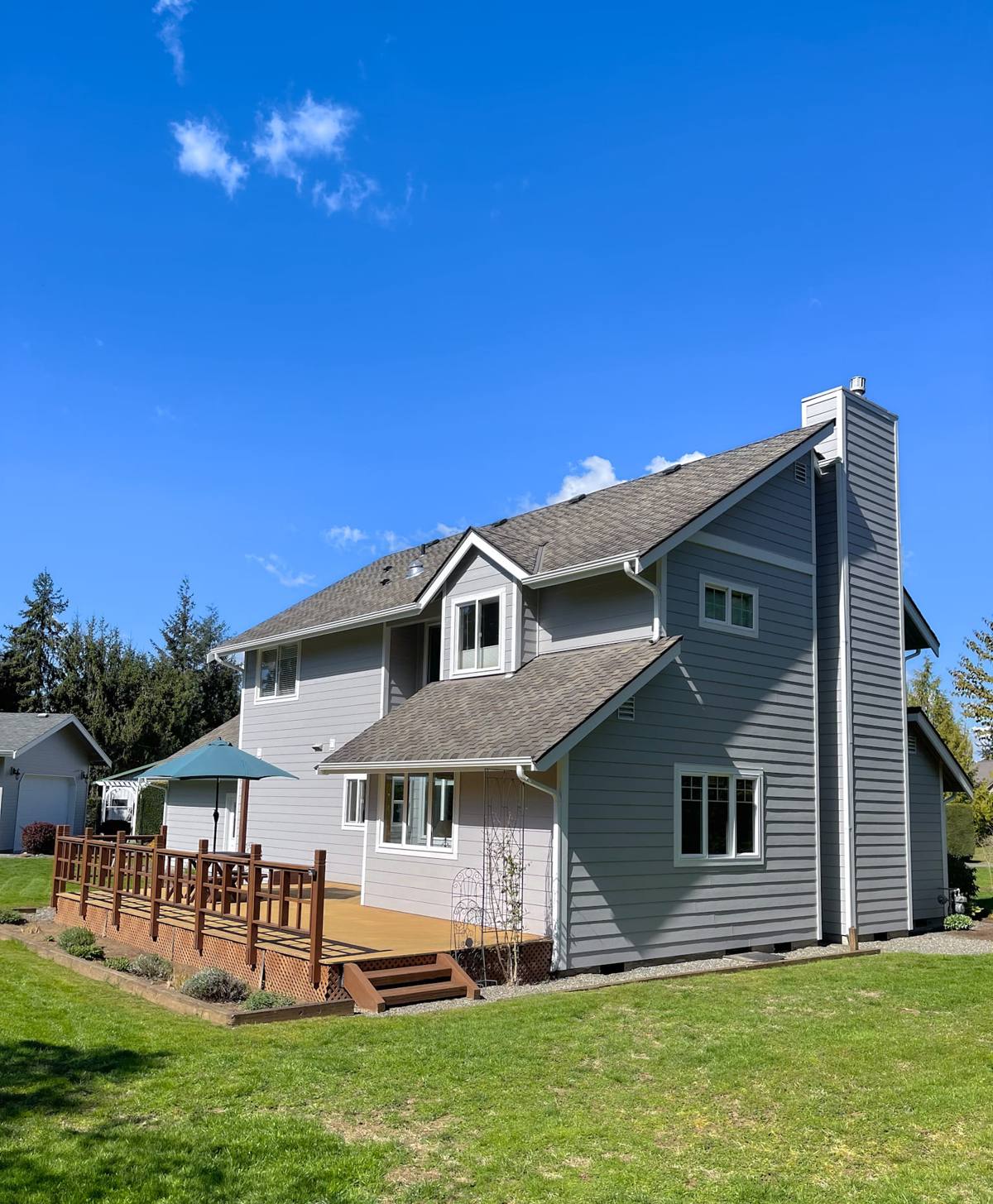
Signs Your Big Lake Home Needs Siding Replaced, Not Just Patched
Not every siding problem calls for a full replacement — but a lot of the ones we see on Big Lake properties have already gone past the point where patching makes sense. Here's what tells us a homeowner is looking at replacement rather than repair:
- Soft spots or visible give when you press on the siding, especially near the bottom courses or under windows
- Boards that are cupping, buckling, or pulling away from the wall at seams and corners
- Persistent moss or algae staining on north- or lake-facing walls that comes back quickly after cleaning
- Peeling or chalking paint that needs recoating more often than it used to
- Caulked joints and trim seams that keep opening back up every year or two despite repeated recaulking
- Visible gaps at flashing points around windows, doors, or roof-to-wall transitions
- A musty smell or rising interior humidity near exterior walls, which can point to moisture already working its way through
If more than one or two of these apply, a full replacement usually costs less over time than chasing individual repairs on siding that's already past its working life.
Why We Only Install James Hardie Fiber Cement
We install one siding product on Big Lake homes: James Hardie fiber cement. We don't offer vinyl, LP SmartSide, Cemplank, Allura, primed spruce, or cedar, and that's a deliberate standard rather than a limited catalog. Each of those products gets something right for the right buyer in the right climate — vinyl is inexpensive, engineered wood installs quickly, cedar has real natural character — but each one carries a moisture-related trade-off we're not willing to put our name behind on a lot that stays this damp this often.
Vinyl depends entirely on the weather barrier behind it staying intact and can grow brittle with age and temperature swings. Wood-based products, however well treated, still have an organic core that needs flawless field priming and sealing at every cut edge, every time, to keep sustained moisture out. Cedar is genuinely attractive but asks for an ongoing maintenance schedule that only gets heavier in a shaded, damp setting like this one. Fiber cement sidesteps that core problem because there's no organic substrate for moisture to work into, and it doesn't feed moss growth the way wood-based siding can.
HZ5 Engineered for This Climate
James Hardie builds region-specific HZ product lines rather than one generic formulation for the whole country. The HZ5 line is engineered for climates with sustained moisture and coastal exposure — exactly the profile Big Lake and the rest of Skagit County present. Specifying the right line is part of what a correct installation means here, not an upsell.
ColorPlus Factory Finish
Hardie's ColorPlus finish is baked on at the factory under controlled conditions rather than painted on site. That matters on a lot with limited dry windows for field paint to cure properly — a factory-cured finish holds color and resists cracking and chalking longer than most site-applied paint manages through repeated wet-dry cycling.
What a Correct Siding Replacement Involves
The material is only half the equation. A Hardie installation is only as good as the details underneath it, and that's especially true on a shaded, moisture-heavy lot where a shortcut has more time and more water to expose it.
Full Tear-Off and Sheathing Inspection
We remove the existing siding down to the sheathing rather than installing over it, because that's the only way to actually see what's happening behind the old cladding. On Big Lake properties in particular, tear-off is often where we find moisture damage that wasn't visible from outside — softened sheathing, rusted fasteners, or a weather barrier that's failed at a seam. That gets addressed before anything new goes up.
Flashing and Weather-Resistive Barrier Details
Every window, door, and roof-to-wall transition gets flashed and integrated with a new weather-resistive barrier before the siding goes on. This is the step that actually keeps wind-driven rain out of the wall assembly — the siding itself sheds most of the water, but the flashing behind it is what handles everything the siding doesn't catch.
Fastening, Clearance, and Joint Treatment
Fastener pattern and spacing follow Hardie's specification for the product line and local exposure, clearance from grade and any decks or patios is kept correct so the bottom edge doesn't sit near standing moisture, and joint treatment accounts for which walls actually get shade and which get sun — a shaded, lake-facing wall doesn't get treated the same as an open, south-facing one.
Our Siding Replacement Process
- On-site assessment — we walk the property, check the current siding condition, and look for signs of moisture damage before writing a scope of work
- Written proposal — a clear scope covering tear-off, sheathing repair allowances, flashing details, product line, and color, so there's no ambiguity before work starts
- Tear-off and inspection — old siding comes off, sheathing gets inspected and repaired as needed, and we flag anything that changes the original scope before proceeding
- Weather barrier and flashing installation — new barrier and flashing go in at every penetration and transition before any new siding is hung
- Hardie installation — siding goes up to manufacturer specification, with fastening, clearance, and joint treatment matched to each wall's actual exposure
- Final walkthrough — we go over the finished work with the homeowner and cover basic seasonal care specific to their property
What Separates a Correct Job From a Corner-Cut One
| Factor | Corner-Cut Approach | Correct Approach |
|---|---|---|
| Tear-off | New siding installed over old, hiding existing damage | Full tear-off to sheathing with inspection and repair |
| Product selection | One generic product regardless of climate | HZ5 line specified for sustained moisture and coastal exposure |
| Flashing | Caulk relied on to cover gaps after the fact | Flashing integrated into the weather barrier before siding goes up |
| Joint treatment | Same approach on every wall regardless of sun or shade | Treatment adjusted for shaded, lake-facing walls versus open, sunlit ones |
| Finish | Field-applied paint needing regular recoating | Factory-cured ColorPlus finish |
Cost Factors for Siding Replacement in Big Lake
We don't publish blanket pricing because the honest number depends on the house in front of us, but the factors that move cost up or down are consistent enough to lay out plainly.
| Factor | How It Affects Cost |
|---|---|
| Sheathing condition found at tear-off | Hidden moisture or rot damage on a shaded lot adds repair scope |
| Home size and wall complexity | More corners, gables, and window penetrations mean more flashing and labor time |
| Siding profile and trim package | Board-and-batten or heavier trim detail runs higher than standard lap siding |
| Site access | Tree cover, shoreline setbacks, or a tight lot near the water can affect staging and labor time |
| Scope bundling | Combining siding with related trim, flashing, or gutter work can reduce overlapping setup costs |
Why a Crew That Already Works Big Lake Matters
A contractor who works this area regularly already knows how differently a shaded, lake-facing wall ages compared to an open one two lots away, and adjusts flashing, joint treatment, and product recommendations accordingly. That judgment comes from doing the work here repeatedly, not from a general spec sheet written for the whole country. It also means someone local is reachable years down the road if a warranty question or a flashing detail needs a second look, instead of chasing down a crew that's moved on to another part of the state entirely.
If your siding is showing any of the signs above, or you just want an honest read on where it stands, we're glad to take a look. Reach out for a free, no-pressure estimate — we'll walk the property with you, tell you what we actually see, and lay out what a correct replacement would involve for your specific home.