 Skagit County
 Why Burlington's Climate Is Hard on Siding
Burlington sits in a part of Skagit County where three things work against exterior siding at the same time: salt-laden air moving in off Puget Sound and the Skagit River delta, long stretches of driving rain through fall and winter, and a moss and algae season that can run most of the year on shaded or north-facing walls. None of these are dramatic events. They're slow, constant pressure — and slow, constant pressure is exactly what wears out the wrong siding material years before it should fail.
Homes here don't need siding that looks good on a dry, sunny install day. They need siding engineered to hold its finish, its shape, and its seal through repeated wet-dry cycles, year after year, without the homeowner having to think about it.
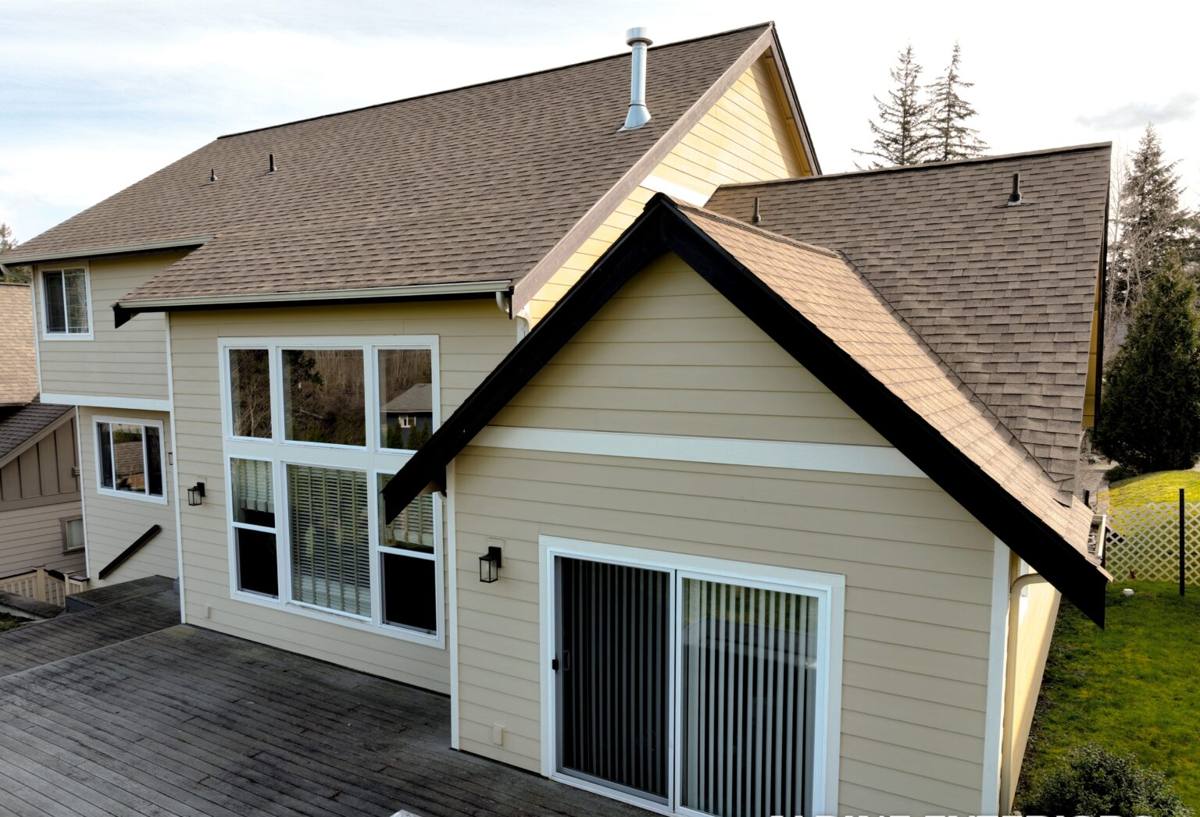
What Fiber Cement Actually Solves for Local Homes
Salt Air and Coastal Exposure
Salt air accelerates corrosion of fasteners and trim, and it degrades paint film faster than inland air does. Fiber cement's cement-and-cellulose composition doesn't corrode, and a factory-applied finish holds up to airborne salt far better than a field-applied coat of paint on wood or engineered wood.
Moss, Algae, and Prolonged Dampness
Moss and algae need moisture and a food source to establish. Untreated or under-sealed wood-based products give them both. Fiber cement is inorganic — it doesn't feed organic growth the way wood fiber can — and it doesn't swell, cup, or delaminate the way products with a wood or wood-fiber core can when they stay damp for extended periods, which is common under the Skagit Valley's persistent cloud cover and driving winter rain.
Why We Install Only James Hardie Fiber Cement
We standardized on James Hardie products exclusively. We don't install LP SmartSide, vinyl, Cemplank, Allura, primed spruce, or cedar, and we're upfront with homeowners about why. It comes down to four things that matter specifically in a Pacific Northwest coastal climate:
- Non-combustible material — fiber cement doesn't contribute fuel to a fire the way wood-based sidings can.
- ColorPlus factory-applied finish — a baked-on finish system designed to resist fading and hold adhesion far longer than field-applied paint, which matters when a house faces constant damp weather.
- Climate-engineered HZ5 formulation — Hardie's zone-specific product line for regions like ours that see repeated freeze-thaw and prolonged moisture exposure, rather than a one-size-fits-all product.
- A strong, transferable warranty — backed by decades of Hardie's own installation and manufacturing track record, which gives homeowners real recourse if something goes wrong with the product itself.
Other products on the market aren't necessarily bad products in isolation. But every alternative we don't install has a real trade-off — higher maintenance burden, more sensitivity to moisture, more dependence on perfect field application, or a thinner warranty — and we'd rather tell you that honestly than sell you something we don't believe will perform here long-term.
What a Correct Fiber Cement Installation Involves
Fiber cement is only as good as the installation behind it. The material resists moisture, but a house doesn't stay dry because of the siding panel alone — it stays dry because of the flashing, gaps, and fastening details underneath it.
The Details That Actually Keep Water Out
- Proper weather-resistive barrier installed and lapped correctly before any siding goes up
- Flashing at every window, door, and roof-to-wall intersection, installed so water sheds outward, not behind the siding
- Correct clearance between the bottom edge of siding and the ground, roofline, or deck surface — a common corner that gets cut
- Fasteners driven to manufacturer spec, not overdriven or underdriven, in the correct pattern
- Joints and butt seams sealed or flashed per the manufacturer's installation instructions, not just caulked over
- Proper gapping at trim and penetrations to allow for expansion without trapping moisture
Common Installation Mistakes That Cause Early Failures
Most fiber cement problems we're called out to inspect trace back to installation shortcuts, not the product. Siding installed tight to grade with no clearance wicks moisture up from the ground. Missing or reversed flashing at a window head lets water track behind the panel instead of over it. Overdriven fasteners crack the board's fastening zone and create a path for water intrusion. These aren't cosmetic issues — they're the reason a 30-to-50-year product sometimes fails in year eight, and they're entirely avoidable with a crew that knows the manufacturer's spec and follows it every time, not just when it's convenient.
Our Process for Burlington Fiber Cement Projects
We start with a walk-around inspection of the existing wall assembly — what's on the house now, where water has clearly been getting in, and whether there's any hidden rot in the sheathing that needs to be addressed before new siding goes on. Covering up a wet wall with new siding just hides the problem; we won't do that.
From there, the sequence is straightforward: remove existing siding and inspect/repair sheathing as needed, install or correct the weather barrier, install flashing at all penetrations, hang and fasten the Hardie panels or planks to spec, seal and finish trim details, and do a final walk-through with the homeowner before cleanup. On a typical single-family home in the Burlington area, a full siding replacement runs from a few days to a couple of weeks depending on size, existing wall condition, and weather windows — and in this part of Skagit County, we plan around rain rather than pretend it won't happen.
Comparing Siding Options for This Climate
Homeowners researching siding options for the Skagit Valley often compare fiber cement against vinyl, wood, and engineered wood products like LP SmartSide. Here's an honest look at how they stack up on the factors that matter most in a wet, coastal climate:
| Material | Moisture/Rot Resistance | Maintenance Needed | Fire Resistance | Typical Lifespan (correct install) |
|---|---|---|---|---|
| Vinyl | Doesn't rot, but can warp or crack in temperature swings and doesn't stop moisture behind it | Low, but limited repair options if damaged | Low — can melt or deform under heat | 20-30 years |
| Cedar / primed wood | Vulnerable to rot, especially in prolonged damp conditions | High — regular refinishing and sealing required | Low — combustible | 15-25 years with diligent upkeep |
| LP SmartSide (engineered wood) | Treated for moisture resistance but still wood-fiber based; sensitive to unsealed cut edges and prolonged wetting | Moderate — edge sealing and touch-up over time | Low-moderate — still wood-based | 20-30 years with proper maintenance |
| James Hardie fiber cement | High — inorganic, doesn't swell or rot | Low — factory finish holds up without repainting on a regular cycle | Non-combustible | 30-50+ years with correct installation |
What to Ask Before Hiring a Siding Contractor
Fiber cement is unforgiving of a rushed or unfamiliar installer — the material itself won't fail, but a poorly executed install will. Before you hire anyone for a fiber cement project in Burlington or elsewhere in Skagit County, ask:
- Are you a certified or factory-trained installer for the specific Hardie product line you're proposing?
- Will you inspect and repair the existing wall sheathing before installing new siding, not just install over it?
- What's your flashing detail at windows, doors, and roof lines — can you walk me through it?
- Do you follow the manufacturer's fastener spacing and clearance requirements, and will that be in writing?
- What warranty covers the material, and what warranty covers your labor separately?
- Can I see recent work you've done in this area, on homes facing similar weather exposure?
A contractor who can answer these clearly and without hesitation is a good sign. Vague answers on flashing and clearance details are the biggest red flag we see.
Why Local Experience in Skagit County Matters
A crew that already works in Burlington and the surrounding Skagit County area knows how this specific climate behaves — which walls take the worst of the driving rain, where moss establishes fastest, and how salt air exposure differs even a few miles inland versus closer to the water. That local knowledge shapes real decisions on a job: where to be extra careful with flashing, which sides of the house need the most attention to ventilation and clearance, and what to expect from the material over the decades it's meant to last. It's the difference between a generic install and one actually built for the place it's going on.
If you're weighing siding options for a home in Burlington or elsewhere in Skagit County, we're happy to take a look and talk through what your house actually needs. Fill out the form below for a free, no-pressure estimate.