 Skagit County
 Composite Decking Built for Cedardale's Climate
Cedardale sits close enough to the water and the marine air patterns that move through Skagit County that decking here takes a different kind of beating than decking further inland. Salt-laden air corrodes fasteners and hardware faster than people expect. Driving rain off Puget Sound and the Salish Sea gets pushed sideways under railings and against ledger boards. And the long stretch of gray, wet months every year gives moss and algae months to set up shop on any surface that holds moisture. A deck that isn't built with those three things in mind will show it within a few seasons — soft spots, green film, rust streaks at the fastener heads, and boards that cup or move.
Composite decking, installed correctly, holds up well against all three of these pressures. But "installed correctly" is doing a lot of work in that sentence. Composite is more forgiving than wood in some ways and less forgiving in others, and a lot of the decks we get called to repair or replace in this area were installed by crews using techniques that work fine in drier climates but fail here.
What Cedardale Homes Actually Need From a Deck
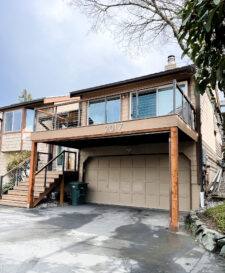
Most of the homes we work on in and around Cedardale fall into a few categories: houses on sloped lots with a walkout deck facing the water or a view corridor, single-level homes with a rear deck off the kitchen or living room, and older homes replacing a original wood deck that's finally given out after 20-plus years of Skagit County weather. Across all of them, the same handful of needs come up:
- Drainage that actually moves water off the deck surface and away from the house, not just downward through the gaps between boards
- Fasteners and framing hardware rated for coastal/marine exposure, not standard interior-grade hardware
- A substructure that's been treated or protected against the moisture that collects underneath a deck built close to grade
- Surface material and color choices that don't turn into a moss magnet in shaded, damp corners of the yard
- Railing and post connections that won't loosen or corrode from years of salt air cycling through wet and dry
None of this is exotic. It's standard good practice — but it only shows up when the crew building the deck has actually worked in this climate long enough to know where the shortcuts fail.
Why Composite Over Wood for This Location
We install wood decking too, and it has its place. But for Cedardale specifically, composite has a real advantage: it doesn't absorb water the way wood does, so it doesn't swell, cup, or rot the way a pressure-treated or cedar board will after years of driving rain and standing moisture. It also doesn't need refinishing every couple of years, which matters a lot when the weather window for outdoor maintenance work in Skagit County is short.
That said, composite isn't maintenance-free, and we don't tell customers it is. Moss and algae will still grow on any decking surface that stays damp and shaded — composite included. The difference is that composite doesn't rot or splinter while that's happening, and a periodic wash keeps it looking right. We're upfront about that trade-off rather than overselling the product.
Where Composite Struggles If Installed Wrong
The failure points we see on composite decks in this area almost always trace back to installation, not the material itself:
- Boards installed too tight, with no room for thermal movement, leading to buckling
- Poor ventilation underneath the deck, trapping moisture against the framing
- Standard steel screws or clips used instead of coated or stainless hardware, leading to rust streaks and weakened connections
- Picture-frame or border boards installed without proper end-grain protection, which is where composite is most vulnerable to moisture intrusion over time
What a Correct Composite Deck Build Involves
A properly built composite deck in Cedardale starts below the surface, not at the decking itself.
Framing and Substructure
We build to current code span tables for the specific composite product, not generic lumber spacing, since composite boards behave differently than wood under load and over time. Ledger attachment to the house gets proper flashing and moisture barriers — this is one of the most common failure points on older decks in wet climates, where a poorly flashed ledger lets water track behind siding and rot out framing that's invisible until it's already a bigger repair.
Fasteners and Hardware
Given the salt air exposure in this part of Skagit County, we use coated or stainless-rated fasteners and structural hardware throughout, not just at the visible surface. The hardware you can't see is where corrosion does its damage first.
Drainage and Airflow
We grade and detail the substructure so water sheds away from the house rather than pooling under the deck, and we leave enough airflow underneath that the framing has a chance to dry out between rain events instead of staying damp for weeks at a time during the wet season.
Surface Installation
Composite boards get installed with the manufacturer-specified gapping for expansion and contraction, hidden fastener systems where the product supports it, and proper end-cap treatment on any cut ends exposed to weather.
Comparing Decking Options for This Area
| Factor | Composite | Pressure-Treated Wood | Cedar |
|---|---|---|---|
| Moisture resistance | High — doesn't absorb water | Moderate — treated but still absorbs | Low-moderate — natural rot resistance fades |
| Maintenance | Periodic cleaning, no refinishing | Regular sealing/staining needed | Regular sealing/staining needed |
| Moss/algae resistance | Resists growth on surface, still needs cleaning in shaded spots | Prone to moss in damp shaded areas | Prone to moss in damp shaded areas |
| Upfront cost | Higher | Lower | Moderate-higher |
| Long-term cost | Lower over 15-20 years | Higher due to recurring maintenance and replacement | Higher due to recurring maintenance |
| Typical lifespan (this climate) | 25-30+ years with correct install | 10-15 years before major repair/replacement | 15-20 years with diligent upkeep |
Cost Factors for a Cedardale Composite Deck
Every deck is priced based on its own footprint, framing needs, and site conditions, so we won't quote a number here that doesn't mean anything without seeing the property. What actually moves the price:
- Deck size and shape — multiple levels, angles, or picture-framed borders add labor and material
- Substructure condition — whether existing framing can be reused or needs to be replaced
- Height off grade — elevated decks need more substantial railing and structural work
- Composite product tier — boards vary significantly in price, warranty length, and fade/stain resistance
- Railing system — composite, aluminum, or cable railing all price differently
- Site access — sloped lots and limited equipment access add time
Our Process
- On-site assessment of the existing deck or build area, including framing and drainage conditions
- Written scope covering framing work, hardware specification, composite product selection, and railing
- Permitting where required by the local jurisdiction
- Demo of existing structure (if a replacement) with attention to what's found once old decking comes up
- Framing, flashing, and hardware installation to marine-exposure standards
- Composite surface and railing installation
- Final walkthrough covering care and cleaning expectations for this climate
Why Hire a Crew That Already Works in Cedardale
A deck built by a crew that mostly works drier, inland projects will often look fine the day it's finished and start showing problems two or three winters in — because the details that matter here (ledger flashing, fastener grade, underside ventilation) aren't things you can see on a walkthrough. We work throughout Skagit County, and the moisture and salt air conditions in this area shape every decision we make on a decking project, from the hardware we stock to how we detail drainage. That's not a marketing line — it's the difference between a deck that needs attention again in five years and one that doesn't.
Maintaining Your Deck Once It's Built
Composite decking in Cedardale still needs some seasonal attention, especially given the moss season this region sees every year:
- Sweep debris off the surface regularly, especially in fall when leaves and needles accumulate and trap moisture
- Wash the deck surface at least once or twice a year with a composite-safe cleaner to keep moss and algae from establishing, particularly in shaded corners
- Check railing connections annually for any looseness from thermal or moisture cycling
- Keep gutters and downspouts near the deck clear so runoff isn't dumping extra water onto the surface or substructure
- Avoid pressure-washing at close range or high PSI, which can damage the surface texture of some composite products
If you're weighing a new composite deck or need an honest look at whether your current deck's problems are fixable, we're happy to come take a look. The estimate is free, there's no pressure, and you'll get a straight answer about what your deck actually needs — just fill out the form below.