 Skagit County
 Big Lake sits in a pocket of Skagit County where tree cover, lake humidity, and a long wet season combine to punish outdoor structures faster than in drier parts of the state. A deck built here does more work than a deck built on an open, sunny lot — it has to shed water fast, resist moss and mildew, and hold up to freeze-thaw swings every winter. Composite decking, installed correctly, handles all of that better than most alternatives. Installed poorly, it fails in the same ways wood does, just more slowly and more expensively to fix.
Why Big Lake's Climate Is Hard on the Wrong Decking Choice
Homes around Big Lake typically sit under a mix of conifer canopy and lake-adjacent humidity, which means decks get less direct sun and more standing moisture than decks even a few miles away in more open parts of Skagit County. That combination is exactly what moss, algae, and mildew need to take hold. Add driving rain off the water and a genuinely long wet season — often eight or nine months of the year with meaningful moisture — and you get a surface that rarely gets a full chance to dry out between rain events.
Untreated or poorly sealed wood decking absorbs that moisture, swells, and starts to check and splinter within a few seasons. Even sealed wood needs re-staining on a schedule most homeowners don't keep up with. Composite decking doesn't absorb water the way wood does, which is the main reason it's become the default recommendation for lake-adjacent and shaded properties in this area — but only when the substructure underneath it is built to move water away just as well as the boards themselves.
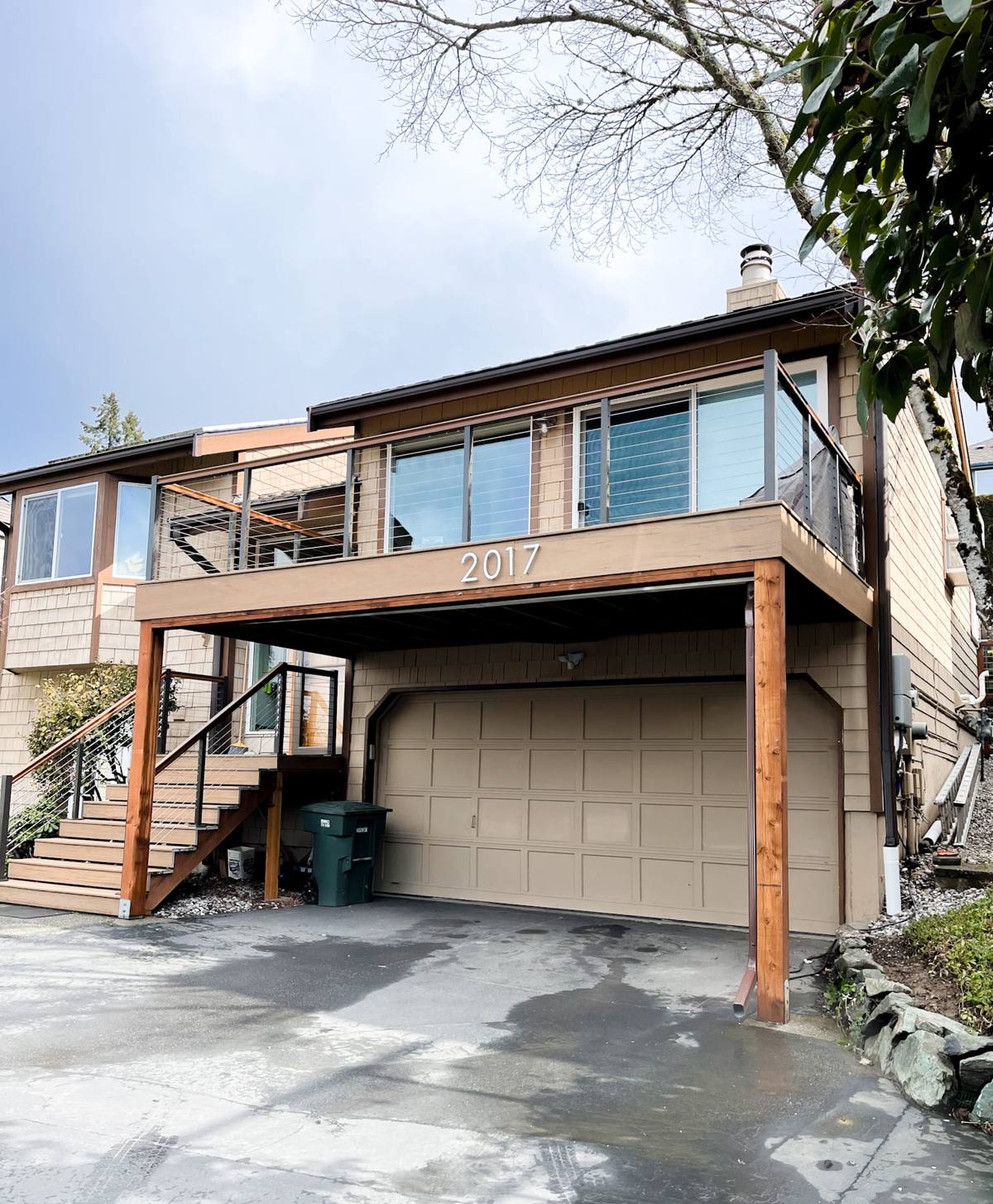
What a Correct Composite Deck Needs Underneath the Boards
Drainage and Airflow Below the Deck
Composite boards resist rot, but the framing underneath them is almost always still wood or a wood-composite blend, and that framing needs to breathe. On a shaded, lake-humid lot, a deck built tight to the ground or against the house with no airflow traps moisture underneath regardless of what the top surface is made of. We grade and gap the substructure so water has somewhere to go and air has a path to move through, rather than pooling under the boards where nobody sees it until there's a problem.
Flashing at the House Connection
Most of the deck failures we get called out to inspect in this area start at the ledger board — the point where the deck attaches to the house. If that connection isn't flashed correctly, water works its way behind the siding and into the rim joist, and by the time it's visible, the damage is already inside the wall. This is the single detail we're most careful about on every job, composite or not.
Fasteners and Hardware
Damp, shaded conditions accelerate corrosion on cheap or mismatched hardware. We use fasteners and structural connectors rated for the moisture exposure a Big Lake property actually sees, not the minimum a code inspector would pass on a drier lot. Hidden fastener systems, when used with the right composite board, also close off small gaps where debris and moisture would otherwise collect between boards.
Composite, Wood, and PVC: How They Actually Compare Here
| Material | Moisture Behavior | Moss/Algae Resistance | Maintenance | Typical Lifespan Locally |
|---|---|---|---|---|
| Pressure-treated wood | Absorbs water, swells and shrinks seasonally | Needs regular cleaning and re-staining to resist growth | Annual sealing/staining recommended | 10-15 years with upkeep |
| Uncapped composite | Low absorption, but surface can hold surface moisture | Better than wood, still needs periodic cleaning | Occasional washing, no staining | 15-20 years |
| Capped composite | Very low absorption, sealed outer shell | Best resistance of the composite options | Rinse or wash a few times a year | 20-25+ years, backed by manufacturer warranty |
| PVC decking | Essentially water-resistant | Good resistance, smoother surface sheds debris well | Low, similar to capped composite | 20-25+ years |
For most Big Lake homes under partial shade, we steer clients toward capped composite as the practical middle ground — the moisture and moss resistance of PVC at a lower cost, with a wood-grain look that fits the neighborhood better than an all-plastic surface.
Choosing the Right Board for a Shaded, Lake-Adjacent Lot
Not every composite board is a good fit for every yard, and this is where local experience matters more than a catalog color chart. A few things we weigh on Big Lake properties specifically:
- Color: darker boards hide pollen, cottonwood debris, and early algae staining better, but they also run hotter in direct summer sun — worth discussing if part of your deck gets afternoon exposure.
- Capped vs. uncapped: a fully capped board is worth the added cost on lots with heavy tree cover, since the cap is what keeps moisture and organic debris from working into the board's surface over time.
- Grain and texture: a slightly textured surface sheds standing water faster than a smooth, glossy finish, which matters more here than on a drier lot.
- Board spacing: correct gapping between boards lets water drain through instead of sitting on the surface, which is one of the most common things we correct on decks originally installed too tight.
Our Installation Process for Big Lake Projects
- Site assessment: we walk the property, check sun and shade exposure, drainage patterns, and the condition of any existing structure being replaced.
- Substructure evaluation or build: framing is graded for drainage, ledger connections are planned or inspected, and any existing rot is identified before a single composite board goes down.
- Flashing and waterproofing: the ledger board and any house connections are flashed to keep water out of the wall assembly, not just off the deck surface.
- Framing and fastening: substructure is built or reinforced with moisture-appropriate hardware suited to Skagit County's exposure.
- Board installation: composite decking is laid with correct spacing and, where applicable, a hidden fastener system for a clean surface with fewer moisture traps.
- Railing and finish work: railings, stairs, and edge trim are installed to match the board system and manufacturer specifications, which matters for keeping any product warranty intact.
- Final walkthrough: we inspect the finished deck with you and go over basic care before we consider the job done.
Cost Factors for a Composite Deck at Big Lake
Every deck is priced on its own specifics, but the variables that move the number most often on lake-area properties are consistent enough to lay out honestly:
| Factor | Why It Affects Cost |
|---|---|
| Existing substructure condition | Rotted or undersized framing has to be rebuilt before new decking goes on, not patched around |
| Deck size and shape | More linear footage of board edges and cuts adds labor beyond simple square footage |
| Board tier (uncapped, capped, premium) | Material cost and warranty length scale with the level of cap and manufacturer |
| Railing type | Composite or metal railing systems cost more than basic wood but hold up better in this climate |
| Site access | Sloped or tree-obstructed lots common around the lake can add setup and material handling time |
| Permitting and inspection | Skagit County permit requirements and inspection scheduling factor into project timeline and cost |
Living With Composite Decking Through Moss Season
Composite decking cuts maintenance significantly compared to wood, but "low-maintenance" doesn't mean "no-maintenance," especially with the amount of shade and moisture this area gets for much of the year. A simple seasonal routine keeps a composite deck looking and performing the way it should:
- Sweep leaves, needles, and pollen off regularly — trapped organic debris is what feeds moss and algae growth, not the board material itself.
- Rinse or wash the deck a few times a year with a soft brush and mild soap; avoid high-pressure washing directly on the board surface, which can damage the cap layer on some products.
- Keep gutters and downspouts near the deck clear so runoff isn't dumping directly onto or under the decking.
- Check railing posts and stair connections once a year for any movement, especially after a hard freeze.
- Trim back overhanging branches where practical to give the deck more light and airflow, which slows moss growth more than any cleaning product will.
Why Hiring a Crew That Already Works Big Lake Matters
A deck built to a generic spec sheet can still fail on a shaded, lake-adjacent lot if it isn't built for the conditions actually present on that property. We work Skagit County regularly, which means we already know how properties around Big Lake tend to drain, how much shade a typical lot gets through the season, and what Skagit County permitting and inspection expects for deck framing and railing height. That local familiarity shows up in decisions a drive-by crew from outside the area is more likely to miss — grading a substructure for the moisture this specific area sees, or flagging a ledger connection that needs extra attention because of how the house sits relative to the lake.
It also matters after the installation is finished. A local crew is the one you can actually call if a warranty question comes up or a board needs attention down the road, not a company that finished the job and moved on to the next county.
Signs an Existing Deck Is Ready for Composite Replacement
If you're deciding whether to repair or replace, a few signs point toward replacement rather than another round of patching:
- Soft, spongy spots in wood decking, which usually indicate rot has already reached the framing below.
- Persistent moss or algae that returns within weeks of cleaning, suggesting the deck isn't drying out between rain events.
- Visible gaps or movement at the ledger board connection to the house.
- Boards that have cupped, splintered, or separated from fasteners despite regular sealing.
If your deck is showing one or more of these, it's worth an honest assessment before another wet season adds to the damage.
If you're weighing a new composite deck or replacing one that hasn't held up to Big Lake's climate, we're glad to take a look and give you a straightforward, no-pressure estimate — just fill out the form below.