 Skagit County
 Why Siding Installation in Cedardale Is Different
Cedardale sits in that part of Skagit County where the weather doesn't pick a lane. Homes here get wind-driven rain off the water, long stretches of shade and dampness under fir and cedar cover, and enough salt-laden air moving in off the nearby saltwater to matter for anything metal or painted on the exterior of a house. None of that is exotic — it's just Pacific Northwest coastal weather — but it adds up differently than it does for a house twenty miles inland in a drier pocket of the county. Siding that would hold up fine in Sedro-Woolley or Mount Vernon's drier stretches can fail faster here simply because it's wet more often, dries slower under tree canopy, and takes more airborne salt on its face.
That's the starting point for every siding installation we do in Cedardale: assume the wall will be wet more than it's dry for a good chunk of the year, assume moss and mildew pressure is real, and build the assembly so water has nowhere to sit and nothing to feed on.
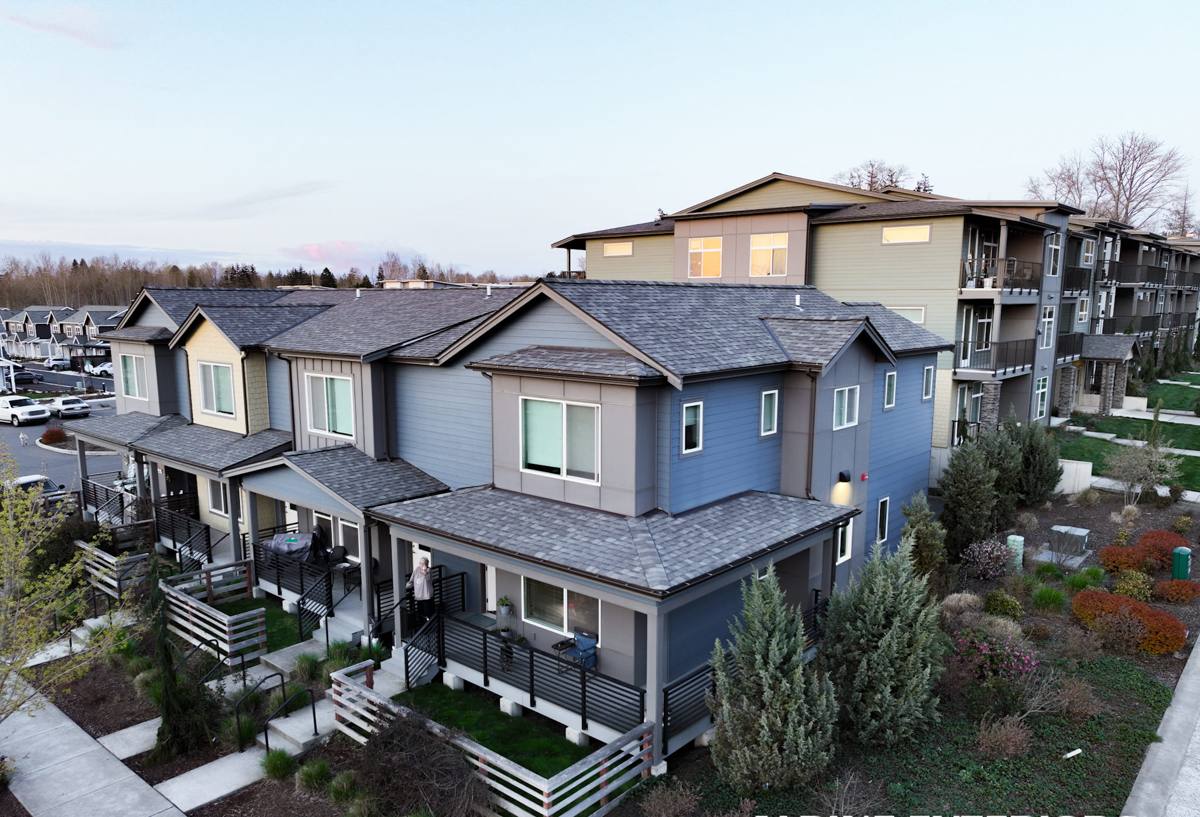
What Cedardale's Climate Actually Does to Siding
Salt Air and Corrosion
Salt air doesn't just affect houses right on the water. Airborne salt travels inland on wind and settles on any exposed surface, and over years it accelerates corrosion on exposed fasteners, uncoated trim, and any siding product with a paint film that isn't built to shed it. Fastener corrosion is one of the most common hidden failure points we find when we tear off old siding — nail heads rusting under the surface long before the siding itself looks bad from the ground.
Driving Rain
Storms coming off the water don't fall straight down — they come in sideways, which pushes water into laps, seams, and butt joints that a calm-weather installation might get away with. A siding job that isn't detailed for wind-driven rain will eventually leak at exactly those spots, usually years after the crew that installed it is gone.
Moss and Sustained Moisture
Skagit County's moss season runs long, and wooded lots like a lot of what you find around Cedardale keep siding shaded and damp well after a storm has passed elsewhere. Moss and algae aren't just cosmetic — sustained organic growth holds moisture against the wall surface, which is exactly the condition that breaks down moisture-sensitive siding materials over time.
What a Correct Installation Involves
Good siding installation is mostly invisible once the job is done — it's in the layers you don't see. For a Cedardale home, that means:
- A continuous water-resistive barrier installed shingle-style so every layer sheds water to the layer below it, not into the wall
- Properly flashed windows, doors, and any wall penetrations, with head flashing that actually directs water back out over the siding below
- Correct fastener placement and type — over-driven or under-driven nails are one of the most common causes of early siding failure, and in a salt-air environment, fastener material matters even more
- Rainscreen or drainage gap detailing where the wall assembly calls for it, so any water that does get behind the siding has somewhere to drain and dry
- Proper clearance at the base of the wall — siding held up off grade, decks, and roof lines so it isn't sitting in standing moisture
- Caulking and sealing only where the manufacturer's install spec actually calls for it — over-caulking traps moisture just as badly as under-caulking lets it in
None of this is unusual or specialized — it's just the difference between an installation done to spec and one that was rushed. In a climate like Cedardale's, corners cut here show up as problems in years, not decades.
Why We Install Only James Hardie Fiber Cement
We standardized on James Hardie fiber cement siding for every job we do, including here in Cedardale, and we don't install vinyl, LP SmartSide, or other fiber cement brands. That's not a marketing position — it's a decision based on what actually holds up in this climate over the long haul.
Fiber cement is non-combustible, which matters increasingly across Washington as wildfire risk gets factored into insurance and building decisions. It doesn't rely on a plastic surface that can warp, fade, or crack in temperature swings the way vinyl can, and it doesn't have an engineered-wood core that's vulnerable if moisture gets past the paint film the way LP SmartSide's OSB-based substrate is. James Hardie's ColorPlus factory finish is baked on under controlled conditions rather than field-painted, which gives it better, more even adhesion and color retention than most site-applied paint jobs — a real advantage in a place that sees this much rain and this much shaded, damp exposure.
HZ5 Engineering for the Pacific Northwest
James Hardie makes climate-specific product formulations, and the HZ5 line is engineered for regions with the kind of moisture exposure Western Washington gets — including freeze-thaw cycling and sustained wet weather. That's the formulation we install throughout Skagit County. It's a meaningful detail: not all fiber cement is engineered the same way for every climate, and installing the wrong regional formulation is its own kind of corner-cutting.
We're upfront that James Hardie costs more up front than vinyl and generally costs more than LP SmartSide. We think the trade-off is worth it for a Cedardale home specifically because of what this climate does to lower-tier materials over time — but it's a decision every homeowner should make with the real numbers in front of them, not a sales pitch.
Comparing Siding Materials for a Cedardale Home
| Factor | Vinyl | LP SmartSide | James Hardie Fiber Cement |
|---|---|---|---|
| Moisture behavior | Won't rot but can trap moisture behind it; warps in heat | Engineered wood core; vulnerable if moisture penetrates cut edges or seams | Cement-based; doesn't swell, rot, or feed fungal growth |
| Salt air exposure | Can chalk and become brittle over years | Coating can wear at exposed edges over time | Factory ColorPlus finish holds up well to airborne salt |
| Fire performance | Combustible | Combustible (wood-based) | Non-combustible |
| Typical lifespan (properly installed) | 20–30 years | 25–30 years | 30–50+ years |
| Upfront cost | Lowest | Mid-range | Highest |
These are general industry ranges, not guarantees — actual performance always comes down to installation quality as much as the material itself. But the pattern holds across the industry: fiber cement's cost premium buys durability that shows up most clearly in exactly the conditions Cedardale gets a lot of.
Our Installation Process
Every job starts with a walk of the existing exterior, not just a measurement. We're looking at what's happening behind the current siding — signs of moisture intrusion, rot at trim and window returns, ventilation issues — because those are the problems a new siding job needs to actually solve, not just cover up. From there:
- On-site assessment and honest scope — what needs repair before new siding goes on, and what doesn't
- Detailed proposal with the specific James Hardie products, colors, and trim specified
- Tear-off and inspection of sheathing and framing once the old siding is off, with any rot or damage addressed before anything new goes up
- Weather-resistive barrier and flashing installed to spec, with particular attention to window and door details
- James Hardie panel or lap installation to manufacturer fastening and clearance specs
- Final walkthrough so you understand exactly what was done and why
What to Ask Before You Hire
A siding job is only as good as the crew installing it — the material choice is half the equation. Before hiring anyone for a siding project in Cedardale or elsewhere in Skagit County, it's worth asking:
- Are you James Hardie certified or factory-trained, and can you explain why that matters for fastening and clearances?
- What's your plan for flashing around windows, doors, and any roof-to-wall transitions?
- Do you carry current liability insurance and workers' comp, and can you show proof?
- What warranty applies to labor, separate from the manufacturer's material warranty?
- Have you worked in this part of Skagit County before, and do you understand the moisture and moss conditions specific to it?
Any legitimate contractor should answer these without hesitation. Vague answers, especially around flashing details and warranty terms, are a red flag regardless of price.
What Drives Cost on a Cedardale Siding Project
| Cost Factor | Why It Matters Here |
|---|---|
| Home size and wall complexity | More corners, gables, and trim details mean more labor and material |
| Condition of existing sheathing | Rot or moisture damage found at tear-off adds repair scope |
| Siding profile chosen | Lap, panel, and shingle-style James Hardie products differ in material and labor cost |
| Trim and accessory work | Corner boards, fascia, and soffit work often get bundled with a siding job |
| Access and site conditions | Wooded or sloped lots common in the area can affect staging and scaffolding needs |
Why Local Experience in Skagit County Matters
A crew that already works Cedardale and the surrounding Skagit County area isn't guessing about how this climate treats a house — they've seen which details hold up and which ones fail early, on homes with the same salt air, the same driving rain, and the same long moss season. That experience shows up in small decisions during the job: where to add extra flashing attention, which trim details need more clearance, how to sequence work around a wet forecast. It's the difference between a siding job that looks right on installation day and one that's still performing correctly ten and twenty years later.
If you're thinking about new siding for a Cedardale home, we're glad to come take a look and give you a straight, no-pressure assessment of what your house needs. There's a form below — reach out and we'll set up a free estimate.