 Skagit County
 Decking in Concrete, WA: A Climate That Doesn't Forgive Shortcuts
Concrete sits up in the Skagit River valley, tucked against forested hillsides that keep a lot of the property shaded for a good part of the day. That shade is part of what makes the area beautiful, and it's also exactly why decks here take more abuse than decks out in an open, sunny yard. Wet wood surfaces that don't get direct sun or wind don't dry out — they just sit damp, and moss, algae, and mildew move in. Add in the driving rain that comes through the valley during the fall and winter storm season, and you've got a deck surface that can stay wet for days at a stretch.
None of that is unique to Concrete — it's a pattern we see across Skagit County wherever a deck faces north, sits under mature trees, or doesn't get much airflow underneath. But Concrete's mix of river-valley humidity and heavy tree cover puts a deck through it more consistently than most. A deck built or maintained the way it might be in a drier part of the state simply won't hold up the same way here.
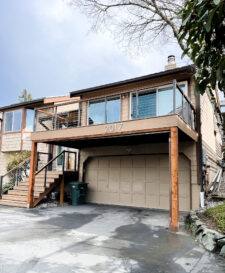
Why Composite Decking Makes Sense in This Environment
What "Composite" Actually Means
Composite decking boards are made from a blend of wood fiber and plastic (usually polyethylene or polypropylene), and on most modern boards, that core is wrapped in a plastic cap — a "capstock" — that seals the surface. That cap is the important part. It's what keeps water, mold spores, and dirt from getting into the board itself the way they can with raw wood or with older uncapped composite products.
How Composite Handles What Wood Can't
Real wood decking swells and shrinks as it takes on and releases moisture, which is what eventually leads to cupping, splitting, and popped nails. In a shaded, damp spot, wood also stays wet longer between rain events, which is exactly the condition mold and moss need to take hold. A quality capped composite board doesn't absorb water the same way, so it isn't feeding that cycle. It still gets dirty and it still needs occasional cleaning — no exterior surface in this climate is maintenance-free — but it isn't fighting moisture from the inside out the way wood is.
We're not against wood decking as a category, and we'll say so plainly to a homeowner who wants that look and is willing to keep up with the sanding, sealing, and re-staining it takes. But for a shaded, damp lot in this part of Skagit County, composite is the lower-maintenance, longer-term answer for most people, and it's what we recommend first.
What a Correct Composite Deck Installation Actually Involves
Composite boards are more forgiving than wood in some ways and less forgiving in others. The board itself resists moisture, but a composite deck built on a poorly ventilated, poorly flashed substructure will still trap water underneath — and that's where a lot of the real damage on older decks actually happens, hidden from view.
The Substructure Comes First
The framing underneath a composite deck matters just as much as the boards on top, arguably more. Ledger boards need proper flashing where they meet the house so water can't work its way behind the siding. Joists that will sit under composite decking should be protected — joist tape or an equivalent moisture barrier over the top edge — because composite boards can hold moisture against the wood joist longer than an open wood deck surface would, which can accelerate rot in the framing if that step gets skipped.
Spacing, Airflow, and Drainage
Board spacing has to account for composite's expansion and contraction with temperature, which behaves differently than wood. Gaps that are too tight can cause buckling; gaps that are too wide look sloppy and catch debris. Underneath, the deck needs enough clearance and airflow to actually dry out between storms — a low, boxed-in deck with no ventilation is one of the most common reasons we find soft framing or standing moss growth on the underside of a deck that looked fine from the top.
Fasteners and Board Movement
Composite boards should be installed with fastener systems designed for composite — hidden clip systems or composite-rated screws — not whatever was left over from a wood job. The wrong fastener can strip out, cause squeaking, or restrict the board's natural movement, which shows up later as buckling or gapping.
Choosing the Right Composite Board for a Concrete Property
Not all composite decking is built the same way, and the differences matter more in a wet, shaded climate than they would somewhere dry. Here's how the main categories generally compare:
| Board Type | Moisture Resistance | Moss/Mold Resistance | Typical Maintenance |
|---|---|---|---|
| Uncapped composite | Lower — core can absorb moisture over time | Weaker — porous surface holds organic growth | Periodic cleaning, more prone to staining |
| Capped composite | Good — sealed surface resists absorption | Good — smoother surface sheds spores more easily | Occasional wash-down |
| Capped composite/PVC hybrid | Very good to excellent | Very good | Occasional wash-down, often lightest upkeep |
For a lot on a shaded slope near Concrete with heavy tree cover, we generally steer homeowners toward a fully capped board at minimum, especially on any run of decking that doesn't get direct afternoon sun. It costs more up front than an uncapped product, but it holds up dramatically better against the moss and mildew cycle this area produces, and that difference shows up within the first couple of wet seasons, not years down the road.
Our Process, From Estimate to Finished Deck
- On-site walkthrough — we look at the existing structure (if there is one), grade, drainage, sun exposure, and how the deck ties into the house.
- Honest assessment of what can be reused versus what needs to be rebuilt — we don't put new decking over framing we wouldn't trust ourselves.
- Board and layout recommendation based on how the space actually gets used and how much shade and moisture it sees.
- Substructure work — framing, ledger flashing, joist protection, and drainage planning, done before a single composite board goes down.
- Installation of decking, fascia, and railing per manufacturer spacing and fastening specs.
- Final walkthrough with the homeowner so you know what the deck needs going forward and what's covered under warranty.
Living With a Composite Deck Through Moss Season
Composite decking is low-maintenance, not no-maintenance, especially somewhere as shaded and wet as Concrete gets through the fall and winter. A little seasonal attention keeps a good deck looking good for its full service life instead of slowly losing the battle to moss.
- Sweep leaves and debris off regularly — wet leaves left sitting are one of the fastest ways to stain a composite surface and feed moss growth.
- Rinse the deck a few times a year with plain water and a soft brush; a pressure washer on the wrong setting can damage the cap on some boards, so keep it on a low, wide setting if you use one.
- Keep gutters and downspouts clear so runoff isn't dumping directly onto or under the deck.
- Trim back overhanging branches where you reasonably can — more sun and airflow on the deck surface goes a long way toward slowing moss.
- Check railing posts and stair connections once a year for movement, since those take the most stress and are usually the first thing to loosen.
Mistakes We See on Existing Decks in This Area
When we're called out to look at an older or problem deck near Concrete, a handful of issues come up again and again:
- Decking installed directly over old framing without checking it, hiding rot that only gets found once the new boards are already down.
- No flashing, or failed flashing, where the deck ledger meets the house — a slow leak point that can damage the house structure, not just the deck.
- Composite boards fastened with the wrong screws or spacing, leading to buckling once temperatures swing.
- Little to no ventilation underneath a low deck, which traps moisture and lets moss and mold take over the underside where nobody looks.
- Mixing uncapped composite in a heavily shaded area where it never gets the chance to dry out between rains.
Every one of these is avoidable with the right build from the start, which is why we spend more time on the substructure and drainage than on the decking material itself.
Cost Factors for a Composite Deck Project
Every property is different, so we don't quote sight-unseen — but these are the main factors that move the price on a composite deck job:
| Factor | Why It Matters |
|---|---|
| Deck size and shape | More square footage and cut angles mean more material and labor |
| Existing structure condition | Reusable framing costs less than a full tear-off and rebuild |
| Board tier chosen | Capped and hybrid boards cost more upfront than uncapped composite |
| Railing type | Composite or metal railing systems add more cost than basic wood rail |
| Height and stairs | Multi-level decks and stair runs add framing and labor time |
| Site access and slope | Sloped or hard-to-access lots, common around Concrete, can add setup and footing work |
Why Hire a Crew That Already Works in Concrete
A deck built to a generic spec sheet, without accounting for how wet and shaded a specific lot is, will underperform here even if the materials are good. Crews who work regularly in Concrete and elsewhere around Skagit County already know to plan for extra drainage, extra ventilation, and board choices that can handle a long moss season — it's not a guess, it's what the local conditions require every time. That local experience is the difference between a deck that still looks good in five years and one that's fighting moss and soft spots by the second winter.
If you're thinking about a new composite deck or replacing an aging one, we're happy to take a look and give you a straightforward, no-pressure estimate — just fill out the form below and we'll get in touch.