 Skagit County
 Siding Built for Concrete's River Valley Weather
Concrete sits up the Skagit River, tucked against the foothills where the valley narrows and the tree cover thickens. That geography shapes what siding actually has to deal with here. Homes get less direct salt exposure than sites closer to the coast, but the marine-driven weather system that defines Skagit County still reaches this far inland — long stretches of driving rain, heavy cloud cover, and deep shade from the surrounding timber that keeps siding wet and cool for days at a time. That combination is exactly what grows moss, and moss is exactly what breaks down the wrong siding material years before it should fail.
When we replace siding in Concrete, we're not designing for a generic Pacific Northwest climate. We're designing for a river valley microclimate: shorter sun windows on shaded lots, rainfall that runs off slower where homes sit close to timber, and a moss season that can stretch nearly nine months on north-facing walls. Siding that isn't built to shed water and resist organic growth doesn't survive that on its own merits — it survives on maintenance, and maintenance gets skipped.
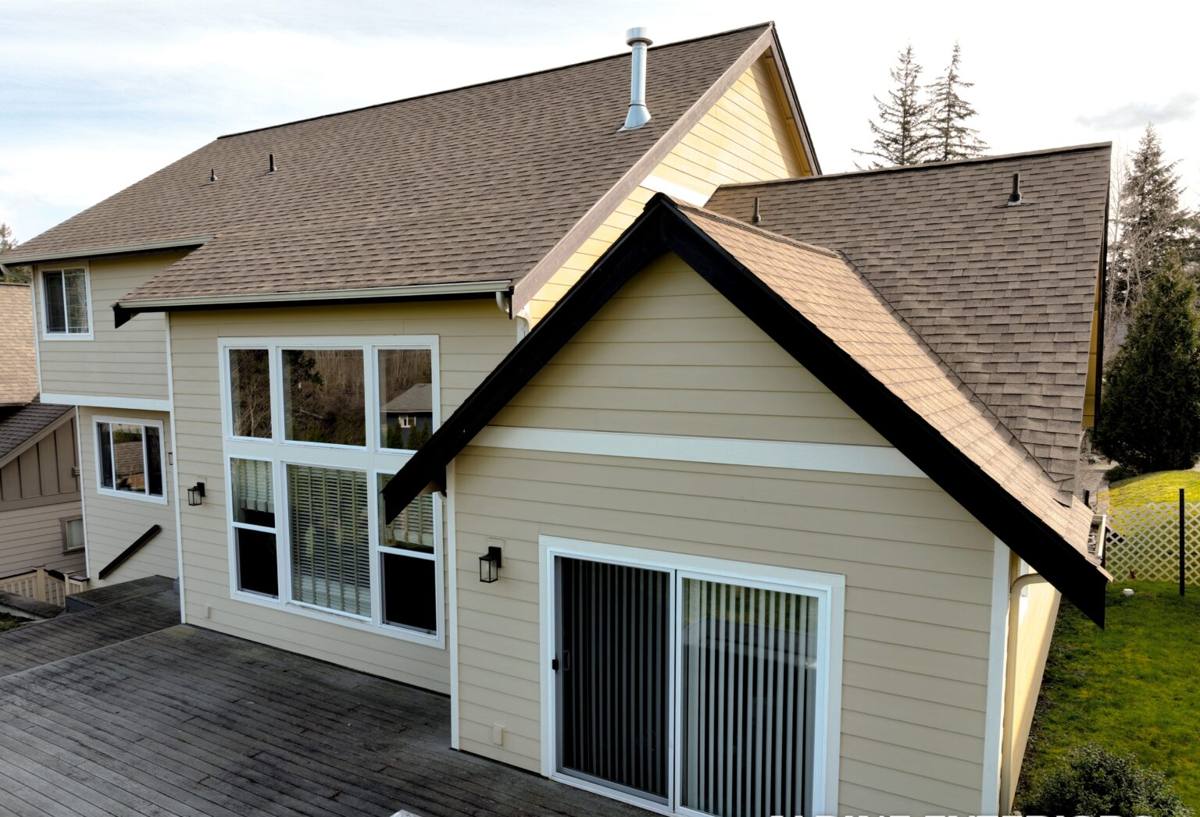
Why Concrete Homes Wear Out Siding Faster Than the Spec Sheet Promises
Shade Changes Everything
A wall that gets four hours of afternoon sun dries out fast after a storm. A wall shaded by second-growth fir most of the day might stay damp for a week. In Concrete, a lot of homes have exactly that second condition on at least one elevation — usually the north or east side. Siding installed without accounting for that reality ends up with moss, mildew staining, and in the worst cases, moisture working its way behind the cladding.
Rain That Doesn't Let Up
Skagit Valley rain isn't usually the dramatic, wind-driven kind you get right on the water — it's the steady, all-day, all-week kind that saturates ground and keeps humidity high around the base of a house. Siding and trim near grade, under eaves that don't overhang far enough, and around ground-level additions take the brunt of it.
Moss Isn't Cosmetic — It's a Moisture Trap
Moss holds water against a surface far longer than bare siding would ever sit wet on its own. On the wrong substrate, that's a slow path to rot, delamination, or paint failure. On the right substrate, installed correctly, it's a maintenance item you pressure-wash off — not a structural threat.
What a Correct Siding Replacement Looks Like Here
A siding replacement in Concrete is not just "take off the old, put on the new." Done right, it addresses the water-management system underneath the cladding, not just the cladding itself.
- Full removal of old siding and inspection of the sheathing underneath for rot, soft spots, or prior water damage
- Repair or replacement of any compromised sheathing or framing before new siding goes on — never sided over
- Correct weather-resistive barrier (house wrap) installation, lapped and taped to actually shed water downward
- Rainscreen or proper furring where the wall assembly calls for it, so siding can dry from behind, not just the face
- Careful flashing at every window, door, and horizontal trim break — the details that actually stop water intrusion
- James Hardie fiber cement siding, installed to manufacturer spec for fastening, clearances, and caulking
- Attention to ground clearance and eave/gutter performance so new siding isn't reintroduced to the same moisture problems
Skip any one of those steps and you've spent real money on a product that looks good in photos and fails the same way the old siding did — just on a longer timeline.
Why We Only Install James Hardie
We don't install vinyl, LP SmartSide, cedar, primed spruce, or other fiber cement brands like Cemplank or Allura. That's not a marketing position — it's a standard we set because of what we've seen hold up in exactly this kind of wet, shaded, moss-prone environment.
Vinyl
Vinyl is affordable and low-maintenance in dry climates, but it expands and contracts with temperature swings, can warp under sustained moisture and heat cycling, and its seams and J-channels give water plenty of places to collect on a shaded, damp wall. It also isn't a fire-rated product, which matters more every wildfire season here.
Wood-Based Siding (Cedar, Primed Spruce, LP SmartSide)
Wood-based products, including engineered wood like LP SmartSide, perform fine when they stay dry and get regular upkeep. In a valley with Concrete's shade and rain profile, "stays dry" is the hard part. Any breach in the factory coating or field-applied paint becomes an entry point for moisture, and once wood-based siding starts absorbing water, swelling and rot follow.
Other Fiber Cement Brands
Products like Cemplank and Allura are legitimate fiber cement siding — the material category is sound. Our standard is on the brand-specific engineering and finish system: James Hardie's ColorPlus factory finish and climate-specific HZ5 formulation for the Pacific Northwest are what we've chosen to stand behind with our own labor and warranty.
James Hardie's HZ5 System and Why It Fits This Climate
James Hardie engineers its HZ product lines by climate zone, and the HZ5 formulation is built for the wetter, harsher moisture conditions found across the Pacific Northwest — which includes river valley towns like Concrete. Fiber cement itself is non-combustible, dimensionally stable, and doesn't feed moss and mildew the way organic wood fiber does. The ColorPlus factory finish is baked on under controlled conditions, which gives it more consistent adhesion and UV resistance than field-applied paint — meaning fewer repaint cycles over the life of the siding, and a finish that holds its line even on a shaded wall that stays damp longer than the rest of the house.
Cost Factors for a Concrete Siding Replacement
Every home is different, but the same handful of variables drive the price on almost every project we quote in this area.
| Factor | Why It Matters Here |
|---|---|
| Sheathing condition | Homes with long-term shade or past moisture intrusion often need sheathing repair before new siding goes on |
| Home size and wall complexity | Dormers, multiple gables, and cut-up elevations add labor and material waste |
| Siding profile (lap, shingle, panel) | Shingle and detailed trim work take more time than straight lap siding |
| Access and site conditions | Sloped lots and tree-lined properties common around Concrete can slow staging and material handling |
| Trim and flashing scope | Full trim replacement costs more upfront but is what actually stops the water problems shaded walls develop |
Our Process, Start to Finish
- On-site inspection of current siding, trim, and sheathing condition, with particular attention to shaded and ground-level areas
- Written estimate that separates siding, trim, flashing, and any sheathing repair so you know exactly what you're paying for
- Material order and scheduling — Hardie products are ordered to your home's specific colors and profiles
- Removal of old siding and a real look at what's underneath before anything new goes up
- Correct installation of weather barrier, flashing, and James Hardie siding to manufacturer spec
- Final walkthrough covering warranty registration and any care instructions specific to your home's shade and drainage conditions
Why Hire a Crew That Already Works Concrete
Concrete isn't Mount Vernon or Burlington, and it isn't the coast either. It's its own microclimate — narrower valley, more shade, slower drying, longer moss season on the north sides of homes. A crew that mostly works flatter, more open sites downriver can still do competent work, but they're not necessarily thinking about furring strategy for a heavily shaded gable end or flashing details for a wall that stays wet longer than the rest of the neighborhood. Working this part of Skagit County regularly means those adjustments aren't an afterthought — they're built into how we bid and install every job.
Signs Your Concrete Home Needs Siding Replacement Now
- Persistent moss or dark staining that returns within weeks of cleaning, especially on shaded walls
- Soft or spongy spots when you press on siding near the ground or under windows
- Visible warping, buckling, or gaps at seams and corners
- Paint that's failing faster than a normal repaint cycle, particularly on one side of the house
- Rot or discoloration visible at trim boards, corner boards, or where siding meets the foundation
Any one of those on its own might just need a repair. Several at once, especially combined with a home's age, usually means the underlying material has run out of road.
If you're seeing any of these signs on a home in Concrete, or you'd just like an honest read on where your siding stands, we're happy to take a look. Estimates are free and there's no pressure — just a straight assessment and a clear number if you decide to move forward. Fill out the form below to get started.