 Skagit County
 Building Decks for Alger's Damp, Shaded Climate
Alger sits in the wooded, semi-rural stretch of northern Skagit County, close enough to the water that salt-laden air is a real factor in material choices, and shaded enough by conifers that moss and algae aren't a seasonal nuisance here — they're a year-round condition. A deck built the same way you'd build one in a dry, sunny climate will fail faster in Alger, usually starting at the places you can't see: the ledger connection, the joist tops, the fastener heads. A deck built for this specific stretch of Skagit County starts from a different set of assumptions.
The short version: more rain days per year than most of the country, driving rain that gets pushed sideways by wind off the water, salt air that accelerates corrosion on unprotected metal, and enough tree cover on most Alger lots that parts of a deck rarely see direct sun. Every material and detail decision below is a response to one or more of those four things.
What Alger Properties Typically Need From a Deck
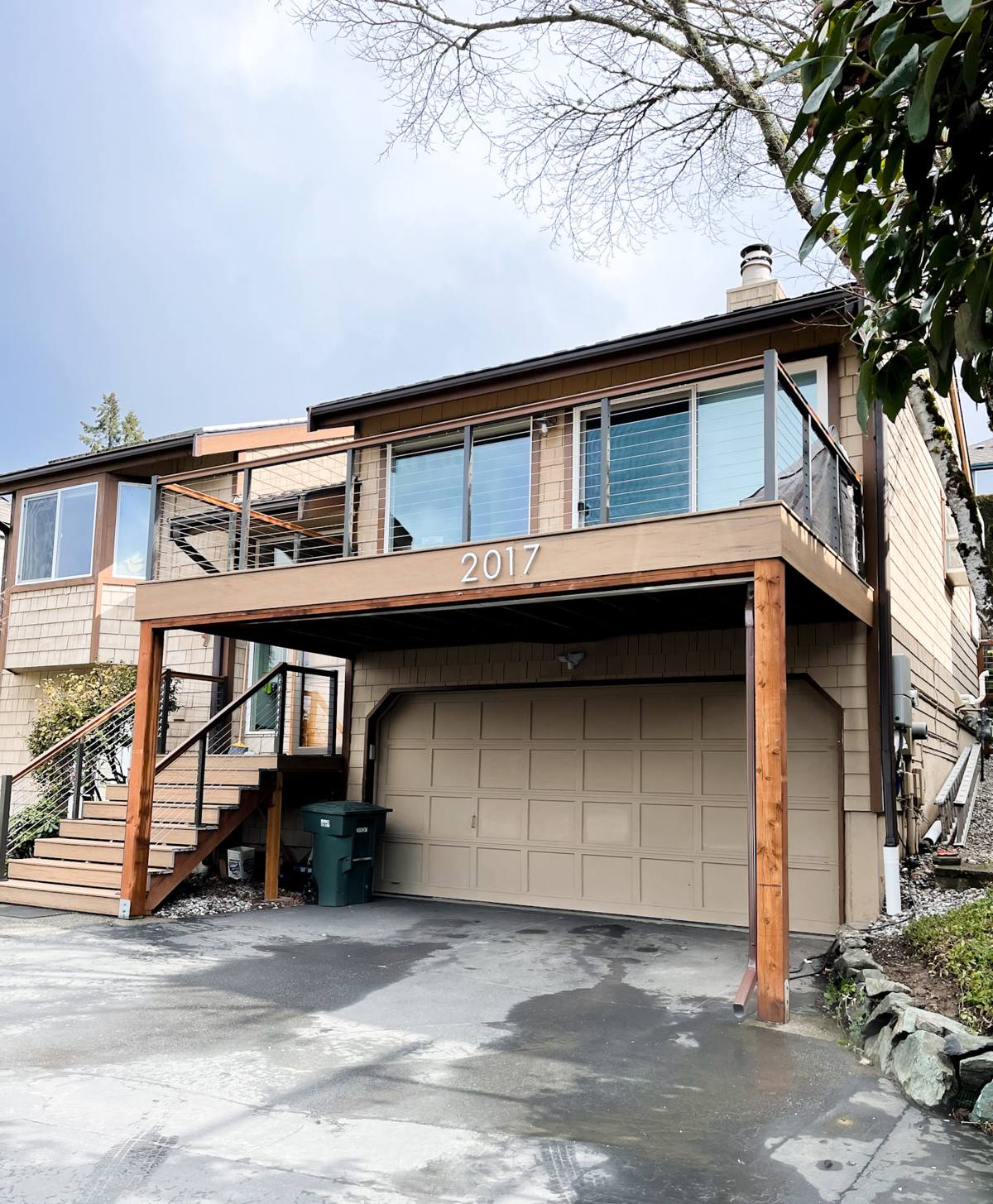
Alger's mix of wooded parcels, sloped lots, and properties tucked back from the road means custom decks here tend to solve for a few recurring conditions rather than a one-size-fits-all layout.
Shade and Moisture Retention
A deck under a stand of firs or cedars stays wet longer after a storm than an open, sun-exposed deck a few miles away. That changes which decking material makes sense and how aggressive the drainage plan under the deck needs to be.
Grade and Elevation Changes
Many lots in this part of the county aren't flat. Custom decks here often step down a slope, wrap a walkout basement, or sit on taller posts than you'd see on a typical suburban build — which puts more weight on getting footings and post bases right the first time.
Views and Outdoor Living
Homeowners building here are usually trying to make more use of a wooded or partially wooded lot — a deck that lets you sit outside without standing in wet grass, positioned to catch what sun does reach the property.
Choosing the Right Decking Material for This Climate
There's no universally "best" decking material — there's the material that matches how much maintenance a homeowner actually wants to do, balanced against upfront cost and how the surface behaves when it's wet more often than dry.
| Material | How It Handles Alger's Climate | Maintenance Reality |
|---|---|---|
| Pressure-treated wood | Affordable and strong, but absorbs moisture readily; needs a real drainage gap and airflow underneath to avoid staying damp | Annual cleaning and periodic staining/sealing to keep moisture out |
| Cedar | Naturally more rot-resistant than PT wood and handles damp shade reasonably well, but still an organic material that will gray and can host moss in low-light areas | Regular cleaning and refinishing to preserve color and protect the surface |
| Capped composite | A plastic cap resists moisture absorption, which matters a lot under tree cover; won't rot, splinter, or need staining | Occasional washing to keep pollen, moss spores, and organic debris from building up in grain texture |
| PVC decking | Fully synthetic, essentially immune to moisture damage, best option for the shadiest, wettest sections of a lot | Lowest maintenance of the group; periodic rinsing is usually enough |
Our default recommendation for shaded Alger lots is capped composite or PVC in the areas that stay damp longest, with wood reserved for homeowners who specifically want that look and are prepared to keep up with sealing. We don't push wood on a heavily shaded, north-facing deck section — not because wood is a bad product, but because that's the combination of conditions where it needs the most upkeep to perform.
Framing and Substructure: Where Decks Actually Fail Here
Most deck failures we get called out to inspect aren't decking-surface problems — they're substructure problems that took years to show up. In a climate this wet, the framing details matter more than the boards on top.
Ledger Flashing
The connection where a deck attaches to the house is the single most common source of hidden rot in this region. Proper flashing — installed so water sheds away from the house rather than behind the ledger board — is not optional in a climate with this much driving rain.
Joist Protection
Joist tops that aren't protected with a flashing tape trap water in the fastener holes where deck boards attach, which is exactly where rot starts from the inside out. This is an inexpensive step that gets skipped on rushed jobs and costs far more to fix later than to do right the first time.
Footings on Sloped Ground
On the grade changes common around Alger, footing depth and post height need to account for how saturated the soil gets in winter, not just how it looks on a dry summer day when the work happens.
Moss, Algae, and Surface Grip
A "long moss season," as it's often described around here, isn't an exaggeration for shaded Skagit County lots — it's closer to most of the year. That affects both how a deck looks and how safe it is to walk on.
- Grooved-edge composite boards can trap moisture and organic debris in the channel between boards; solid or low-gap board profiles shed water and debris more effectively in heavy shade.
- A deck surface with some texture underfoot provides better slip resistance once moss or algae starts to form, compared to a smooth, glossy finish.
- Gaps between boards should be sized to let water drain through rather than pool on the surface — too tight a gap defeats the point in a climate like this.
- Stairs and any section under heavy tree cover deserve extra attention to grip, since that's typically where the first moss growth shows up.
- Periodic cleaning with a deck-safe cleaner extends the life of any material — no decking is truly maintenance-free in a climate this wet, just lower-maintenance.
Railings, Hardware, and Fasteners for Salt Air Exposure
Salt air moving inland from the Puget Sound and Samish Bay area accelerates corrosion on unprotected or lower-grade metal faster than most homeowners expect. This shows up first as rust streaks bleeding down light-colored decking from fastener heads, and eventually as weakened hardware.
Our standard for Alger builds is stainless steel or coated fasteners rated for exterior, coastal-adjacent use, along with hidden fastener systems where the decking material supports them — both to protect the hardware itself and to avoid the surface staining that comes from corroding screw heads. Railing hardware and structural connectors get the same treatment; a deck is only as durable as its weakest fastener, and in this climate that weak point shows up within a few seasons if the wrong hardware grade is used.
Our Process for a Custom Deck Build in Alger
Every property here is different — lot slope, tree cover, how close the deck sits to the water table, and what the homeowner actually wants to use the space for all shape the design. Our process is built to account for that instead of dropping in a standard layout.
- On-site assessment — we walk the property, check grade, drainage, sun exposure, and existing structure before recommending materials.
- Design and material selection — layout, decking material, railing style, and hardware are chosen together based on how that specific section of the lot behaves in wet weather.
- Permitting — Skagit County permit requirements are handled as part of the job, not left for the homeowner to sort out separately.
- Framing and substructure — footings, ledger flashing, and joist protection are built to the standard described above, not the minimum required to pass inspection.
- Decking, railing, and finish work — surface material installed with attention to drainage gaps, fastener grade, and grip.
- Final walkthrough — we go over care and cleaning expectations specific to the material chosen, so there are no surprises the first wet winter.
Why Hire a Crew That Already Works in Alger and Skagit County
A deck contractor who mostly works drier, sunnier markets will make reasonable decisions for that climate — decisions that don't always hold up here. Knowing which sections of a typical Alger lot stay shaded into the afternoon, how Skagit County's permitting and inspection process runs, and which fastener and flashing details actually matter in this much rain isn't something you get from a general contracting background alone. It comes from building decks in this specific climate, repeatedly, and seeing which details hold up five and ten years later versus which ones don't.
That local knowledge is also why we're comfortable giving homeowners a straight answer about material trade-offs instead of steering everyone toward the same product. The right deck for a sunny, open lot near Mount Vernon isn't automatically the right deck for a shaded, sloped lot in Alger, and a crew that treats every job the same misses that.
Getting Started
If you're planning a new deck or replacing one that's showing its age, we're happy to take a look at your property and talk through what makes sense for your lot's sun exposure, slope, and drainage. Reach out for a free, no-pressure estimate using the form below — there's no obligation, just a straight assessment of what your Alger property needs.