 Skagit County
 Building Decks for March Point's Waterfront Conditions
March Point sits close to the water, and that changes what a deck needs to survive here compared to a deck built further inland. Homes on and near the point deal with salt-laden air coming off the bay, wind-driven rain that gets pushed sideways into every gap and joint, and a wet season that stretches long enough for moss and algae to take hold on almost any horizontal surface. A deck built the way it would be built in a dry climate, or even a typical inland Skagit County lot, will show problems here faster: corroding fasteners, cupped boards, slick green film on the walking surface, and rot starting in places you can't see until it's advanced.
We build decks specifically with this environment in mind. That means different material choices, different fastener specs, different framing details, and a different approach to drainage than a generic deck build. This page covers what actually matters for a deck on March Point, not a generic overview of decking.
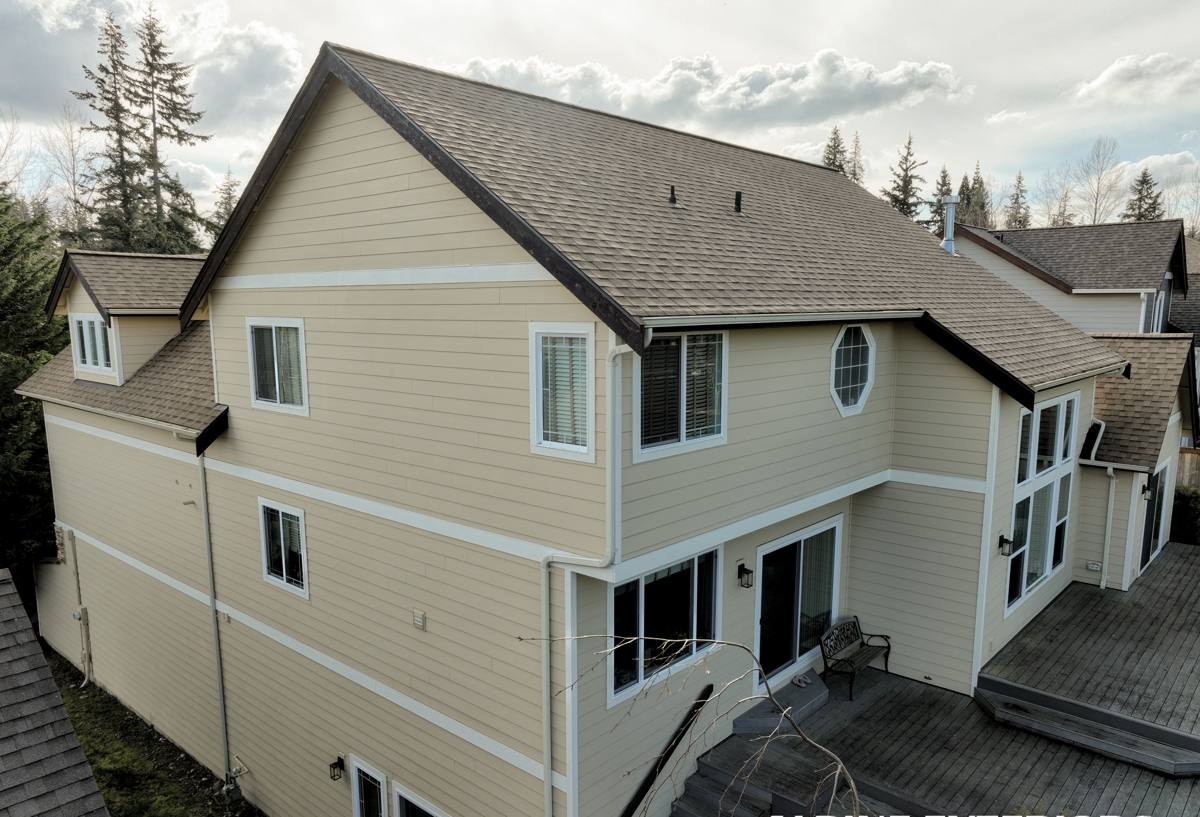
What Salt Air, Driving Rain, and Moss Actually Do to a Deck
Salt Air and Corrosion
Airborne salt accelerates corrosion on any exposed metal — nails, screws, joist hangers, bolts, and railing hardware. Standard galvanized fasteners that hold up fine on an inland deck can start rusting and staining within a few seasons this close to the water. Once a fastener corrodes, it loses holding strength long before the wood around it shows any obvious damage, which is part of what makes this kind of failure sneaky.
Driving Rain and Moisture Intrusion
Wind off the water doesn't just drop rain straight down — it drives it sideways and up under boards, into ledger connections, and behind any trim that isn't properly flashed. That means the parts of a deck most people never think about — the ledger board where the deck attaches to the house, the end grain of joists, the underside of decking boards — take on more water here than a similar deck in a sheltered inland yard.
Moss and Algae Season
Skagit County's wet season runs long, and on a shaded or north-facing deck near the water, moss and algae can establish themselves almost year-round. Beyond looking bad, a mossy deck surface holds moisture against the wood or composite, and it gets genuinely slippery — a real safety issue on stairs and landings.
Choosing Decking Material for This Environment
There's no single "best" decking material for every home — it depends on budget, how much upkeep you want to do, and how exposed the deck is to wind and salt air. Here's how the common options actually compare for a March Point property.
| Material | How it handles salt air & rain | Moss/algae resistance | Maintenance |
|---|---|---|---|
| Pressure-treated wood | Good if fasteners and flashing are correct; treatment resists rot but not corrosion of hardware | Low — needs regular cleaning and treatment | Annual cleaning, periodic staining/sealing |
| Cedar | Naturally rot-resistant, but softer and can weather/gray quickly in salt air | Low to moderate | Regular cleaning, sealing to maintain appearance |
| Composite decking | Excellent — doesn't absorb moisture or corrode | Moderate to good, varies by brand and surface texture | Low — periodic washing, no staining/sealing |
| PVC decking | Excellent — fully moisture-resistant | Good, smoother surfaces resist buildup | Lowest — occasional washing |
We're honest with homeowners about trade-offs rather than pushing one product. Wood costs less up front and can look great, but it asks more of you every year in a climate like this. Composite and PVC cost more initially but hold up with far less maintenance in salt air and constant moisture — for a lot of March Point homes, that math works out in their favor over the life of the deck. We'll walk through the real cost and upkeep differences for your specific project before you commit to a material.
What Correct Framing and Foundation Work Looks Like Here
Most deck problems that show up in five or ten years trace back to decisions made in the framing stage, not the decking material. For homes in this area, we pay particular attention to:
- Proper ledger board flashing and sealing where the deck attaches to the house — this is the single most common failure point on decks near the water
- Corrosion-resistant joist hangers and structural connectors rated for coastal/salt-air exposure, not standard galvanized hardware
- Footings sized and set below frost depth, appropriate to Skagit County's soil and drainage conditions
- Joist spacing and beam sizing that account for our decking material choice and local snow/wind load requirements
- Ventilation gaps under low decks so air can circulate and moisture doesn't sit trapped against framing
None of this is visible once the deck is finished, which is exactly why it matters that it's done right the first time. A deck that looks fine on the surface can still be quietly failing underneath if the framing wasn't built for this environment.
Fasteners, Railings, and Hardware Choices
Given the corrosion issue we mentioned above, we spec stainless steel or coated fasteners rated for coastal exposure on March Point projects rather than standard exterior-grade hardware. It costs a bit more, but replacing rusted screws or a failing hanger a few years in costs far more — and by the time rust is visible on the surface, it's usually already compromised the connection underneath.
For railings, we look at the same salt-air resistance question: powder-coated aluminum and properly finished composite railing systems tend to hold up better here than bare metal or untreated wood balusters, which can pit, corrode, or gray unevenly.
Drainage and Moss-Resistant Design
Good drainage does double duty here — it protects the structure and it reduces how much moss and algae can take hold. We build in a slight slope away from the house on the decking surface, choose board spacing that lets water pass through and air circulate underneath, and avoid low spots or dead zones where water and debris can pool. For elevated decks, we also consider whether a drainage system underneath makes sense to keep the space below usable and dry.
Surface texture matters too. Smoother, denser materials generally resist moss buildup better than porous wood, but no surface is immune — regular cleaning is still part of owning a deck this close to the water, whatever material you choose.
Our Process, Start to Finish
We keep the process straightforward and give you real information at each stage rather than surprises:
- On-site assessment — we look at your home's exposure, existing structure (if replacing a deck), grade, and how the site handles water and wind
- Material and design conversation — honest trade-offs on wood vs. composite vs. PVC, layout, railings, and stairs based on your budget and how you'll use the space
- Written estimate — clear scope and pricing before any work starts, no surprise add-ons
- Permitting — we handle the permit process where required for your project
- Construction — proper flashing, corrosion-resistant hardware, and framing built for this climate, not a generic build
- Final walkthrough — we go over care and maintenance specific to the material you chose
Maintenance Checklist for a March Point Deck
However well a deck is built, ongoing care in this climate makes a real difference in how long it lasts and how it looks. A simple seasonal routine covers most of it:
- Sweep off debris and standing leaves regularly, especially in fall and winter, so moisture doesn't sit trapped against the surface
- Wash the deck surface at least once or twice a year to clear early moss and algae growth before it establishes
- Check railings, stairs, and any visible hardware annually for rust staining or looseness
- For wood decks, plan on re-staining or sealing on a regular cycle rather than waiting until it looks obviously worn
- Keep gutters and downspouts near the deck clear so runoff isn't dumping extra water onto or under the structure
- Trim back vegetation that shades the deck and keeps it damp longer after rain
Why It Matters to Hire a Crew That Already Works This Area
A deck builder who mostly works drier, inland sites will often spec standard hardware, standard flashing details, and whatever decking material is easiest to sell — because that's what works where they usually build. On March Point, those standard choices are exactly what leads to early corrosion, moss problems, and moisture damage. We work throughout Skagit County and understand how differently a deck needs to be built depending on how close it sits to the water and how much weather it takes on directly. That local knowledge shows up in the material recommendations we make, the hardware we spec, and the framing details we don't skip.
If you're planning a new deck or need to replace one that's showing its age, we're happy to come take a look and give you a straightforward, no-pressure estimate. Use the form below to get started.