 Skagit County
 Edison Sits in One of Skagit County's Toughest Microclimates for Siding
Edison is a small community, but the exterior of a house there works harder than it does in a lot of inland Skagit County towns. The combination of nearby saltwater, open farmland wind exposure, and the shade from mature trees along the valley creates a mix of conditions that most siding products were never designed to handle all at once. When we look at a home in Edison, we're not just thinking about rain — we're thinking about salt-laden air, wind-driven moisture, and the long, damp stretch of fall through spring that lets moss and algae take hold on anything that stays wet too long.
Salt Air and Bay Proximity
Homes near Samish Bay and Padilla Bay see a steady drift of salt-carrying air, especially during winter storms. Salt air is corrosive to metal fasteners and trim, and it accelerates the breakdown of paint films and cheaper composite sidings that rely on surface coatings rather than a factory-cured finish. Over years, that exposure shows up as chalking, fading, and edge deterioration on products that aren't built for it.
Driving Rain and Wind-Driven Moisture
Skagit County gets plenty of rain, but the flat, open ground around Edison means wind can push that rain sideways into wall assemblies rather than letting it fall straight down and shed off. That matters more than most homeowners realize — it's not just about a waterproof surface, it's about whether the siding system manages water that gets behind the surface, at seams, corners, and penetrations.
Moss, Shade, and Standing Damp
Many lots in and around Edison carry mature trees and hedgerows that block sun and airflow along at least one side of the house. Combined with our long wet season, that shade creates the ideal environment for moss and algae to establish on north-facing and shaded walls. Siding that holds moisture at the surface, or that has seams and laps where organic debris can collect, will grow moss faster and hold onto it longer.
Why James Hardie Fits This Climate
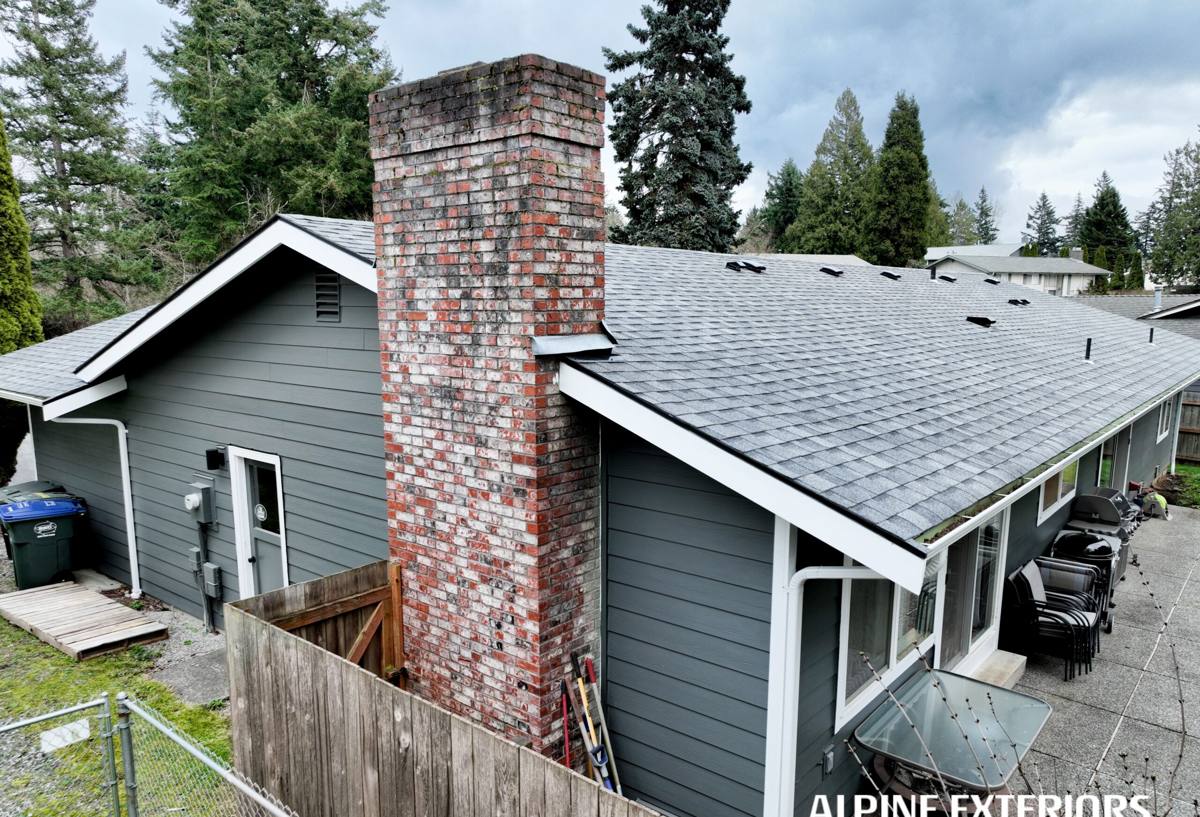
James Hardie fiber cement siding is manufactured from sand, cement, and cellulose fibers, cured into a dense, stable board. It doesn't absorb and swell with moisture the way wood-based products can, and it doesn't rely on a surface paint job alone to keep weather out. For a location like Edison, that matters in three specific ways: it holds up to repeated wetting and drying cycles without warping, its factory-applied ColorPlus finish resists fading and chalking from sun and salt exposure far longer than field-applied paint, and it's non-combustible, which matters during Skagit County's dry summer wildfire smoke season even though the bigger year-round concern here is moisture.
Hardie also engineers regional product lines specifically for climate. Our installs use the HZ5 formulation, which is built for the wetter, more freeze-variable climate zones of the Pacific Northwest, rather than a generic national product. That's a meaningful distinction — it's the difference between siding designed for this weather and siding that simply happens to be sold here.
What a Correct Installation Actually Involves
Fiber cement siding is only as good as the assembly behind it. The board itself resists moisture well, but a poorly installed system can still let water into the wall through the gaps between panels, around windows, or at the bottom edge near grade. On a house exposed to Edison's wind-driven rain, these details aren't optional extras — they're the difference between siding that lasts thirty-plus years and siding that causes hidden rot in five.
The Details That Matter Most
- A drainage plane (weather-resistive barrier) installed continuously behind the siding, with proper shingle-lap overlaps
- A rain screen gap or furring where conditions call for it, so any moisture that gets behind the siding can drain and the wall can dry
- Correct starter strip and bottom clearance from grade, decks, and roof lines to keep splash-back and standing water away from the board's lower edge
- Z-flashing over every horizontal trim piece and window head, not caulk alone
- Fasteners driven per Hardie's published nailing pattern — not overdriven, not into butt joints without blocking
- Factory-cut edges primed or capped, since a raw cut edge is the one part of the board that can absorb moisture
Any one of these skipped can undercut the product entirely. A good board installed badly will fail before a lesser product installed with real care and attention to flashing.
Installed Right vs. a Common Shortcut
| Detail | Correct Installation | Common Shortcut |
|---|---|---|
| Bottom clearance | Minimum clearance held from grade, decks, and roofs per Hardie spec | Siding run tight to grade or a lower roof, holding splash-back moisture |
| Window and door flashing | Metal flashing integrated with the drainage plane | Caulk relied on as the primary water seal |
| Panel joints | Butt joints backed with flashing or blocking, gapped per manufacturer spec | Joints butted tight and caulked over, trapping moisture |
| Fastening | Corrosion-resistant fasteners at the specified pattern and depth | Fasteners overdriven or spaced inconsistently, cracking the board |
Our Process for Edison Projects
We start with a walk-around assessment of the existing siding and, where it's already off or accessible, a look at the sheathing underneath for soft spots or past moisture damage — this is especially important on shaded or bay-facing walls where problems tend to concentrate. From there we scope the tear-off, confirm the drainage and flashing plan for each wall, and order material sized to the house rather than a generic package.
During installation we sequence the work to keep the house weather-tight at every stage, since a partially open wall during a wet-season storm is exactly the situation that causes damage. We finish with a full punch-list walkthrough covering trim, caulking points, and touch-up, so nothing is left half-finished at the corners or around penetrations.
Maintenance That Actually Matters Here
James Hardie siding needs far less upkeep than wood or many composite products, but "low maintenance" doesn't mean "no maintenance," particularly in a climate like this one. A periodic soft wash removes the algae and moss film before it takes hold, and keeping gutters and downspouts clear prevents water from sheeting down a wall face repeatedly in one spot. On lots with heavy tree cover, trimming back branches that shade a wall or drop debris into corners and laps goes a long way toward keeping that side of the house dry and clean between washes.
Caulking at trim joints and penetrations should be checked every couple of years — caulk is a maintenance item on any siding system, including Hardie, and catching a failed joint early is a five-minute fix instead of a moisture problem later.
Why a Crew That Already Works Edison and Skagit County Is Worth It
A crew that regularly works this part of Skagit County already knows which walls on a given lot orientation tend to hold moss, how far inland the salt exposure realistically reaches, and how local permitting and inspection expectations run for exterior work. That's not something you get from a general contractor who occasionally does siding on the side, or from a crew based well outside the area that hasn't dealt with these specific conditions repeatedly. It also means a shorter response time if a punch-list item or a warranty question comes up after the job is done — we're not driving in from across the state.
Cost Factors for an Edison Siding Project
Every house is different, so we won't quote a number without seeing the home, but the factors that actually move the price are consistent from job to job.
| Factor | Why It Matters |
|---|---|
| Tear-off scope | Removing old siding down to sheathing costs more than installing over a properly prepped surface, but it lets us inspect and fix any hidden moisture damage |
| Wall complexity | Homes with more corners, gables, and trim detail take more labor per square foot than a simple rectangular elevation |
| Access and site conditions | Tree cover, tight setbacks, and slope affect scaffolding, staging, and how quickly crews can move around the house |
| Product selection | Hardie's lap, shingle, and panel styles, plus trim and accessory choices, carry different material costs |
| Sheathing or framing repair | Any rot found during tear-off needs to be repaired before new siding goes on, which is discovered work, not padding |
What to Ask Before You Hire
- Do you install to James Hardie's published fastening and clearance specifications, and can you show me the flashing plan for my walls?
- Will you inspect the sheathing during tear-off, and how do you handle anything you find?
- What warranty covers the labor, separate from the manufacturer's material warranty?
- Have you worked on homes in Edison or elsewhere near the bay, and what did that site's conditions require?
- How do you handle unexpected repair costs if rot or damage turns up once old siding is off?
If you're weighing a siding project on an Edison home, we're glad to take a look and walk you through what your specific walls need. Reach out for a free, no-pressure estimate — there's no obligation, just a straight assessment of what the job actually involves.