 Skagit County
 Fiber Cement Siding for Hamilton Homes
Hamilton sits along the Skagit River in the eastern part of Skagit County, tucked closer to the foothills than the coast — but the weather that runs through this whole county doesn't stop at the water. Marine air pushes inland off Puget Sound and up the Skagit Valley most of the year, and Hamilton gets its own version of the same problem every other town in the county deals with: siding that stays damp too long, too often, for too many months in a row.
We install James Hardie fiber cement siding, and only James Hardie. This page covers what that looks like specifically for a Hamilton property — what the climate actually does to a wall assembly here, what a correct fiber cement install involves, and why hiring a crew that already works this area matters more than it sounds like it should.
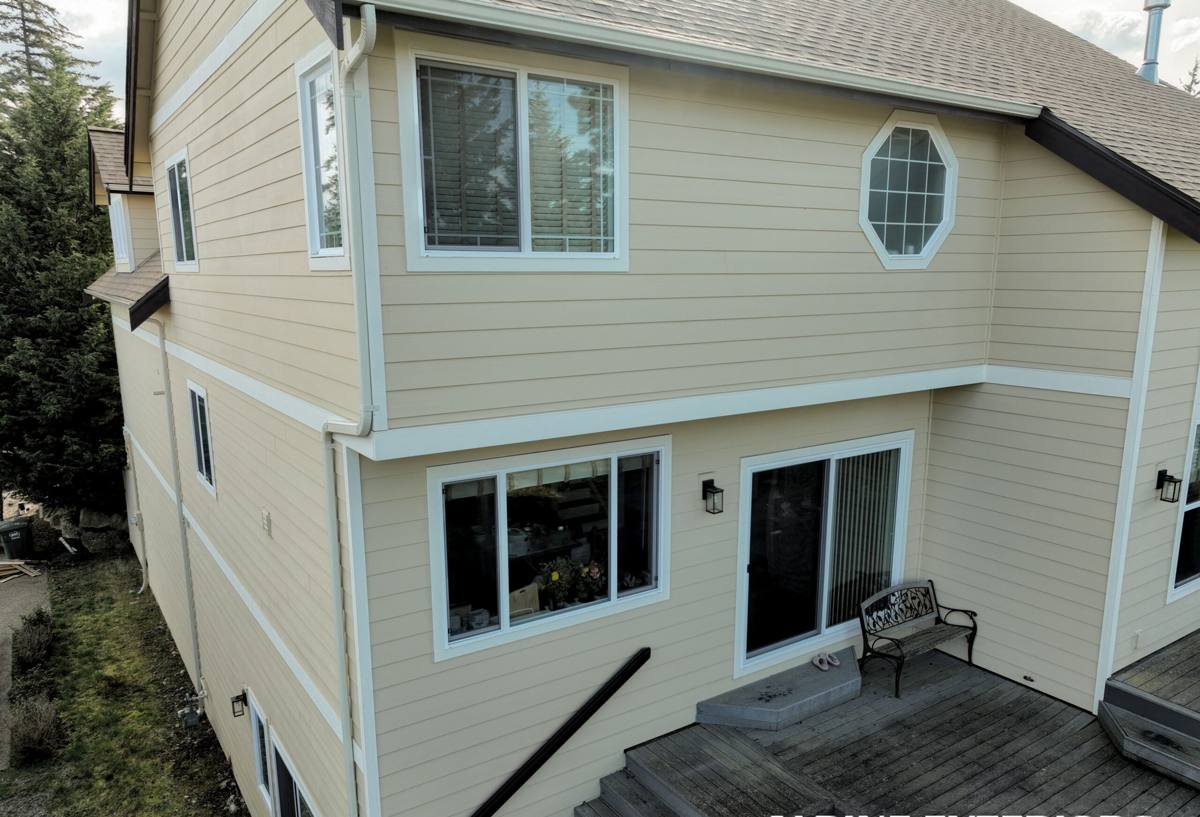
What Hamilton's Climate Does to Siding
Driving rain and long wet stretches
Skagit County doesn't get hurricane-force storms, but it gets something arguably harder on a house: months of steady, wind-driven rain. Water doesn't just fall straight down here — it gets pushed sideways into lap joints, corner trim, and butt seams. Any siding product that isn't dimensionally stable when saturated, or that relies on paint film alone to keep water out, is going to show it within a few winters.
Moss, shade, and slow-drying walls
Hamilton's river-valley setting means more tree cover and more shaded wall exposures than you'd find on an open lot near the water. Shade keeps siding wet longer after every storm, and that's exactly the condition moss and mildew need. A north-facing wall under fir or cedar canopy can stay damp for days after a system passes through. Over a full "moss season" — which in this part of the county runs roughly October through May — that adds up to real cumulative moisture exposure, even without any single dramatic storm.
Humidity and freeze-thaw cycling
Cold snaps in the valley aren't extreme, but they're frequent enough in winter that any siding holding moisture at the wrong moment will go through repeated freeze-thaw cycles. Wood-based products swell, contract, and eventually delaminate or crack under that pattern. Fiber cement doesn't absorb water the same way wood or wood-composite products do, which is a big part of why it holds up better here.
Why We Only Install James Hardie
We get asked why we don't offer LP SmartSide, vinyl, or other fiber cement brands like Allura or Cemplank. It's not a marketing position — it's a standard we set based on what actually survives a Pacific Northwest wet season without babysitting.
- Non-combustible core — fiber cement doesn't feed a fire the way wood-based siding can, which matters as wildfire smoke and dry-season risk creep further into western Washington summers.
- Factory-applied ColorPlus finish — baked-on color that resists the fading and peeling that field-painted siding shows first, especially on sun-facing walls that swing between wet winters and bright summer exposure.
- Engineered for wet climates — Hardie's HZ10 product line is specifically formulated for regions with prolonged moisture exposure, which describes Skagit County's weather almost exactly.
- Warranty that transfers — a real, transferable manufacturer warranty matters if the home sells before the siding's functional life is up.
Vinyl is cheap and low-maintenance in dry climates, but it becomes brittle in cold snaps and can warp under sustained heat against dark colors — and it can't be painted to refresh a tired look years down the road. LP SmartSide and other wood-strand products perform fine when installation and caulking are perfect and stay perfect, but the margin for error is thin in a climate that stays wet this long. We'd rather install one product correctly, to spec, every time, than manage the trade-offs of several.
What a Correct Fiber Cement Install Involves
Fiber cement is only as good as the installation behind it. Most of the siding failures we get called out to inspect in Skagit County aren't product failures — they're installation shortcuts. For a Hamilton property, correct installation means:
Water management before the siding goes up
- Weather-resistant barrier installed and lapped correctly, shingle-style, so water sheds outward at every seam
- Rainscreen or drainage gap behind the siding so any moisture that gets past the cladding can actually drain and dry, instead of sitting against the wall sheathing
- Properly flashed windows, doors, and any wall penetrations — the single most common source of hidden rot we find on older homes
Installation to Hardie's actual specifications
- Correct nail placement and fastening pattern — not just "enough nails," but the pattern Hardie specifies for the wind and moisture exposure category
- Proper clearance at the bottom of the siding — ground contact and paved-surface contact are two of the fastest ways to void a warranty and start rot
- Caulking only where Hardie's install guide calls for it, and factory-cut or field-cut edges sealed as specified — over-caulking traps water just as badly as under-caulking
- Proper overlap and gapping at butt joints to allow for the material's minor expansion and contraction without cracking paint or opening gaps
Fiber Cement vs. the Alternatives, for This Climate
| Factor | James Hardie Fiber Cement | Vinyl | Wood-Strand (e.g. LP SmartSide) |
|---|---|---|---|
| Moisture resistance | High — cement-based, doesn't rot | Won't rot, but seams can let water behind it | Vulnerable if edges/seams aren't perfectly sealed |
| Moss/mildew resistance | Good, especially with factory finish | Fair — smooth surface but can trap moisture at laps | Poor if shaded and slow to dry |
| Cold-weather stability | Stable across temperature swings | Can crack or warp in cold | Can swell/crack with freeze-thaw cycling |
| Fire resistance | Non-combustible | Melts, can contribute to fire spread | Combustible, wood-based core |
| Repaintable/refinishable | Yes | No — color is the material itself | Yes, but recoating needed more often |
| Typical warranty | Long-term, transferable | Varies, often prorated | Shorter, installation-sensitive |
None of these products are inherently "bad." Vinyl and wood-strand siding both have a place. But for a house that has to survive Skagit County's wet season year after year with minimal upkeep, fiber cement's combination of moisture stability and finish durability is what tips the decision for us — enough that we don't install the alternatives at all.
Why a Crew That Already Works Hamilton Matters
Hamilton isn't a subdivision full of identical production homes — it's older homes, river-valley lots, varied sun and shade exposure, and properties that were often built or added onto over several decades. A crew that hasn't worked this specific stretch of the county tends to make the same handful of mistakes:
- Underestimating how long a shaded, tree-covered wall stays wet after a storm, and skipping the drainage gap because "it's just siding"
- Treating flashing details the same on an older home with settled framing as they would on new construction
- Not accounting for the extended wet season when scheduling install timing and material staging on site
We work this part of Skagit County regularly, which means we're not guessing at how the climate behaves here — we've seen what holds up and what doesn't, on homes with the same rain exposure and tree cover yours has.
What to Expect From Our Process
- On-site assessment — we look at your home's actual exposure: sun, shade, prevailing wind direction, and the condition of the wall assembly underneath your current siding.
- Moisture and substrate check — if there's existing rot or a moisture problem hiding behind old siding, we identify it before covering it back up.
- Product and color selection — we'll walk through Hardie's HZ product lines and ColorPlus options suited to this climate and to your home.
- Correct-spec installation — weather barrier, drainage gap, flashing, and fastening done to Hardie's requirements, not shortcuts.
- Final walkthrough — we go over the finished work with you before we consider the job done.
Maintenance: What Hamilton Homeowners Should Actually Expect
Fiber cement is low-maintenance, not no-maintenance. In a climate like this, plan on:
- An annual walk-around to check caulking at trim and penetrations, especially after the first hard winter
- Gentle washing of shaded, moss-prone walls once a year — a soft wash, not pressure that can drive water behind the siding
- Keeping gutters and downspouts clear so water isn't dumping directly onto or behind a wall section
- Trimming back vegetation that keeps a wall section shaded and slow to dry
That's a modest list compared to what wood-based siding demands in this climate, and it's part of why the long-term cost of fiber cement tends to compare well once you factor in avoided repaints and repairs.
Ready to Talk About Your Siding?
If you're in Hamilton or elsewhere in Skagit County and dealing with siding that's showing moss, staining, or soft spots after another wet season, we're glad to take a look. Reach out for a free, no-pressure estimate — we'll assess your home's actual exposure and walk you through what a correct James Hardie install would involve, no obligation either way.