 Skagit County
 Siding Built for Hamilton's Weather, Not Just Its Looks
Hamilton sits along the Skagit River corridor, where the weather doesn't do a home any favors. Winters bring long stretches of driving rain that comes in sideways more often than straight down. Humidity stays high enough, long enough, that moss and algae get a real foothold on north- and east-facing walls. And because this is Skagit County, salt-tinged air moving up from the Sound and through the valley adds a slow corrosive edge to anything on a house that isn't built to handle it. None of that is dramatic on its own. It's the accumulation — season after season — that wears out the wrong siding material years before it should fail.
We install James Hardie fiber cement siding exclusively. Not because it's the only decent product on the market, but because after years of doing exterior work in this specific climate, it's the one we're willing to put our name behind for a Hamilton home. This page covers what that actually means for a house in this area: what the climate demands, what a correct installation looks like, and how our process works from first look to finished wall.
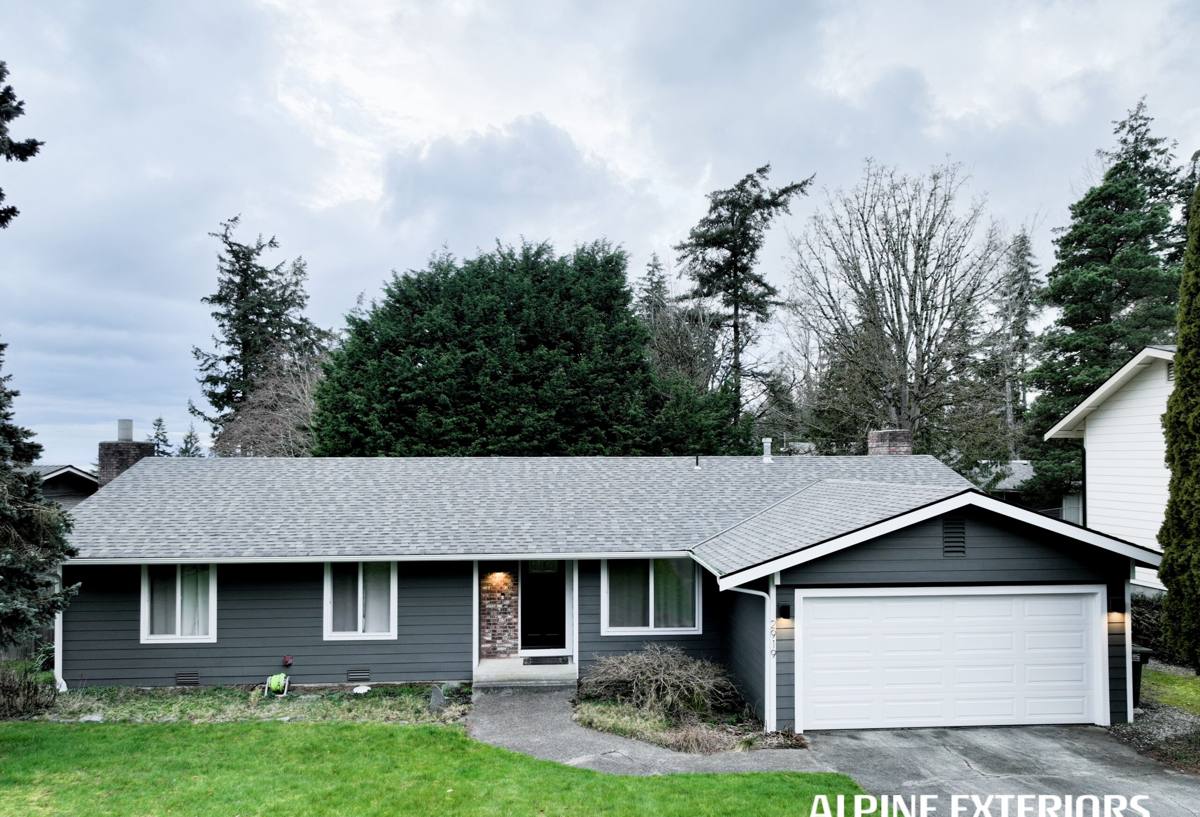
What Hamilton's Climate Actually Does to Siding
Moss and Algae Season Runs Long
In a lot of the country, "moss season" is a few weeks in spring. In Skagit County, shaded and north-facing walls can stay damp enough to support moss and algae growth for a good chunk of the year. Wood-based products absorb that moisture and start to soften and swell underneath the growth. Fiber cement doesn't feed the problem the same way — it doesn't wick moisture into its core, so moss and algae sit on the surface where a wash-down actually removes them instead of just knocking back what's growing on top of a slowly rotting substrate.
Driving Rain Finds Every Weak Point
Wind-driven rain doesn't just fall on a wall, it gets pushed into laps, seams, and fastener points. A siding system is only as good as its weakest transition — around windows, at butt joints, behind trim. This is less about the siding material itself and more about the install, but it matters more here than in drier climates because Hamilton's homes get tested by this kind of weather dozens of times a year, not a handful.
Salt Air Accelerates Corrosion and Finish Breakdown
Being inland from the coast doesn't fully protect a home from salt-laden air moving through the Skagit Valley, especially during storm systems pushing in off the Sound. Salt exposure is hard on unprotected fasteners and on paint finishes that aren't formulated to resist it. This is one of the practical reasons we specify stainless or hot-dip galvanized fasteners and rely on Hardie's factory-applied ColorPlus finish rather than a field-painted finish that's more vulnerable to salt-driven fading and chalking.
Why We Only Install James Hardie
We get asked why we don't offer vinyl, LP SmartSide, or cedar as options. The honest answer is that we used to work with a broader range of products, and the callbacks and premature failures we saw in this climate — specifically in Skagit County conditions like Hamilton's — pushed us to standardize on one system we trust completely.
- Non-combustible core: fiber cement doesn't feed a fire the way wood-based siding can, which matters more every year as wildfire smoke and rural fire risk become bigger regional concerns.
- Engineered for this region: Hardie's HZ10 product line is formulated for the wetter, milder climate zone the Pacific Northwest sits in, rather than a one-size-fits-all national spec.
- Factory-cured ColorPlus finish: the color is baked on at the factory under controlled conditions, not brushed on a job site where weather and dry time are variables. That finish holds up better against UV and moisture cycling than field-applied paint.
- Rigid, moisture-stable substrate: fiber cement doesn't swell and contract with humidity the way wood-based composites can, which keeps caulk lines and paint film intact longer.
- Transferable warranty: Hardie's warranty structure protects the product for decades and can transfer to a new owner, which matters for resale in a market where buyers are increasingly asking about siding condition and age.
We're not going to tell you vinyl or LP SmartSide are junk — they're not, and they work fine in a lot of climates and budgets. What we will say is that in Skagit County's combination of salt air, sustained moisture, and moss pressure, we've made a professional call to only put our name on the product we believe holds up best over the long run, and that's Hardie.
What a Correct Installation Involves
Fiber cement siding is only as good as the install behind it. A rushed or under-detailed job can undercut even the best material. Here's what we treat as non-negotiable on every Hamilton project:
| Install Detail | Why It Matters Here |
|---|---|
| Weather-resistant barrier with properly lapped seams | Stops wind-driven rain from reaching the sheathing even when the outer siding layer gets wet |
| Rainscreen or drainage gap where conditions call for it | Lets any moisture that gets behind the siding drain and dry instead of sitting against the wall |
| Correct fastener type and placement | Stainless or hot-dip galvanized fasteners resist the corrosive effect of salt-tinged air over time |
| Manufacturer-spec clearances from grade, roof lines, and decks | Keeps splash-back and standing moisture away from the siding's bottom edge, a common failure point |
| Properly caulked and flashed penetrations and trim joints | Every seam is a potential entry point for driving rain; this is where most real-world leaks start |
| Factory-cut and pre-primed cut edges field-sealed per spec | Unsealed cut edges are the fastest way for moisture to get into the board itself |
Signs a Hamilton Home Needs Siding Attention
- Persistent moss or algae staining that comes back within weeks of cleaning
- Soft spots, bubbling, or visible swelling, especially near the bottom courses or trim
- Paint that's chalking, peeling, or fading unevenly across different sides of the house
- Visible gaps or separation at butt joints and corner boards
- Rust streaking below fastener heads or trim fasteners
- Rising energy bills that suggest the wall assembly isn't performing the way it should
Any one of these on its own isn't necessarily an emergency. Several together, especially on a home that's had the same siding for fifteen-plus years, usually means it's worth having someone take a real look rather than just repainting over the symptoms.
Our Process for a Hamilton Project
1. On-Site Assessment
We walk the exterior, check for moisture damage, evaluate the existing weather barrier where it's exposed, and note anything specific to the property's exposure — shade patterns, roof runoff, prevailing wind direction — that affects how the new siding should be detailed.
2. Product and Color Selection
We go over Hardie's plank profiles, panel options, and ColorPlus palette, and talk through what suits the home's style and the practical maintenance trade-offs of lighter versus darker tones in a moss-prone area.
3. Written Scope and Timeline
You get a clear scope of work before anything starts — what's being removed, what's being replaced, how the weather barrier and flashing details are being handled, and a realistic timeline given typical Skagit County weather windows.
4. Installation to Manufacturer Spec
Our crews install to Hardie's published installation guidelines, not a shortcut version of them. That includes fastener spacing, clearances, and joint treatment — the details that determine whether the siding performs for decades or needs attention in five years.
5. Final Walkthrough
We walk the finished job with you, point out anything you should know for long-term care, and make sure the work matches what was scoped.
Why Local Experience in Skagit County Matters
A crew that mostly works drier inland climates, or that treats every job the same regardless of region, is more likely to skip details that don't matter much elsewhere but matter a lot here — like drainage planes, moss-resistant detailing, and fastener corrosion resistance. Working Hamilton and the surrounding Skagit County area regularly means we already know how this specific stretch of weather behaves across a full year, not just how it looks on the day of the estimate. That local pattern recognition is part of what a correct install actually depends on.
Maintenance Expectations After Installation
Hardie siding installed correctly is low-maintenance, not no-maintenance. In Hamilton's climate, that generally means:
- An annual rinse-down to keep moss and algae from establishing on shaded walls
- A visual check of caulk lines and trim joints every year or two, since caulk is the first thing to age even when the siding itself is fine
- Prompt attention to any landscaping or irrigation changes that direct more moisture toward the foundation and lower siding courses
- Keeping gutters clear so roof runoff isn't dumping extra water against the wall
None of this is heavy upkeep — it's the kind of routine care that keeps a correctly installed Hardie system performing the way it's designed to for the long haul.
If your Hamilton home's siding is showing its age, or you're planning ahead of a project, we're happy to walk the exterior with you and give you a straight, no-pressure assessment. Use the form below to request a free estimate.