 Skagit County
 March Point sits out on its own finger of land between Fidalgo Bay and Padilla Bay, on the Anacortes side of Skagit County, and it takes weather that other neighborhoods nearby don't see quite as directly. Salt air moves off open water for most of the year, driving rain — rain pushed sideways by wind instead of falling straight down — shows up regularly through the fall and winter, and the long stretch of gray, damp weather that settles over this part of Skagit County gives moss and algae plenty of time to take hold on anything that stays wet. We install James Hardie fiber cement siding exclusively, and on a site like March Point, the reasons for that show up in how a house actually looks and performs five and ten years after the install, not just on the day it's finished.
What March Point's Exposure Does That an Inland Lot Doesn't
A house set back from the water in Mount Vernon or Sedro-Woolley deals with Skagit County's wet season too, but a property on March Point takes it from more directions and more consistently. Salt-laden air is corrosive to fasteners, flashing, and any exposed metal, and it accelerates the breakdown of coatings that aren't built to handle it. Driving rain finds every gap in a wall assembly that wouldn't be a problem in calmer weather — butt joints, inside corners, and anywhere trim meets siding become the places where a mediocre install shows its weaknesses first. And because the peninsula holds moisture in the air longer than a more open, sun-exposed inland site, the moss and algae season here tends to run longer, which matters more for how a siding finish holds up than most homeowners expect.
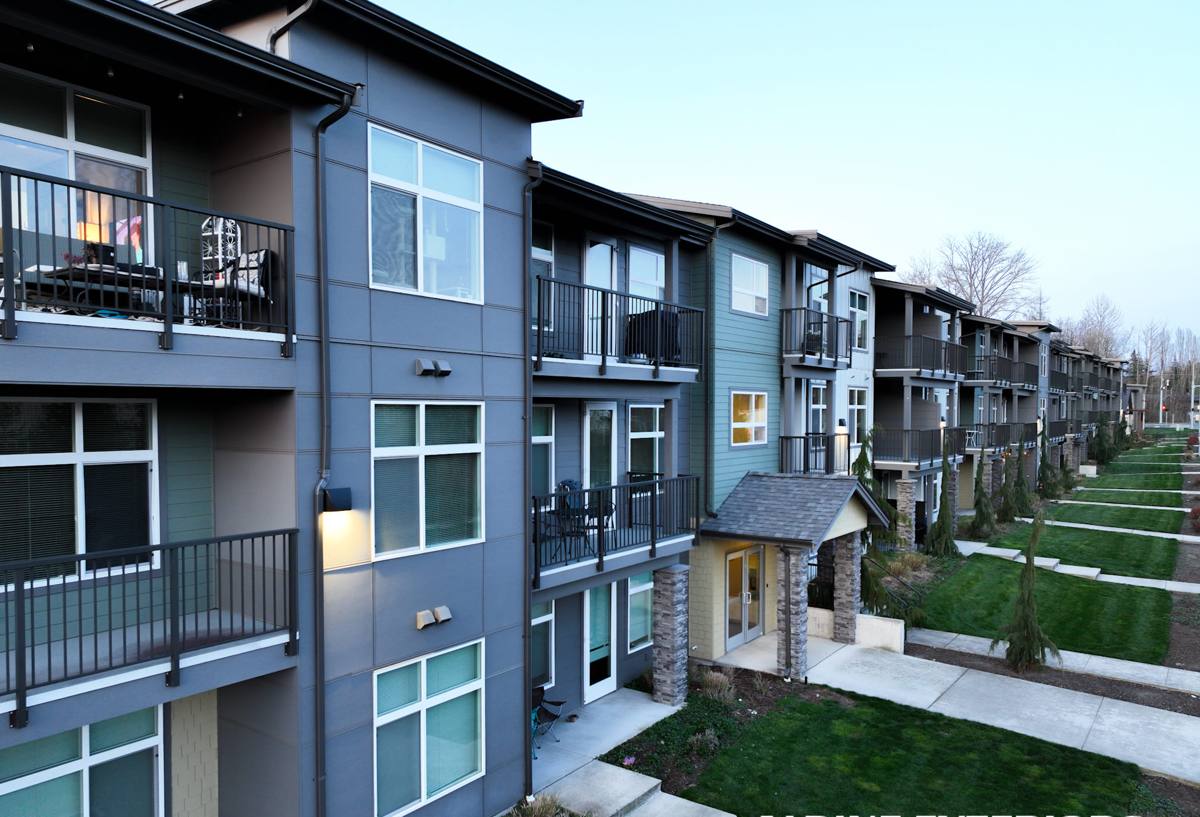
What Fiber Cement Needs to Do in This Climate
Siding on March Point needs to handle sustained moisture exposure without swelling, warping, or providing food for mold and mildew, and it needs to keep its finish and color without constant repainting. Fiber cement handles this differently than the alternatives. It doesn't absorb water the way wood-based products do, it's dimensionally stable through wet-dry cycles that would swell and shrink a wood or wood-strand product, and it's non-combustible, which matters regardless of exposure but is a real point in its favor anywhere. James Hardie's ColorPlus finish is baked on at the factory under controlled conditions rather than applied in the field, which means it isn't dependent on the weather window a painter happened to get on installation day — a real consideration in a climate where a dry stretch long enough to properly cure field-applied paint isn't guaranteed.
The HZ5 Formulation and Why Zone Matters
James Hardie engineers its siding formulations for different climate zones, and homes in western Washington fall into the HZ5 zone, built for wetter, more humid conditions rather than the hot, dry formulation used in the desert Southwest. That's not a marketing detail — it affects how the product is engineered to manage moisture over time. Using the correct zone-engineered product, installed to the manufacturer's specification for that zone, is part of what keeps a warranty valid and part of what actually determines how the siding performs on a site like March Point.
What a Correct Installation Looks Like on an Exposed Site
Most siding failures on exposed coastal properties aren't failures of the material — they're failures of installation detail that would have been forgiving on a sheltered inland lot but aren't forgiving here. A correct install on March Point starts with a drainage plane behind the siding, not caulk as the primary water barrier. That means a proper weather-resistant barrier, and in many cases a rainscreen gap that lets any moisture that does get behind the siding drain and dry out instead of sitting against the sheathing. Fasteners need to be corrosion-resistant and driven at the manufacturer's specified spacing and depth — over-driven or under-driven nails are one of the most common install mistakes and one of the hardest to spot after the fact. Kick-out flashing where a roofline meets a wall, proper head flashing above windows and doors, and correct clearance between the bottom of the siding and grade or a roof surface all matter more here than they would on a calmer site, because driving rain finds any shortcut in those details faster than straight-down rain would.
Where Driving Rain Finds a Bad Install First
If a job is going to fail, it usually shows up first at butt joints between siding pieces, inside corners, and anywhere a fastener was placed too close to a panel edge. Caulk that's used to seal a gap instead of correcting the underlying flashing or clearance issue tends to fail within a few years, and once it does, water gets a direct path behind the siding. On March Point specifically, we pay extra attention to walls facing open water, since those take the most direct wind-driven rain and the most consistent salt exposure.
ColorPlus Finish, Moss, and Long-Term Maintenance
The long moss season in this part of Skagit County affects roofs more visibly than siding, but siding isn't immune — algae and mildew staining shows up fastest on walls that stay damp and shaded, which on a peninsula lot can be more walls than a typical inland home has. A factory-cured ColorPlus finish resists moisture uptake better than field-applied paint, which slows how quickly algae and mildew can establish on the surface, though no exterior finish is completely immune in a climate this wet. Occasional gentle washing keeps a Hardie installation looking like it did on day one; what it doesn't need is repainting on the five-to-seven-year cycle that wood siding typically demands in this climate. ColorPlus is also backed by its own finish warranty separate from the substrate warranty, which is worth understanding before you pick a color, since touch-up and repair processes differ from field-painted siding.
Our Process for a Hardie Installation on March Point
We start with a walk of the property that looks specifically at exposure — which walls face open water, where wind-driven rain is going to hit hardest, and where existing trim, flashing, or window details need correction rather than just a fresh layer of siding over them. If we're removing existing siding, we check the sheathing underneath for moisture damage before anything new goes up; covering rotten sheathing with new siding just hides a problem instead of fixing it. From there we install or repair the weather-resistant barrier, address rainscreen and drainage where the wall assembly calls for it, and install the Hardie product to manufacturer spec — correct fastener type and spacing, correct clearances, and flashing integrated at every window, door, and roof intersection. We finish with a walk-through so you understand what was done and why, not just a finished wall.
Profiles and Colors That Work Well Here
James Hardie's lap siding, known as HardiePlank, is the most common choice for a full re-side and pairs well with the traditional home styles common throughout Skagit County. HardieShingle gives a different, more textured look that some March Point homes use as an accent on gables or dormers, and board-and-batten profiles work well on modern builds or as a contrast element. Color choice matters more here than in a drier climate — darker colors absorb more heat and can show dust, pollen, or salt residue differently than lighter tones, and a factory ColorPlus finish holds its color more evenly across a wall than field paint would, which is worth factoring in on a home that's going to face direct weather off the water.
Cost Factors for a March Point Hardie Installation
| Factor | Why It Matters on This Site |
|---|---|
| Existing siding removal & disposal | Adds labor and disposal cost; also the point where hidden moisture damage gets found |
| Sheathing repair | Common on exposed walls that have taken years of wind-driven rain; must be fixed before re-siding |
| Profile choice | Lap siding is generally the most economical; shingle and board-and-batten involve more labor per square foot |
| Trim & flashing detail | Homes with more windows, dormers, or roof intersections need more flashing work, which affects both cost and long-term performance |
| Site access | Peninsula lots can have tighter staging areas or longer material transport, which factors into scheduling and cost |
Why a Crew That Already Works March Point Matters
March Point doesn't see the volume of contractor traffic that busier parts of Skagit County do, and that can mean homeowners here end up with a crew that treats the job like any other inland install — same fastener spec, same flashing approach, same assumptions about how much weather the wall is going to take. A crew that already works this area knows which walls on a peninsula lot take the worst of the wind and salt, has seen what a first-year install failure actually looks like nearby, and adjusts flashing, fastener choice, and drainage detailing accordingly before problems start rather than after a callback.
What to Check Before Hiring for a Hardie Installation Here
- Confirm the contractor is a certified James Hardie installer, not just someone who has installed it before
- Ask for a written scope that specifically addresses flashing, rainscreen or drainage plane, and fastener spec — not just "Hardie siding, installed"
- Ask how they handle sheathing found to be damaged during tear-off, and get that answer in writing before work starts
- Get clear terms on both the manufacturer's material warranty and the contractor's workmanship warranty
- Confirm the contractor is licensed, bonded, and insured to do exterior work in Washington State
What This Means for Your Home
Not every March Point home needs a full re-side — some need a section repaired, some need better flashing at a few problem points, and some are due for a complete replacement because the existing siding has been fighting a losing battle against salt air and driving rain for years. We're not going to recommend more work than a house actually needs, and we're not going to install a product on your home that we don't think will hold up to what March Point's location throws at it.
If you'd like an honest look at what your home's siding actually needs, reach out for a free, no-pressure estimate. We'll walk the property, point out what we see, and give you a straight answer on what makes sense for the house and the budget.