 Skagit County
 Decking Built for March Point's Waterfront Climate
March Point sits close to the water, tucked between Fidalgo Bay and Padilla Bay, which means homes here deal with a combination that inland Skagit County properties don't face nearly as often: salt-laden air, wind-driven rain coming off the water, and long stretches of gray, damp weather that keep every outdoor surface wet longer than it should be. A deck built here isn't just furniture for the backyard — it's a structure that has to shrug off moisture intrusion, resist corrosion on every metal component, and survive a moss season that can run from October through May in a bad year. Composite decking has become the go-to material for this stretch of the county precisely because it handles that combination better than solid wood, but only when it's installed correctly. A lot of the composite deck problems we get called out to fix didn't start with the boards — they started with a substructure or fastening choice that ignored the local conditions.
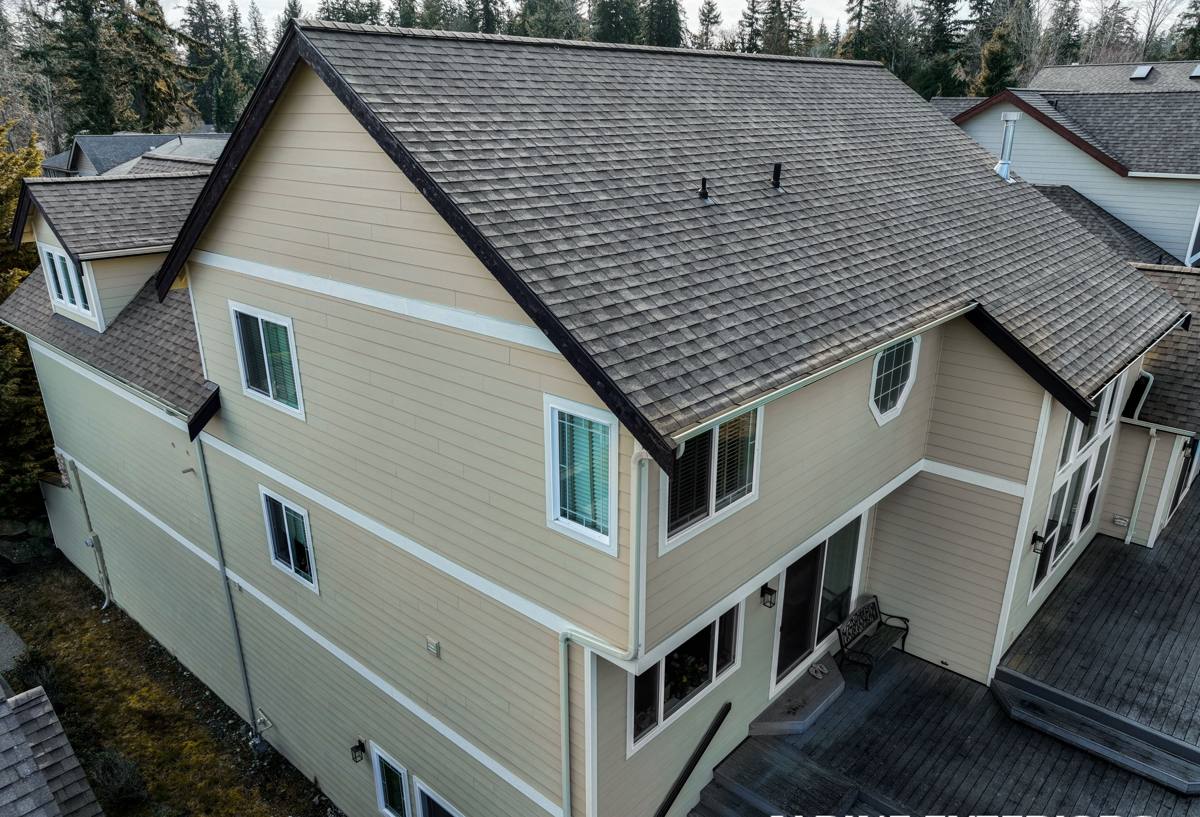
What Salt Air and Standing Moisture Actually Do to a Deck
Salt air is corrosive to anything metal that isn't rated for coastal exposure. Standard interior-grade screws, joist hangers, and hidden fastener clips will start showing rust streaks and pitting years before they would in a drier, inland yard. That corrosion weakens the connection long before it's visible from the surface, which is why the fasteners and hardware matter as much as the decking material itself on a March Point job.
Rain is the other half of the equation. Skagit County gets a steady volume of driving rain rather than short, hard downpours, and on a waterfront-adjacent property that moisture doesn't always evaporate quickly — humidity stays higher for longer, especially under the deck where airflow is limited. That combination of near-constant dampness and organic debris (fir needles, maple leaves, algae spores carried on the wind) is exactly what moss and mildew need to take hold. Any decking surface that traps moisture against the board, or any substructure that doesn't drain and dry between rain events, becomes a long-term moss and rot problem no matter what material sits on top.
Why Solid Wood Struggles Here
Traditional wood decking isn't a bad product, but it asks a lot of the homeowner in this specific climate. It needs to be cleaned, brightened, and resealed on a schedule most people don't keep up with, and once the sealer starts to fail, the board is absorbing rain faster than it can dry between storms. Over a few seasons that shows up as graying, splintering, cupping, and eventually soft spots. We still install wood decking when a homeowner specifically wants that look and understands the maintenance commitment — it's a legitimate choice, not one we discourage outright. But for most March Point properties, composite decking removes that maintenance burden almost entirely, which is the main reason it's become the more common request on this side of the county.
What a Correct Composite Install Involves
Composite boards themselves are engineered to resist moisture absorption, but the deck as a whole is only as good as everything underneath and holding it together. On every composite deck we build in this area, a few things are non-negotiable:
- Pressure-treated or coastal-rated framing lumber, sized and spaced to the manufacturer's specifications for the board being installed
- Stainless steel or coated/coastal-rated fasteners and joist hangers — not standard galvanized hardware, which corrodes faster in salt air
- Joist tape over every joist top to keep water from wicking into the framing where the board sits against it
- Proper board spacing and hidden fastener systems that allow water to drain through rather than pool on the surface
- Ventilation gaps at the deck perimeter and skirting so air can actually move underneath and dry the substructure out between rain events
- Ledger board flashing where the deck attaches to the house, sealed against wind-driven rain intrusion at the siding line
Skip any one of these and the composite boards can still look fine on the surface while the frame underneath is quietly failing. That's the failure pattern we see most often on older or budget-installed composite decks in this area — the boards outlast the substructure because the substructure wasn't built for the climate.
Choosing the Right Composite Board
Not all composite decking is built the same way, and the differences matter more in a salt-air, high-moisture environment than they would somewhere drier. The main distinction is between capped and uncapped composite boards.
| Feature | Capped Composite | Uncapped Composite |
|---|---|---|
| Moisture resistance | Sealed polymer shell resists absorption and staining | More porous surface, higher risk of moisture uptake over time |
| Moss/mildew resistance | Smoother, less porous surface is harder for organic growth to grip | More texture for spores and algae to establish on |
| Fading in coastal sun/salt exposure | UV-stable cap resists fading and chalking | More prone to graying and surface wear over time |
| Upfront cost | Higher per square foot | Lower per square foot |
| Long-term maintenance | Occasional soap-and-water rinse | Periodic cleaning and closer monitoring for surface wear |
We generally steer March Point homeowners toward capped composite for anything close to the water or exposed to direct wind off the bay, simply because the sealed surface holds up better against salt residue and the extended damp season. Uncapped composite is a legitimate lower-cost option for more sheltered yards, but we'll walk through the trade-off honestly for your specific lot rather than pushing one product across the board.
Our Installation Process
Every deck project follows the same general sequence, adjusted for the specific site conditions we find once we're on the ground:
- Site assessment — we look at drainage, sun/wind exposure, existing structure condition if it's a replacement, and how close the deck sits to salt water exposure or prevailing wind.
- Design and material selection — board style, color, and capped vs. uncapped decision based on exposure and budget, plus railing and fastener planning.
- Demolition (for replacements) — removing old decking and inspecting the ledger, posts, and footings for rot or corrosion before anything new goes up.
- Framing and substructure — coastal-rated lumber and hardware, correct joist spacing, ledger flashing, and joist tape as standard practice, not an upsell.
- Board installation — hidden fastener systems where the product supports it, correct expansion gaps, and attention to drainage slope so water sheds off the surface instead of pooling.
- Railing, stairs, and trim — matched to the board system and rated hardware throughout.
- Final walkthrough — checking fastener tightness, drainage, and ventilation gaps before we call the job done.
Substructure and Drainage on March Point Lots
Lot conditions around March Point vary — some properties sit close to grade with limited slope away from the house, others are elevated with a walk-under space beneath the deck. Both situations need deliberate drainage planning. On low-clearance decks, we pay close attention to grading beneath the structure so water doesn't sit and evaporate slowly against the framing, which is exactly the condition that breeds moss and mildew even on a composite surface. On elevated decks with usable space underneath, ventilation becomes the priority — skirting needs gaps or vents so the underside can dry between storms rather than trapping the same humid air for weeks at a time during our wetter months.
We also look at how close the deck sits to the water and prevailing wind direction. A deck that catches direct wind off Fidalgo Bay or Padilla Bay is going to see more salt deposit on the surface and hardware than one tucked behind the house or shielded by trees, and that affects both the board recommendation and how often we'd suggest rinsing the surface down.
Maintenance Through a Long Moss Season
Composite decking cuts the maintenance workload compared to wood, but "low-maintenance" isn't "no-maintenance," especially with a moss season that can stretch most of the year here. A simple seasonal routine keeps a composite deck looking and performing the way it should:
- Rinse the surface with a garden hose and mild soap a few times a year, more often if the deck sits under trees or catches direct salt spray
- Sweep off fir needles, leaves, and other organic debris regularly — it holds moisture against the board and gives moss spores something to grip
- Check railing posts, stair connections, and any exposed fasteners once a year for corrosion, especially if standard hardware was used instead of coastal-rated fasteners
- Keep gutters and downspouts near the deck clear so runoff isn't dumping extra water onto or under the deck surface
- Trim back overhanging branches that keep the deck surface shaded and damp longer than the rest of the yard
None of this requires sealing, staining, or sanding — that's the real advantage composite offers over wood in this climate. It just requires staying ahead of debris and organic growth rather than letting a full season build up untouched.
What Affects the Cost of a Composite Deck
Pricing on any deck project depends on several factors that are worth understanding before you request an estimate, so the number makes sense in context rather than feeling arbitrary.
| Factor | Why It Matters |
|---|---|
| Deck size and shape | Square footage and complexity (multiple levels, angles, curves) both drive labor and material |
| Board tier (capped vs. uncapped) | Capped composite costs more upfront but holds up better in salt air and wet conditions |
| Substructure condition | Replacing rotted framing or footings on an existing deck adds cost but isn't optional if the frame has failed |
| Height and railing requirements | Elevated decks need more structural work and code-compliant railing systems |
| Site access | Tight lots or waterfront access constraints can add time for material staging and equipment |
| Fastener and hardware grade | Coastal-rated stainless hardware costs more than standard galvanized but is the right call this close to the water |
We won't quote a job without walking the site, because the substructure condition and drainage situation on your specific lot change the scope more than the board choice alone. What we can tell you upfront is that we don't cut corners on hardware or framing to hit a lower number — that's exactly what leads to the substructure failures we get called to fix on other people's decks a few years down the road.
Why Local Experience on This Coastline Matters
A composite deck built to a generic specification will survive fine in a lot of climates. March Point isn't a generic climate. The combination of salt exposure, wind-driven rain, and an extended damp season means the difference between a deck that looks good for two years and one that holds up for decades often comes down to details that aren't obvious from a sales brochure — hardware grade, joist tape, ventilation gaps, and drainage slope. A crew that already works this specific stretch of Skagit County has already seen what fails here and builds around it from the start, rather than learning the lesson on your deck.
If you're weighing a new composite deck or replacing an aging wood deck in March Point, we're happy to walk the site, talk through board options honestly, and put together a straightforward estimate — no pressure, no upsell script. Use the form below to request your free estimate and we'll get back to you to schedule a time that works.