 Skagit County
 Why March Point Decks Wear Out Faster Than the Manufacturer's Warranty Suggests
March Point sits close to open water on more than one side, which means homes here take on a different kind of weather than a deck ten miles inland. Salt-laden air corrodes fasteners and connectors from the inside out, long before the visible wood or composite surface shows a problem. Driving rain off the water gets pushed sideways into ledger boards, stair stringers, and railing posts by wind that a more sheltered lot never sees. And because the surrounding tree cover and damp ground hold moisture late into spring, decks here spend more months of the year growing moss and algae than decks in drier parts of Skagit County.
None of that means a deck can't last on March Point — it means it has to be built with those specific conditions in mind, not built to a generic spec sheet and hoped for the best. Most of the deck failures we get called out for aren't dramatic. They're slow: a soft spot near the house where the ledger board has been trapping water for years, fasteners bleeding rust through the decking, or a railing post that flexes because the post base has been sitting in standing moisture since it was installed.
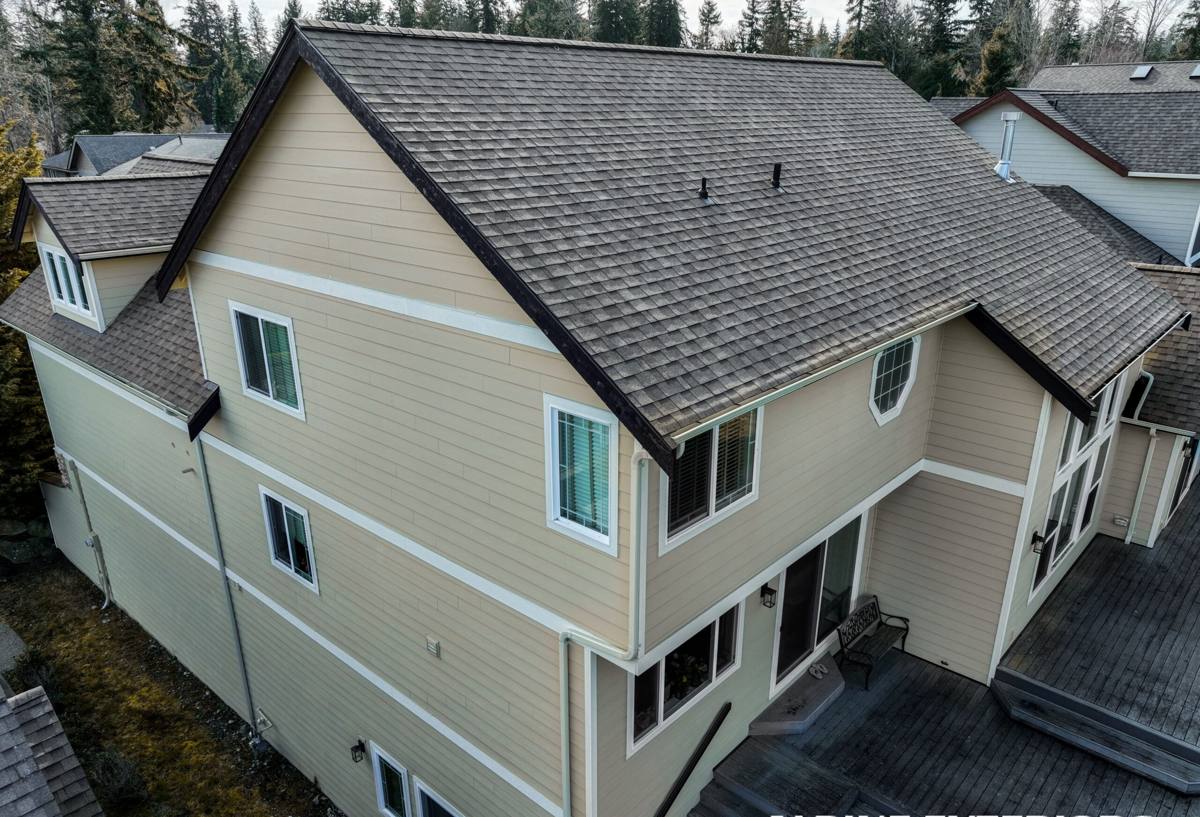
Signs a Deck Needs Replacement, Not Another Repair
Repair makes sense when the framing is sound and the problem is cosmetic or isolated. Replacement makes sense once the structure itself is compromised. Homeowners often ask us to just "fix the boards," and sometimes that's genuinely all that's needed — but on older decks near the water, the boards are rarely the real story.
- Soft, spongy, or bouncy spots underfoot, especially near the house or at stair landings
- Visible rust streaking from fastener heads or joist hangers
- Gaps opening up between the ledger board and the house siding
- Railing posts that wiggle when pushed, even slightly
- Persistent black or green staining that comes back within weeks of cleaning
- Wood that's soft or crumbly when probed with a screwdriver at ground contact points
If more than one or two of these apply, the framing underneath is usually further along in failure than the surface suggests. That's the point where patching individual boards is just delaying a full rebuild — and spending money on a repair you'll redo in two or three years.
What a Correct Deck Replacement Actually Involves
Substructure and Ledger Connection
The ledger board — where the deck attaches to the house — is the single most common failure point in this climate, because it's the one spot on the whole structure where wood, flashing, and the home's siding all meet at once. A correct install uses proper flashing that directs water away from the house rather than behind it, structural lag bolts or through-bolts rather than undersized fasteners, and a ledger board rated for ground or near-ground contact if it's close to grade. We also check and typically replace joist hangers and post bases, since galvanized hardware from a couple decades ago rarely holds up to sustained salt exposure the way current-generation coated or stainless hardware does.
Framing and Footings
Footings need to sit below frost depth and bear on undisturbed soil, and posts need proper post bases that keep the wood off standing water rather than buried in concrete or sitting directly on a footing where moisture collects. On a wet lot, this is usually the difference between a deck that's stable in ten years and one that starts to lean.
Decking Surface and Railings
Whatever surface material a homeowner chooses, it only performs as well as what's underneath it. We set fastener spacing and joist spacing to the manufacturer's spec for the specific decking product — composite and PVC boards typically need tighter joist spacing than solid wood to avoid sagging over time — and we use hidden fastener systems or coated screws rated for the material, not whatever's cheapest at the moment.
Comparing Decking Materials for a Salt-Air, High-Moisture Site
There's no single "best" decking material — there's a best fit for the site, the budget, and how much upkeep a homeowner actually wants to do. Here's how the common options stack up for a location like March Point specifically.
| Material | How It Handles Salt Air & Moisture | Maintenance | Typical Lifespan |
|---|---|---|---|
| Pressure-treated wood | Good if properly sealed and re-sealed on schedule; end grain and fastener holes are where rot starts | Annual cleaning, re-staining every 2-3 years | 15-20 years with upkeep |
| Cedar | Naturally rot-resistant, but still needs sealing near the water to prevent graying and moss uptake | Cleaning plus periodic oil or stain | 15-20 years with upkeep |
| Capped composite | Excellent — the cap resists moisture absorption and algae staining far better than wood | Occasional washing, no sealing or staining | 25-30+ years |
| PVC decking | Fully moisture-proof surface, least prone to moss growth of any option | Lowest — soap and water | 25-30+ years |
Wood costs less upfront and has a warmer look that some homeowners prefer, but it asks for consistent maintenance to hold up here — skip a season of sealing near the water and you'll see it. Composite and PVC cost more initially but largely remove moss and moisture absorption from the equation, which matters more on a site like this than on a sheltered inland lot.
Our Process, Start to Finish
Site Assessment
We start by getting under the existing deck, not just looking at the surface. That means checking the ledger connection, probing footings and posts, and looking at drainage around the base of the structure. This tells us honestly whether a repair is realistic or whether a full replacement is the better use of the budget.
Design and Permitting
Skagit County requires permits for most deck rebuilds, and depending on proximity to water, some March Point properties fall under additional shoreline or critical-area review. We handle the permit application and work within whatever setback or review requirements apply to the specific lot, rather than leaving that for the homeowner to sort out after the fact.
Build and Inspection
Demolition of the old deck, framing and footing work, then decking, railings, and stairs — with the required county inspections scheduled at the appropriate points rather than skipped. We don't cover framing before it's been signed off.
Final Walkthrough
Before we consider the job finished, we walk the deck with the homeowner, check that railings meet code height and spacing, and go over any maintenance the chosen material actually needs.
Keeping a New Deck Looking Good Through Skagit County Winters
Even a well-built deck needs a small amount of seasonal attention to stay ahead of moss and moisture — this is true regardless of which material is chosen, though the workload differs a lot by material as shown above.
- Sweep leaves and debris off the surface regularly in fall — trapped organic matter is what feeds moss
- Keep gutters and downspouts clear so runoff isn't dumping directly onto or near the deck
- Rinse the surface a couple of times a year to interrupt algae and moss buildup before it takes hold
- Check railing posts and stair connections once a year for any looseness
- Re-seal or re-stain wood decking on the schedule the product calls for — don't wait until it looks gray
- Keep planters and rugs elevated slightly or moved periodically so moisture doesn't pool underneath them
Why Hiring a Crew That Already Works March Point Matters
A lot of deck problems we see started with a build that wasn't wrong anywhere else in the state — just not matched to this specific environment. A crew that already works in Skagit County, and specifically on the peninsula, knows to spec hardware rated for salt exposure without being asked, knows which lots have drainage issues before digging a single footing, and knows the county's permitting and shoreline review process instead of learning it for the first time on your project. That local familiarity shows up less in the sales conversation and more in the parts of the build nobody sees once it's finished — the flashing detail at the ledger, the post base that keeps wood off standing water, the fastener spec that won't be bleeding rust in three years.
If your deck is showing any of the signs above, or you're just planning ahead rather than reacting to a problem, we're happy to take a look and give you a straightforward, no-pressure estimate — no obligation, just an honest read on what your deck actually needs. Use the form below to get started.