 Skagit County
 Why March Point Siding Has to Work Harder Than Most
March Point sits low and exposed on the Skagit County coastline, and that location shapes everything about how siding performs there. Homes on the point face a combination most inland Skagit County neighborhoods don't deal with year-round: salt-laden air blowing off the water, driving rain that hits walls sideways instead of falling straight down, and a moss season that can stretch from October well into spring. Siding that would hold up fine in a sheltered subdivision a few miles inland can start showing problems within a few years out here — peeling paint, swollen seams, dark streaking, soft spots at the bottom courses. None of that is bad luck. It's the predictable result of installing the wrong material, or installing the right material the wrong way, in a place that doesn't forgive shortcuts.
We work on homes across Skagit County, and March Point is one of the areas where we're most careful about material choice and installation detail, because the margin for error is smaller. This page walks through what that actually means in practice — not marketing language, just what a correct fiber cement siding job looks like on a house exposed to this kind of weather.
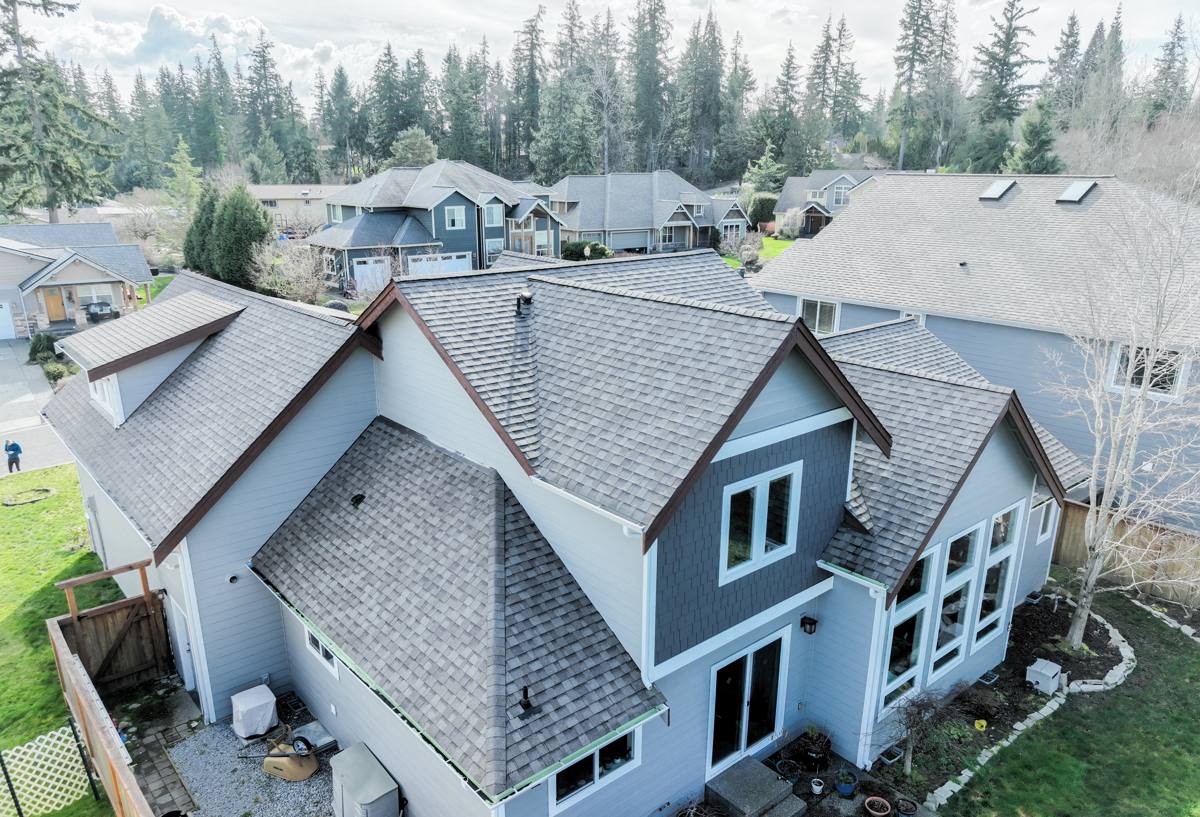
The Three Forces Wearing Down March Point Homes
Salt Air
Airborne salt is corrosive and it doesn't stay near the shoreline — wind carries it across yards, decks, and exterior walls well inland from the water. On siding, salt exposure accelerates the breakdown of cheap paint films, pits and corrodes exposed metal fasteners and trim, and speeds up general weathering on any material that isn't built to resist it. Over years, homes on exposed points like this one show the difference between a factory-applied finish designed for coastal exposure and a field-applied paint job that was never rated for it.
Driving Rain
Skagit County gets plenty of rain generally, but wind-driven rain off open water behaves differently than a straight-down shower. It gets pushed sideways into laps, seams, corner boards, and anywhere two pieces of siding or trim meet. If those joints aren't flashed, caulked, and lapped correctly, water finds its way behind the siding — and once moisture gets behind a wall system in a climate this wet, it rarely dries out fast enough between storms to avoid causing damage.
Moss and Sustained Dampness
Western Washington's long, cool, damp stretch of the year is ideal moss- and algae-growing weather, and north-facing or shaded wall sections on March Point homes often stay damp for days at a time. Moss holds moisture against a surface, and surfaces that stay wet longer age faster — paint fails sooner, wood-based products soften sooner, and any siding without inherent moisture resistance is fighting an uphill battle for most of the year.
Why We Install Only James Hardie Fiber Cement Siding Here
We don't install vinyl, LP SmartSide, primed spruce or cedar lap, or other fiber cement brands. We install James Hardie fiber cement siding exclusively, and on a site like March Point that decision isn't a brand preference — it's a direct response to the three forces above.
Fiber cement itself is a cement-based composite, not wood and not plastic, so it doesn't rot, doesn't attract wood-boring insects, and won't soften or delaminate the way engineered-wood products can when moisture gets past the surface. James Hardie specifically manufactures its siding with ColorPlus Technology, a factory-baked finish that's formulated and warranted to hold up against UV and weather exposure far longer than field-applied paint. On a home fighting salt air and driving rain, that factory finish is doing real work every day it's on the wall — it's not just about how the house looks when it's new.
James Hardie also engineers separate product formulations for different climate zones, rather than selling one generic mix everywhere in the country. That climate engineering, combined with a non-combustible, moisture-resistant substrate and a strong transferable warranty, is why we standardized on it instead of splitting our crew's expertise across several different siding systems.
The James Hardie Product Lines We Use in Skagit County
Not every Hardie product is used the same way on every wall. Here's how the main lines typically get applied on a Skagit County home:
| Product | Where It's Used | Why It Fits This Climate |
|---|---|---|
| HardiePlank Lap Siding | Primary wall covering, most of the home's exterior | Factory ColorPlus finish resists salt and UV; engineered lap profile sheds driving rain |
| HardiePanel Vertical Siding | Accent walls, gables, modern-style elevations | Fewer horizontal laps means fewer water-entry points on exposed faces |
| HardieShingle Siding | Gable accents, dormers, decorative sections | Individual shingle profile drains water quickly, resists moss buildup in shaded areas |
| HardieTrim Boards | Corners, window and door trim, fascia | Matches the substrate's moisture resistance so trim and field siding age together |
James Hardie also builds its siding to different HZ (Hardiezone) engineering specifications depending on climate — a wetter, cooler zone like ours gets a different formulation than a hot, dry zone. When we order material for a March Point job, we're specifying product engineered for a Pacific Northwest coastal climate, not a generic national blend.
What a Correct Fiber Cement Siding Install Actually Involves
Fiber cement siding is only as good as its installation. Most of the failures we get called out to inspect on other contractors' work trace back to a handful of installation shortcuts, not the material itself. A correct install on a home like this includes:
Tear-Off and Substrate Inspection
Old siding comes off down to the sheathing so we can actually see what's underneath — soft spots, past water damage, or framing issues that need to be addressed before new siding goes up. Covering over an existing problem just hides it behind a new wall.
Weather-Resistive Barrier and Flashing
A correctly lapped weather-resistive barrier, along with proper flashing at windows, doors, decks, and roof-to-wall intersections, is what actually keeps wind-driven rain from reaching the sheathing. The siding itself is the second line of defense, not the only one.
Fastening and Clearances
James Hardie publishes specific fastening patterns, nail types, and minimum clearances from grade, roof lines, and decks. Skipping these — nailing too close to the edge, fastening into the wrong layer, or leaving no gap at grade — is a common shortcut that shows up as cracking or moisture intrusion years later.
Joint Treatment and Caulking
Every butt joint, corner, and trim intersection needs to be treated correctly, whether that's a factory joint, a properly primed and caulked field cut, or a flashed and shingled overlap. On a house facing driving rain regularly, joint quality is often the difference between a wall that stays dry and one that doesn't.
Our Process, Start to Finish
- Free on-site inspection and estimate — we look at the existing siding, trim, and any visible moisture damage before quoting anything
- Written scope and product selection — profile, color, and trim details confirmed before ordering material
- Tear-off and substrate check — old siding removed, sheathing inspected, any damaged framing addressed
- Weather barrier and flashing installed correctly around every penetration and transition
- James Hardie siding, trim, and accessories installed to manufacturer specification
- Final walkthrough with the homeowner before we consider the job finished
What Fiber Cement Siding Costs to Install in Skagit County
Every home is different, and an accurate number only comes from an on-site look at square footage, current siding condition, trim complexity, and access. That said, a few factors consistently move the price up or down:
| Cost Factor | Why It Matters |
|---|---|
| Amount of tear-off required | Removing and disposing of old siding (especially multiple layers) adds labor beyond the new install |
| Substrate repair | Water-damaged sheathing or framing found during tear-off has to be fixed before new siding goes on |
| Home shape and trim detail | Gables, dormers, and multiple wall planes require more cutting, flashing, and labor time than a simple rectangular footprint |
| Siding profile mix | Combining lap siding with vertical panels or shingle accents adds material and labor variety |
| Site access | Multi-story sections, tight lot lines, or limited staging space affect crew efficiency |
We give straightforward, honest ranges once we've actually seen the house — not a phone-quote guess. Given the climate this material has to survive, we'd rather quote it accurately than lowball it and cut corners later.
Keeping March Point Siding Looking Right Between Installs
James Hardie siding is low-maintenance compared to wood or engineered-wood products, but "low-maintenance" doesn't mean "no maintenance," especially in a climate built for moss and salt buildup. A simple annual routine goes a long way:
- Rinse siding down once or twice a year to clear salt residue and general grime, especially on walls facing open water
- Check shaded, north-facing sections for early moss or algae growth and clean it off before it spreads
- Keep gutters clear so overflow doesn't run down and pool against siding at the roofline
- Trim back landscaping that keeps siding shaded and damp longer than it needs to be
- Inspect caulking at trim joints and penetrations every year or two and re-caulk where it's cracked or pulled away
- Walk the exterior after major windstorms to check for any loose or damaged panels near rooflines and corners
Why Hiring a Crew That Already Works This Coastline Matters
A contractor who mostly works inland, sheltered neighborhoods can do a technically fine install and still under-build for a site like March Point, simply because they're not used to accounting for salt exposure and sustained wind-driven rain in their flashing and fastening decisions. A crew that regularly works this stretch of Skagit County treats those factors as standard practice, not an afterthought — because we've seen what happens when they're skipped.
That local familiarity also shows up in smaller, practical ways: knowing which wall orientations on a point like this take the worst weather, sequencing work around the wetter months instead of fighting them, and recognizing early moisture damage during tear-off because we've seen the same failure patterns on other homes nearby.
If you're planning a siding replacement on a March Point home, we're happy to come take a direct look and walk you through what we'd recommend and why — no pressure, no obligation, just a straightforward assessment from a crew that already knows this coastline. Reach out for a free estimate using the form below.