 Skagit County
 March Point sits out on its own peninsula near Anacortes, surrounded by water on more than one side, which means the siding on a March Point home works harder than siding on a typical inland Skagit County property. Salt-laden air, rain that comes in sideways instead of straight down, and a moss season that can run most of the year on shaded walls all take a toll on exterior cladding faster here than they do a few miles inland. When siding on a March Point home starts to fail, it's rarely one single cause — it's usually this combination of exposures working on the same walls, year after year, until the material or the installation underneath it can't keep up anymore. Replacing that siding correctly, with the right material and the right details underneath it, is the single best thing a homeowner on the peninsula can do for the long-term health of the house.
What Salt Air, Driving Rain, and Moss Season Do to Siding Here
Salt air is corrosive. It accelerates the breakdown of fasteners, flashing, and any coating that isn't built to handle sustained exposure, and on a peninsula like March Point that exposure doesn't let up the way it might on a sheltered inland lot. Driving rain — wind-driven rain pushed sideways into a wall rather than falling straight onto a roof — is common in this part of Skagit County, and it tests the water-resistant barrier behind the siding in a way that calm, straight-down rain never does. Any gap, any poorly lapped joint, any spot where the barrier wasn't properly integrated with a window, door, or penetration becomes a path for moisture to get behind the cladding.
Moss adds a third layer to the problem. Shaded, north-facing, or tree-adjacent walls around Skagit County hold moisture longer than sun-exposed walls, and moss that's allowed to establish itself on or near siding keeps that moisture pressed against the material instead of letting it dry out between storms. Older siding, or siding that was installed without attention to drainage and clearance, tends to show the combined effect of all three factors first — fading and chalking from UV and salt exposure, soft spots or swelling where moisture has gotten behind panels, and dark staining or growth in the shaded corners of the house.
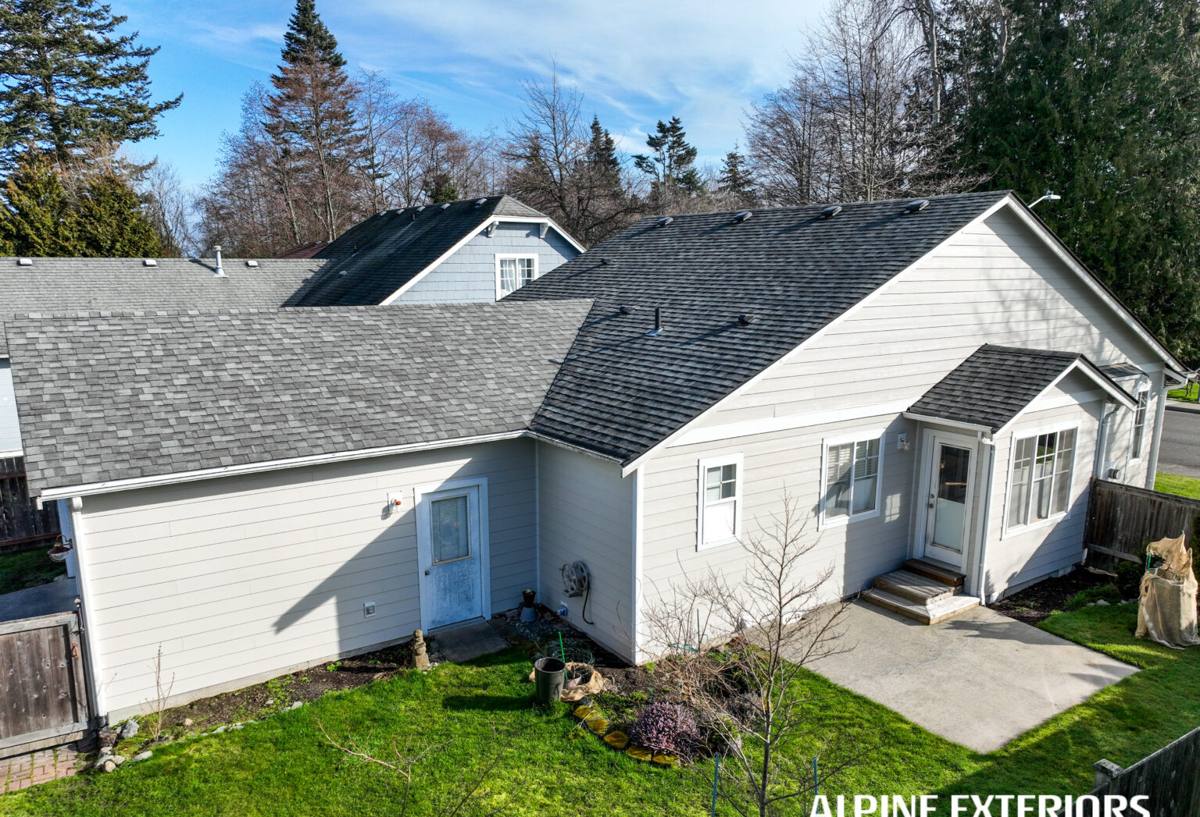
Signs a March Point Home Needs Replacement, Not Just Repair
Not every siding problem on the peninsula calls for a full tear-off. A cracked panel, a section of caulk that's failed, or isolated fastener corrosion can often be repaired without replacing the whole wall. But there's a point where patching stops making sense, and recognizing that point early saves money over waiting until the damage spreads.
What Usually Points Toward Full Replacement
- Soft, spongy, or visibly swollen siding in more than one location, which usually means moisture has been getting behind the material for a while
- Widespread fading, chalking, or finish breakdown across multiple walls rather than one isolated section
- Repeated moss or algae growth returning within a season or two of cleaning, especially on shaded walls
- Warping, cupping, or panel separation at seams and corners, which points to a failing water-resistant barrier underneath
- Siding that's original to a home built more than 20-25 years ago, especially if it's a wood-based or vinyl product not engineered for this kind of coastal exposure
If a house is only showing one or two of these signs in a contained area, a repair is often the right call, and we'll say so. If several of them are showing up across the exterior, the underlying material or the original installation is telling you something, and a targeted repair usually just delays a bigger job down the road.
Why We Replace Siding With James Hardie Fiber Cement Only
We install James Hardie fiber cement exclusively for siding replacement, and a peninsula property is a good example of why. Fiber cement doesn't have an organic core for moisture to work into over time, so it doesn't swell, rot, or delaminate the way wood-based products can when water gets past the surface. It doesn't rust the way exposed metal components can in salt air, and it isn't prone to the brittleness and fading that vinyl develops under years of UV and salt exposure. Hardie's ColorPlus finish is baked on at the factory under controlled conditions rather than applied on-site, which matters on a property that's going to see more weather cycles per year than a sheltered inland home — that finish holds its color and resists cracking longer than field-applied paint typically does, and it's backed by its own manufacturer warranty. Hardie also builds region-specific HZ product lines engineered for higher-moisture climates like this one, rather than a single generic formulation sold everywhere in the country.
Why We Don't Install Vinyl, LP SmartSide, or Primed Wood on March Point Homes
We get asked about cheaper alternatives regularly, and we understand the appeal — they cost less upfront. We still don't install them on the peninsula. Vinyl becomes brittle with age under sustained UV and salt exposure and relies entirely on the barrier behind it to keep water out, since the vinyl itself isn't a true water-management layer. Engineered wood products like LP SmartSide use a wood-strand core that's vulnerable wherever a field cut or fastener penetration isn't primed and sealed exactly right, every time — a real risk in a wind-driven-rain environment where every wall takes on more water cycles than average. Primed wood siding needs a regular repainting schedule and swells or rots quickly if that maintenance lapses even briefly. None of these are indefensible products in every market, but on an exposed site like March Point, we don't think they're the right call for a homeowner who wants a replacement that lasts.
What a Correct Replacement Job Actually Involves
The siding itself is only part of what determines whether a replacement lasts. Most of the failures we see on older March Point homes trace back to what was done — or skipped — underneath the old siding, not to the cladding material alone. A correct replacement addresses the whole wall assembly, not just the visible surface.
| Step | Why It Matters Here |
|---|---|
| Full removal of old siding and inspection of sheathing | Reveals hidden rot or moisture damage before it's covered up again — common on older peninsula homes with years of wind-driven rain exposure |
| Repair or replacement of damaged sheathing | New siding installed over compromised sheathing fails early no matter how good the cladding is |
| New weather-resistant barrier, properly lapped | The primary water-management layer behind the siding — critical in a driving-rain environment |
| Flashing at windows, doors, and penetrations | The most common failure point on exposed homes; correct flashing directs water out and away instead of into the wall |
| Corrosion-resistant fasteners and hardware | Standard-grade fasteners degrade faster in salt air; marine-rated hardware holds up over the life of the siding |
| Fiber cement installed to manufacturer spec | Proper clearance from grade and roofline, correct fastening pattern, and sealed joints determine long-term performance and keep the warranty intact |
Our Siding Replacement Process
Every March Point project starts with an on-site look at the house, not a phone estimate. From there, the process generally follows the same sequence:
- Inspection and estimate — we walk the exterior, note problem areas, and give a straight assessment of what the house actually needs, whether that's full replacement or something less.
- Tear-off and sheathing check — old siding comes off and the sheathing underneath gets inspected before anything new goes up, so hidden damage doesn't get sealed behind a new wall.
- Repairs where needed — any compromised sheathing or framing gets addressed before the new water-resistant barrier goes on, not patched around.
- Barrier and flashing installation — a new weather-resistant barrier and properly integrated flashing at every window, door, and penetration, since this is what actually keeps water out over the life of the siding.
- Fiber cement installation — James Hardie siding installed to manufacturer specification, with corrosion-resistant fasteners appropriate for a coastal site.
- Trim, caulking, and finish detail — the details that determine how the finished job looks and how well it sheds water at every joint and corner.
- Final walkthrough — we go over the finished work with the homeowner before calling the job done.
Why Hiring a Crew That Already Works March Point Matters
March Point doesn't see the volume of contractor traffic that busier parts of Skagit County do, and that can mean homeowners here end up with a crew that's more used to sheltered, inland installs than to a site taking on salt air and wind-driven rain from open water. A crew that regularly works the peninsula already knows which walls take the worst weather, what an early-failure install actually looks like on a nearby house, and which flashing and clearance details matter most given how exposed a given wall is. That knowledge doesn't show up in a sales pitch, but it shows up in whether the job still looks and performs the way it should five and ten years later.
What to Check Before You Hire for Siding Replacement Here
- Ask whether the contractor does a full tear-off and sheathing inspection, or just installs new siding over the old wall assembly
- Confirm what fasteners and hardware are used, and whether they're rated for coastal or marine-level salt exposure
- Get specifics on how window, door, and penetration flashing is handled — this is where most long-term leaks start
- Ask for the manufacturer's warranty terms in writing, along with the contractor's own workmanship warranty
- Confirm the contractor is licensed, bonded, and insured to do exterior work in Washington
- Ask how many projects they've done specifically on March Point or similarly exposed Skagit County properties, not just siding jobs in general
What This Means for Your Home
Every house on March Point sits a little differently relative to wind, water, and sun exposure, and the right scope of work depends on the specific property — its age, orientation, and the actual condition of what's on the walls now. We're not going to sell a full replacement if a targeted repair will genuinely hold up, and we're not going to install anything other than James Hardie fiber cement, because we don't think anything else is the right call for a peninsula exposure like this one. If your siding is showing its age, or you just want an honest read on how much life it has left, we're happy to take a look.
If you'd like a free, no-pressure estimate on siding replacement for your March Point home, reach out through the form below. We'll walk the property, tell you what we actually see, and give you a straight answer — no pressure either way.