 Skagit County
 Windows Built for the Skagit Valley, Not Just "Standard" Weather
Mount Vernon sits in a part of Skagit County that gets hit from two directions at once: marine air moving in off Puget Sound and Padilla Bay, and long stretches of driving rain that roll up the valley off the water. Add in a moss season that can run from late fall through early spring, and you've got a climate that's genuinely harder on windows than most manufacturers' spec sheets assume. Off-the-shelf, big-box windows are built to a national average. Custom windows are built, sized, and sealed for the house and the weather actually in front of it.
That distinction matters more in Mount Vernon than it does in drier parts of the state. Wind-driven rain doesn't just hit a window head-on — it gets pushed sideways and upward into gaps that would never leak in a calm rain. Salt-tinged, moisture-heavy air accelerates corrosion on hardware and finishes that aren't rated for it. And moss doesn't just grow on roofs; it takes hold in window sills, tracks, and any wood trim that stays damp too long. A correct window job here accounts for all of that before the first piece of glass ever gets set.
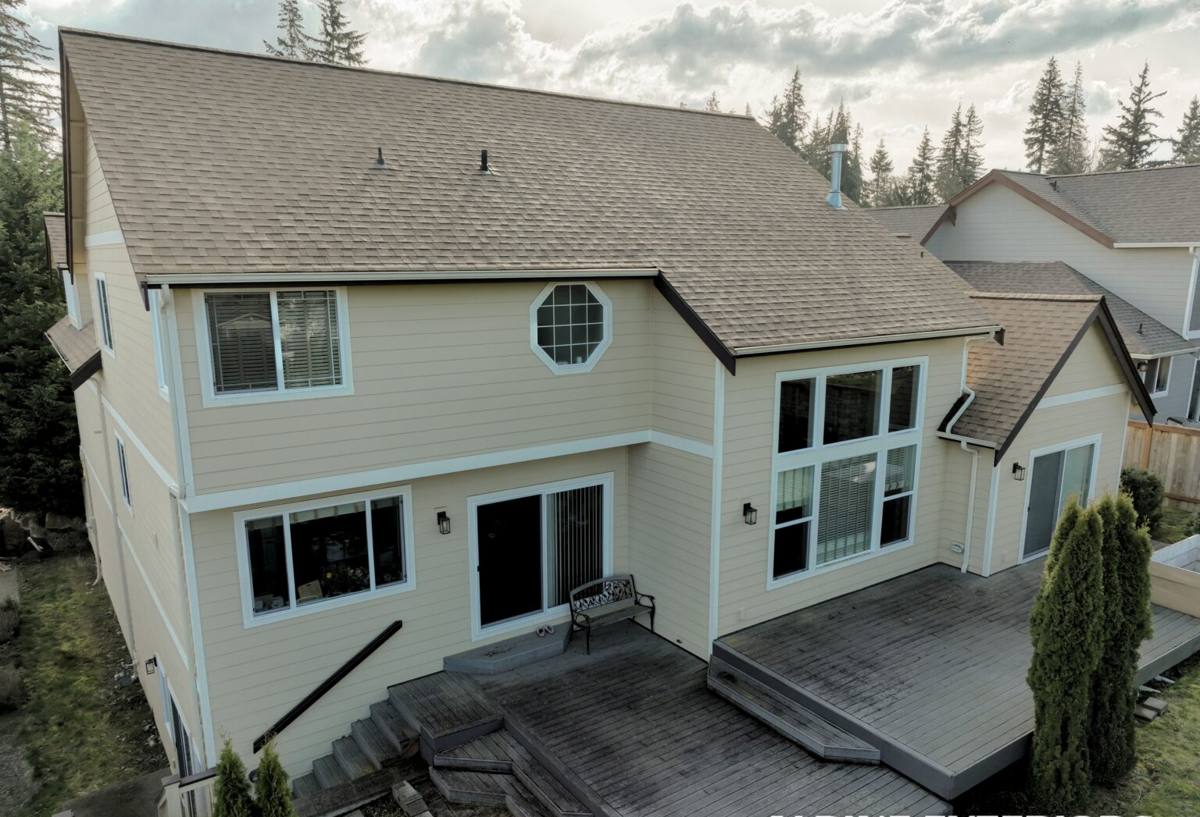
What "Custom" Actually Means
"Custom windows" doesn't mean fancy shapes or a showroom upgrade — it means the window is made to the exact opening in your house rather than forced to fit a stock size. That matters for two reasons specific to this area:
- Older Mount Vernon homes — especially those closer to downtown and the river valley — often have openings that have shifted slightly over decades of settling and moisture cycling. Stock sizes leave gaps that get packed with foam and trim and called "done." That's exactly where wind-driven rain finds its way in.
- Newer construction and additions still benefit from custom sizing because it lets us match sightlines, sill height, and trim profile across a whole elevation, so a replacement doesn't look like a patch job from the street.
Custom also means choosing the right frame material, glass package, and flashing detail for that specific wall — not applying the same spec to every window on the house regardless of exposure. A window on the weather side of a house facing open fields or water frontage needs a different sealing and flashing approach than one tucked under an eave on the leeward side.
Signs Your Current Windows Are Losing the Fight
Most window failures in this climate show up slowly, as moisture problems rather than obvious breaks. Here's what we look for on inspections around Mount Vernon:
- Fogging or a milky haze between the panes — the seal has failed and the gas fill (or just dry air) has been replaced by humid outside air
- Soft or spongy wood at the sill or bottom corners of the frame — a sign moisture has been sitting there through more than one wet season
- Visible moss, algae, or dark streaking on the sill, frame, or exterior trim
- Drafts you can feel with a hand near the frame on a windy, rainy day, even with the window latched
- Hardware — locks, cranks, hinges — that's stiff, corroded, or won't latch tight anymore
- Paint or finish that's bubbling, peeling, or chalking faster on window trim than on the rest of the siding
- Interior condensation on the glass or sill during cold snaps, even when the rest of the house feels dry
Any one of these on its own might just mean a caulking touch-up. Two or three together, especially on the same window, usually means the unit itself is done and patching it is just delaying a bigger repair.
Why Waiting Costs More Here Than Elsewhere
In a drier climate, a failing window seal is mostly a comfort and energy-bill issue. In Skagit County's wet season, a failing seal is a moisture-intrusion issue — and moisture that gets behind trim or into framing during our long rainy stretch doesn't get a chance to dry out before the next storm comes through. That's how a $30 caulking problem turns into a rot repair a couple of years later.
Frame Material Comparison for This Climate
| Material | How It Handles Wet, Salty Air | Maintenance | Typical Fit |
|---|---|---|---|
| Vinyl | Won't rot or corrode; performs consistently in coastal moisture | Low — occasional cleaning, no repainting | Most homes, especially where budget and low upkeep matter most |
| Fiberglass | Excellent moisture and temperature stability, holds paint well | Low to moderate | Homes wanting a wood-like look with less long-term risk |
| Wood (clad or unclad) | Needs careful detailing and upkeep to avoid moisture and moss issues at the sill | Higher — finish maintenance, sill inspection each season | Historic or period-detail homes where the look is the priority |
| Aluminum | Prone to condensation and corrosion in this level of moisture unless thermally broken | Moderate | Limited use — mainly where sightline demands are very specific |
We'll be straightforward about this: in Skagit County's climate, we lean toward vinyl and fiberglass for most replacements because they hold up with far less ongoing attention. If you want a wood window's appearance, a clad wood or wood-look fiberglass option can get you there without taking on the sill-rot risk of unclad wood exposed to this much seasonal moisture. That's a trade-off we'll walk through honestly rather than push whatever's easiest to sell.
Glass and Sealing Choices That Matter Locally
The frame is half the job. The glass package and how the unit is sealed into the wall is the other half, and it's where a lot of cheaper installs cut corners.
- Double vs. triple-pane: Double-pane with a good low-E coating handles Mount Vernon's temperature swings fine for most homes. Triple-pane earns its cost on north- or west-facing walls that catch the worst of the wind and rain, or for homeowners prioritizing sound and heat retention through the wet, gray months.
- Low-E coatings: Cut down on heat loss during cold, damp stretches and reduce interior condensation risk — a real issue in a climate this humid.
- Warm-edge spacers: Keep the seal at the edge of the glass performing longer in constant damp conditions instead of failing early, which is the single biggest cause of the "foggy window" problem.
- Flashing and sill pan detailing: This is the part homeowners never see and cheap installs skip. A properly integrated sill pan and flashing sequence is what actually stops wind-driven rain from getting behind the window frame — not just caulk around the outside edge.
Our Installation Process
- On-site assessment — We check every opening for existing moisture damage, out-of-square framing, and exposure direction before recommending anything.
- Custom measurement — Each window is measured to its actual opening, not a nearest-stock-size approximation.
- Material and glass selection — Based on that specific wall's sun and weather exposure, not a blanket spec for the whole house.
- Removal and inspection — Old units are removed carefully so we can inspect the framing underneath for rot or moisture damage before it gets covered up again.
- Flashing and sill pan installation — Done correctly the first time, integrated with the existing siding and building paper or house wrap.
- Window setting and shimming — Leveled, squared, and secured per manufacturer spec.
- Sealing and insulation — Proper low-expansion foam and sealant at the perimeter, not just a bead of caulk.
- Interior and exterior trim — Finished to match the home, with attention to sill slope so water sheds away from the frame.
- Final walkthrough — Every window opened, closed, and locked in front of the homeowner before we call the job done.
Common Situations We See Around Mount Vernon
A lot of the homes we work on fall into a few recurring categories. Older homes in and around the older parts of Mount Vernon often have single-pane or early dual-pane windows original to the house, with wood sills that have taken decades of seasonal moisture. Homes on larger lots out toward the farmland and river valley tend to catch more direct wind and rain with fewer windbreaks nearby, which puts extra demand on flashing and seal quality. And homes in newer developments sometimes have builder-grade windows that were installed to a budget rather than to this specific climate — they're not old, but they weren't necessarily built for the long wet season either.
None of that requires guessing or generic advice — it just means an honest look at your specific windows and walls before recommending a fix.
Cost Factors to Expect
| Factor | How It Affects the Estimate |
|---|---|
| Number and size of openings | Larger and more windows increase material and labor cost directly |
| Frame material | Vinyl is typically the most budget-friendly; fiberglass and wood cost more upfront |
| Glass package | Triple-pane and upgraded low-E coatings add cost but reduce long-term energy and condensation issues |
| Existing damage | Rot or moisture damage found during removal adds repair scope before the new window goes in |
| Access and site conditions | Second-story windows, tight lots, or difficult access can add labor time |
| Trim and finish work | Matching existing interior trim or exterior siding detail adds finishing labor |
We'll never hand you a number before actually looking at your windows — anyone quoting a firm price sight unseen is guessing, and guesses go wrong in both directions.
Why a Locally Established Crew Makes a Real Difference
Window installation isn't just carpentry — it's water management. A crew that already works throughout Skagit County knows how wind-driven rain actually behaves on homes in this valley, what sill details hold up through a full wet season, and where builder-grade shortcuts tend to fail first. That's not something you can fully substitute with a general how-to guide or a crew unfamiliar with this specific mix of salt air, rainfall, and moss. Being local also means we're reachable if something needs a look after the install — not a call center for a company that installed windows here once and moved on.
If your windows are showing any of the signs above, or you're planning ahead for a remodel, we're happy to take a look and give you a straight answer — no pressure, no upsell script. Reach out for a free estimate using the form below, and we'll walk your home's windows with you in person.