 Skagit County
 Clear Lake's Climate Is Harder on Siding Than It Looks
Clear Lake sits inland from the saltwater shorelines that get most of the attention in Skagit County siding conversations, but the lake itself creates its own version of the same problem: persistent moisture. Mature evergreen cover ties up humidity at ground level, lake-effect dampness keeps north- and east-facing walls from drying out between storms, and the long stretch of gray, drizzly months from fall through spring means siding here rarely gets a real chance to dry completely. Add in the driving rain that blows through the valley during winter storms, and even homes tucked well back from open water end up dealing with the same wood rot, moss growth, and paint failure that coastal Skagit County properties fight every year.
Lake-facing lots add another wrinkle. Homes built into a slope toward the water often have one or two walls that sit in near-constant shade from the tree line, while the water-facing side gets full sun and wind exposure. That mismatch means one wall can be bone dry while the other is still damp from a storm two days earlier, and a siding system that can't handle both conditions on the same house is going to show uneven wear within a few years.
The result is a local climate that punishes any siding product or installation detail that traps water instead of shedding it. That's the lens we use on every Clear Lake project: not "what looks good going up," but "what still looks good and still keeps water out in year fifteen."
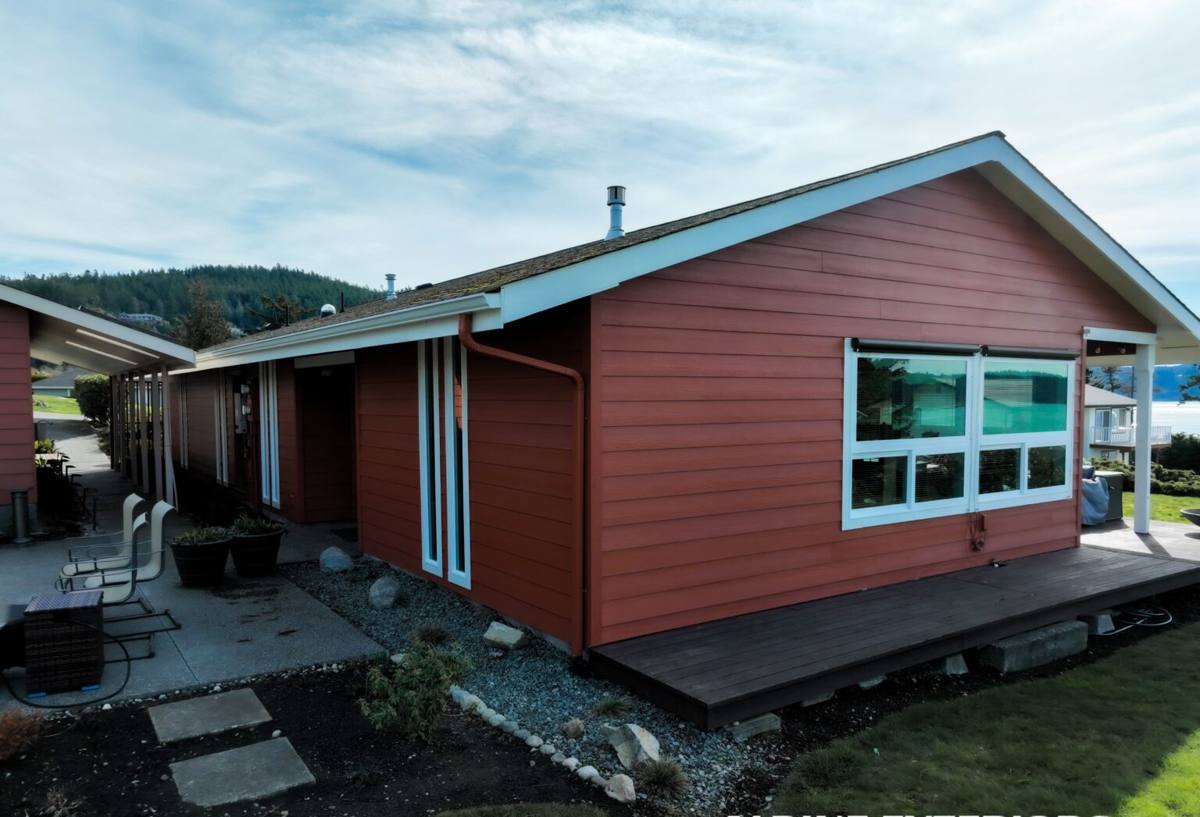
What We See on Clear Lake Homes
Every neighborhood has its own siding failure patterns, and Clear Lake's are pretty consistent once you've worked enough properties out here:
- Moss and algae staining concentrated on shaded, north-facing walls near tree lines, where surfaces stay damp longest
- Soft, delaminating trim and corner boards on older wood or engineered wood siding, especially near ground level and under gutters
- Paint that's failing years ahead of schedule because the substrate underneath is holding moisture
- Vinyl siding that's warped, faded, or pulled loose from expansion and contraction cycles
- Caulk joints that have shrunk and cracked, giving wind-driven rain a path behind the cladding
None of these are cosmetic issues by the time a homeowner notices them. They're almost always a sign that moisture has already been working behind the siding for a while, and the fix is rarely a patch — it's a full reassessment of the wall assembly.
Why We Only Install James Hardie Fiber Cement
We don't offer vinyl, LP SmartSide, cedar, primed spruce, or other fiber cement brands, and that's a deliberate call rather than a limitation. Each of those products has real strengths, but each also comes with a trade-off — moisture sensitivity in engineered wood, expansion and warping in vinyl, ongoing refinishing demands in natural wood — that shows up faster in a climate like Skagit County's than it does in drier regions.
James Hardie fiber cement is engineered specifically for this kind of moisture load. It's non-combustible, it doesn't swell or rot the way wood-based products can, and its ColorPlus factory finish is baked on under controlled conditions rather than field-applied, which means better adhesion and color retention through repeated wet-dry cycles. Hardie also builds region-specific HZ product lines, and the HZ5 formulation used in the Pacific Northwest is engineered around exactly the freeze-thaw and moisture exposure profile Skagit County sees. That's the version we install.
Hardie also backs its products with a strong, transferable warranty, which matters more than it might seem on a lake property. If the home sells down the road, that warranty coverage can pass to the next owner rather than resetting, which is a real point of value in a market where buyers are increasingly asking about siding age and condition.
None of this makes fiber cement maintenance-free. It still needs to be installed correctly, caulked correctly, and painted or touched up over time like any exterior product. But it gives a Clear Lake home a much longer runway before moisture becomes a structural problem instead of a cosmetic one.
What a Correct Installation Actually Involves
The Drainage Plane and Rainscreen Gap
Siding is the visible layer, but the water-resistive barrier underneath it is what actually keeps a wall dry. On every installation we lap and seal the WRB correctly, then build in a rainscreen gap behind the Hardie boards using vertical furring strips. That gap lets any moisture that gets past the cladding drain and evaporate instead of sitting against the sheathing — which matters a lot more in a shaded, humid microclimate like Clear Lake's than it would somewhere drier.
Flashing at Every Penetration
Windows, doors, hose bibs, light fixtures, and vents are where wind-driven rain finds its way behind siding. Each one gets proper head flashing and integration with the WRB before a single board goes up. This is the detail that separates a siding job that holds up for decades from one that starts leaking behind the walls within a few wet seasons.
Fastening, Clearances, and Joints
Hardie's installation manual specifies fastener type, spacing, and placement, along with minimum clearances from grade, roof lines, and decks. We follow that spec exactly — not because it's a formality, but because those clearances are what keep splashback and standing water away from the bottom edge of the siding, which is the first place moisture damage typically shows up.
How Our Process Works
| Stage | What Happens |
|---|---|
| Inspection | We walk the exterior, check for existing moisture damage, and assess sun/shade exposure on each wall |
| Tear-off and prep | Old siding and trim come off; sheathing is inspected and repaired before anything new goes on |
| Weather barrier and rainscreen | WRB is installed and sealed, furring strips create the drainage gap |
| Flashing and trim | Windows, doors, and penetrations are flashed before siding installation begins |
| Hardie installation | Boards, panels, and trim are installed to manufacturer fastening and clearance specs |
| Final detailing | Caulking, touch-up painting where needed, and a final walkthrough |
We don't skip stages to save a day, and we don't cover up sheathing problems instead of fixing them. On a lake-adjacent property where shade and moisture are already working against the siding, cutting corners at the prep stage is exactly how a ten-year-old installation ends up looking twenty years old.
Comparing Siding Options for a Clear Lake Property
| Material | Moisture & Moss Resistance | Fire Rating | Maintenance | Typical Lifespan |
|---|---|---|---|---|
| James Hardie fiber cement | Strong — non-combustible, dimensionally stable, ColorPlus resists staining | Non-combustible | Periodic gentle washing, occasional caulk/paint touch-up | Multiple decades with correct install and upkeep |
| Vinyl | Can warp or expand with temperature swings; seams can let moisture behind panels | Combustible | Low, but limited repair options if damaged | Variable, shorter under harsh sun/cold cycling |
| LP SmartSide (engineered wood) | Vulnerable to swelling and edge damage if moisture reaches the substrate | Combustible | Requires diligent caulk and paint maintenance | Shorter if moisture management lapses |
| Cedar / primed spruce | Natural wood — absorbs moisture, prone to rot and moss without upkeep | Combustible | High — regular refinishing and inspection needed | Shorter without consistent maintenance |
This isn't a claim that other materials are unusable — plenty of homes around the country wear them fine. It's a statement about which product holds up best against this specific combination of shade, humidity, and driving rain, which is why it's the only one we put our name on.
What Drives Cost on a Project Like This
Every Clear Lake home is a little different, and cost follows the details rather than a flat rate. The biggest factors are the square footage of wall area, how many stories the home has, and how much trim, corner detail, and architectural feature work is involved. Removal complexity also matters: tearing off old fiber cement is straightforward, while stripping multiple layers of old vinyl or repairing rotted sheathing underneath takes more time and changes the scope once we're into the wall. Sloped, lake-facing lots can also add a bit to access and staging compared to a flat, street-facing lot. We walk through all of this during the estimate so there aren't surprises once work starts.
Signs a Clear Lake Home May Need New Siding
- Soft spots when you press on siding or trim, especially near the bottom edge or under windows
- Persistent moss or dark staining that comes back within a season of cleaning
- Paint that's peeling, bubbling, or failing faster than it should
- Visible warping, buckling, or gaps at panel seams
- Rising energy bills that suggest the wall assembly isn't sealing the way it used to
- Interior signs like musty smells or discoloration on walls that share an exterior wall line
Living With Fiber Cement in a Moss-Prone Area
Correct installation solves most of the moisture problem, but ongoing care still matters, especially on shaded lots near mature trees. A gentle wash on a normal schedule keeps moss and algae from establishing on north-facing walls. Keeping gutters clear and directing downspout discharge away from the foundation reduces splashback onto the lowest courses of siding. And a periodic walk-around to check caulking at trim and penetrations catches small gaps before they become entry points for wind-driven rain. None of this is heavy maintenance — it's the same kind of upkeep any exterior surface needs in a wet climate — but skipping it is how even good materials underperform.
Why Local Experience Matters for This Job
Skagit County isn't a uniform climate. A wall that faces open water handles differently than a shaded wall backed up against timber near Clear Lake, and a crew that's only worked drier inland regions can miss those distinctions. Knowing which walls need the most attention to drainage detailing, how the county's permitting and inspection process works, and how HZ5-rated products actually perform through a full Skagit County winter comes from doing this work here repeatedly, not from a manufacturer's install guide alone. It also means fewer surprises with permitting and inspection timelines, since a crew that regularly pulls permits in the county already knows what the process expects. That local pattern recognition is a big part of what keeps a siding installation performing the way it's supposed to, years after the crew has moved on to the next job.
If you're weighing a siding project on a Clear Lake property, we're glad to walk the exterior with you, point out what we're seeing, and put together a straightforward, no-pressure estimate. There's a form below to get that conversation started.