 Skagit County
 Conway's Climate Puts Real Demands on Exterior Siding
Conway sits low in the Skagit River delta, close enough to Puget Sound and the Skagit Bay tideflats that salt-laden air is a constant companion to anything installed on the outside of a house here. Add in the long, wet Skagit County winters, driving rain that comes sideways off the water during storms, and a moss season that can stretch from October through April, and you have a climate that is genuinely harder on siding than most inland parts of Washington. Homes in and around Conway don't just get rained on — they sit in humid, saturated air for months at a stretch, and whatever is on the exterior walls has to shed that moisture instead of holding onto it.
This matters more than most homeowners realize when it's time to replace siding. A product that performs fine in a drier climate can fail early in Conway's conditions — not because it was installed badly, but because it was never engineered for this kind of sustained moisture and salt exposure. That's the starting point for every siding replacement conversation we have with Conway homeowners: what does this specific site need, not what's generic advice for "the Pacific Northwest."
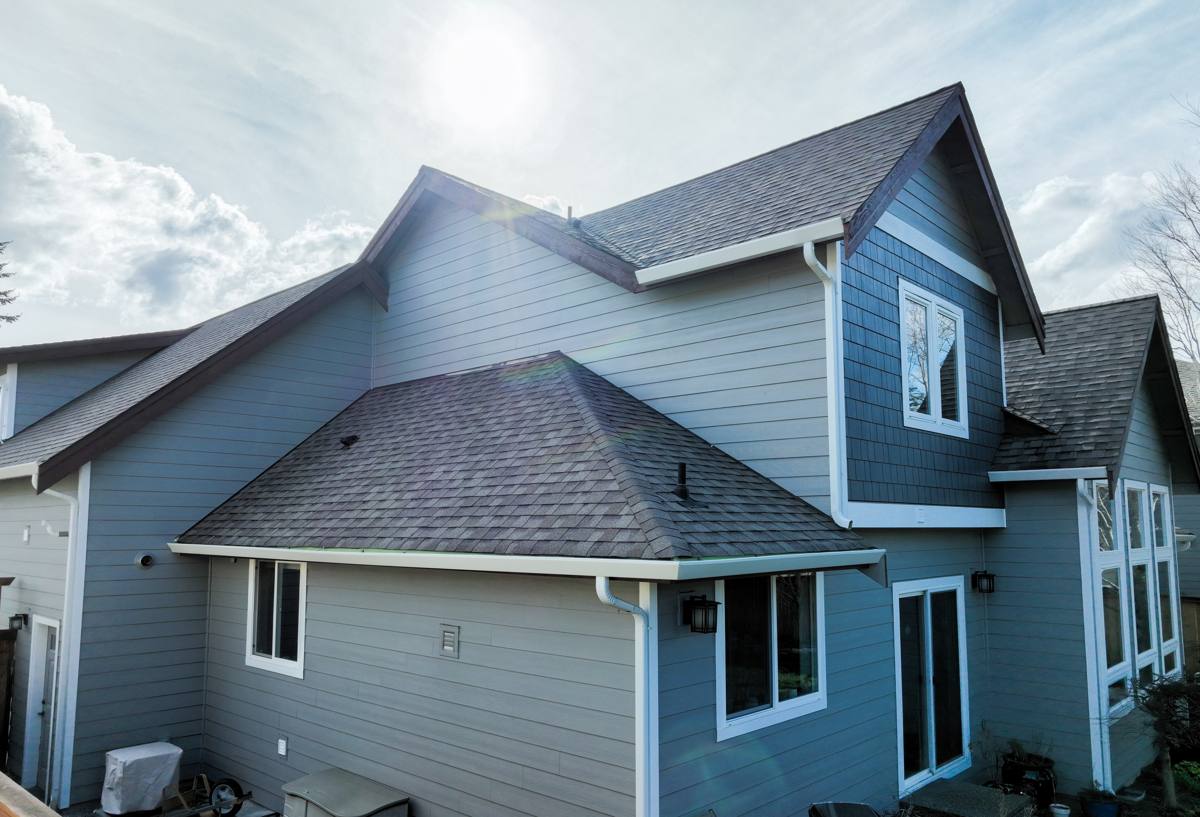
How to Tell a Conway Home Actually Needs Siding Replacement
Not every tired-looking exterior needs full replacement. Some issues are cosmetic and some are structural, and telling the difference is the first job of any honest estimate. Signs that point toward replacement rather than repair or repaint include:
- Soft or spongy spots when you press on siding, especially near the bottom courses and around window and door trim
- Visible warping, buckling, or panels pulling away from the wall
- Persistent moss or dark streaking that returns within a season or two of cleaning
- Paint that won't hold — blistering, peeling, or chalking faster than a normal repaint cycle
- Soft trim boards or rot visible at corner boards, window sills, and the bottom of wall sections
- A musty smell or visible staining on interior walls that back up to exterior siding
In Conway specifically, we see the bottom two or three feet of a wall fail well before the rest of the siding, because that's where splashback, moisture from the ground, and standing dampness concentrate. If that's the only area showing damage, it's worth having someone look at whether it's isolated water intrusion versus a sign the whole assembly is past its service life.
What a Correct Siding Replacement Actually Involves
Siding replacement is not just swapping old boards for new ones. Done right, it's a full rebuild of the wall's weather barrier system, and skipping steps here is exactly why some replacements fail again within a handful of years — a real risk in a climate like Conway's where mistakes get punished fast.
Full Tear-Off and Inspection
We remove the old siding down to the sheathing so we can actually see what's underneath. This is the point where hidden rot, past water intrusion, or damaged sheathing gets found and dealt with — not covered over. Any soft or compromised sheathing gets replaced before anything new goes back up.
Weather-Resistive Barrier
A new, correctly lapped weather-resistive barrier goes over the sheathing. In a high-moisture, salt-air location like Conway, getting the laps, seams, and penetrations right is not optional — this layer is what protects the structure if any water ever gets past the siding itself.
Flashing at Every Penetration
Windows, doors, hose bibs, vents, and any other wall penetration need proper flashing integrated with the weather barrier, so water is directed out and down rather than behind the siding. This is one of the most common places we find shortcuts on older installations, and it's usually the root cause when a wall fails early.
Correct Fastening and Clearances
Fiber cement siding has specific fastening patterns, nail placement, and butt joint treatment that manufacturers spell out for a reason — get it wrong and you create entry points for water or panels that don't perform as designed. We also hold proper clearance at grade, decks, and roof lines, since ground-level moisture and splashback are a constant issue on many Conway properties near the delta.
Caulking and Finish Details
Trim, corners, and joints get sealed with the right products in the right places — not everywhere, since over-caulking can trap moisture just as badly as under-caulking. This is a judgment call that comes from experience with how these assemblies actually perform over time.
Why We Install Only James Hardie Fiber Cement
We made a decision as a company to install one siding system: James Hardie fiber cement. We don't install vinyl, LP SmartSide, or other fiber cement brands, and in a place like Conway that decision isn't about brand preference — it's about what holds up under salt air, sustained rain, and moss pressure without becoming a maintenance headache or a repeat callback.
Fiber cement is non-combustible, doesn't expand and contract with moisture the way wood-based products can, and holds paint and factory finish far longer in wet, humid conditions than most alternatives. James Hardie backs its ColorPlus factory finish with a dedicated finish warranty separate from the product warranty, and their HZ5 product line is engineered specifically for climates like ours — higher humidity, more rain exposure, more freeze-thaw cycling than the standard HZ10 line built for warmer regions.
We're not going to tell you every other product on the market is junk. Vinyl and engineered wood sidings have real uses and real advantages in some situations. But for a Conway property exposed to salt air and near-constant moisture for a good chunk of the year, we've seen enough real-world performance differences that we no longer install anything else. That's a professional standard, not a sales pitch.
Choosing the Right Hardie Product for a Conway Exposure
James Hardie's HZ5 line is the baseline recommendation for anything in Skagit County, and especially for properties closer to the water or in low-lying, delta-adjacent areas like Conway. Beyond the base product, the practical choices come down to profile and finish:
| Product Line | Best Fit For | Key Consideration |
|---|---|---|
| HardiePlank Lap Siding | Most homes; classic or farmhouse look common in the area | Available in several exposures and textures; most common choice |
| HardieShingle | Accent gables, dormers, or full-shingle styling | More labor-intensive install; used selectively or as a full accent |
| HardiePanel with Battens | Modern or board-and-batten styling | Needs correct batten spacing and fastening for water shedding |
| HardieTrim | Corner boards, fascia, window and door trim | Pairs with any of the above; matches durability of field siding |
ColorPlus factory-applied finish is worth the upfront cost difference over field-painting in nearly every case here, since the factory process bakes on a finish that resists the fading and moisture-related paint failure that's common with site-applied paint in a climate that stays damp this much of the year.
Our Process, Start to Finish
- Site visit and assessment — we look at existing siding condition, sheathing access points, moisture history, and any problem areas specific to your property
- Written estimate — scope, product selection, and price broken down clearly, with any sheathing or rot repair called out as a contingency, not a surprise
- Scheduling — timing that accounts for Skagit County's wet season where possible, since dry working conditions matter for a correct install
- Tear-off and inspection — full removal and a real look at what's underneath before anything new is ordered or installed
- Weather barrier, flashing, and siding installation — installed to James Hardie's published specifications, not shortcuts
- Final walkthrough — we review the finished work with you before calling the job done
What Drives Cost on a Conway Siding Replacement
Every property is different, but the same handful of factors drive most of the price variation we see on Conway jobs:
| Factor | Why It Matters |
|---|---|
| Condition of existing sheathing | Hidden rot found during tear-off adds material and labor that can't be priced sight-unseen |
| Home size and number of stories | More square footage and taller walls mean more material, staging, and labor time |
| Number of windows, doors, and trim details | Every penetration needs flashing and precise trim work, which adds labor beyond flat wall area |
| Site access | Rural lots, fencing, landscaping, or limited driveway access can slow staging and material delivery |
| Product and finish choice | Panel versus lap, shingle accents, and factory ColorPlus versus standard finish all shift material cost |
| Current moisture damage | Properties with a history of water intrusion may need more extensive sheathing or framing repair |
A Homeowner's Checklist Before Hiring
Whether you call us or someone else, these are the questions worth asking before signing a contract for siding replacement in this area:
- Will you fully tear off the old siding and inspect the sheathing, or install over what's there?
- What weather-resistive barrier and flashing details will you use, and can you explain why?
- Is the crew installing to the manufacturer's published installation instructions, and can that be verified if there's ever a warranty issue?
- What's included in the written estimate versus what would be a change order?
- Do you carry liability insurance and workers' comp coverage, and can you provide proof?
- Have you worked on homes in this specific area before, and do you understand the moisture and salt-air exposure here?
Why Local Skagit County Experience Matters in Conway
Conway isn't a big place, and it doesn't need to be for the exposure here to be distinct — proximity to the Skagit River delta and Puget Sound air, the flood-prone low ground, and a moss season that runs longer than in drier parts of the county all shape how a wall assembly needs to be built. A crew that already works throughout Skagit County has seen how these conditions actually play out on real houses over multiple seasons: where moisture collects, which details fail first, and what actually holds up. That experience shows up in the small decisions — flashing details, clearance at grade, fastening patterns — that don't show up on a spec sheet but make the difference between a siding job that lasts and one that needs attention again in a few years.
If you're weighing a siding replacement on a Conway property, we're happy to take a look, walk the exterior with you, and give you a straightforward, no-pressure estimate — including an honest read on whether replacement is really what the house needs right now. Use the form below to get started.