 Skagit County
 Why La Conner Roofs Take a Different Kind of Beating
La Conner sits right on the Swinomish Channel, which means homes here deal with a combination most inland Skagit County towns don't see as often: salt-laden air rolling off the water, wind that funnels down the channel during winter storms, and long stretches of damp, low-angle weather that never quite lets a roof dry out. Any one of those on its own is manageable. Together, over years, they wear on roofing materials in ways that aren't always obvious from the ground.
Salt air accelerates corrosion on exposed metal — flashing, fasteners, vent caps, gutter hardware. Driving rain, especially when it comes in sideways off the water, finds its way into laps and seams that would stay dry in a straight-down rainstorm. And Skagit County's moss season, which can run most of the year on north-facing and shaded roof sections, holds moisture against shingles and slowly lifts them at the edges. None of this shows up as a single dramatic failure. It shows up as a slow leak nobody notices until there's a stain on a ceiling.
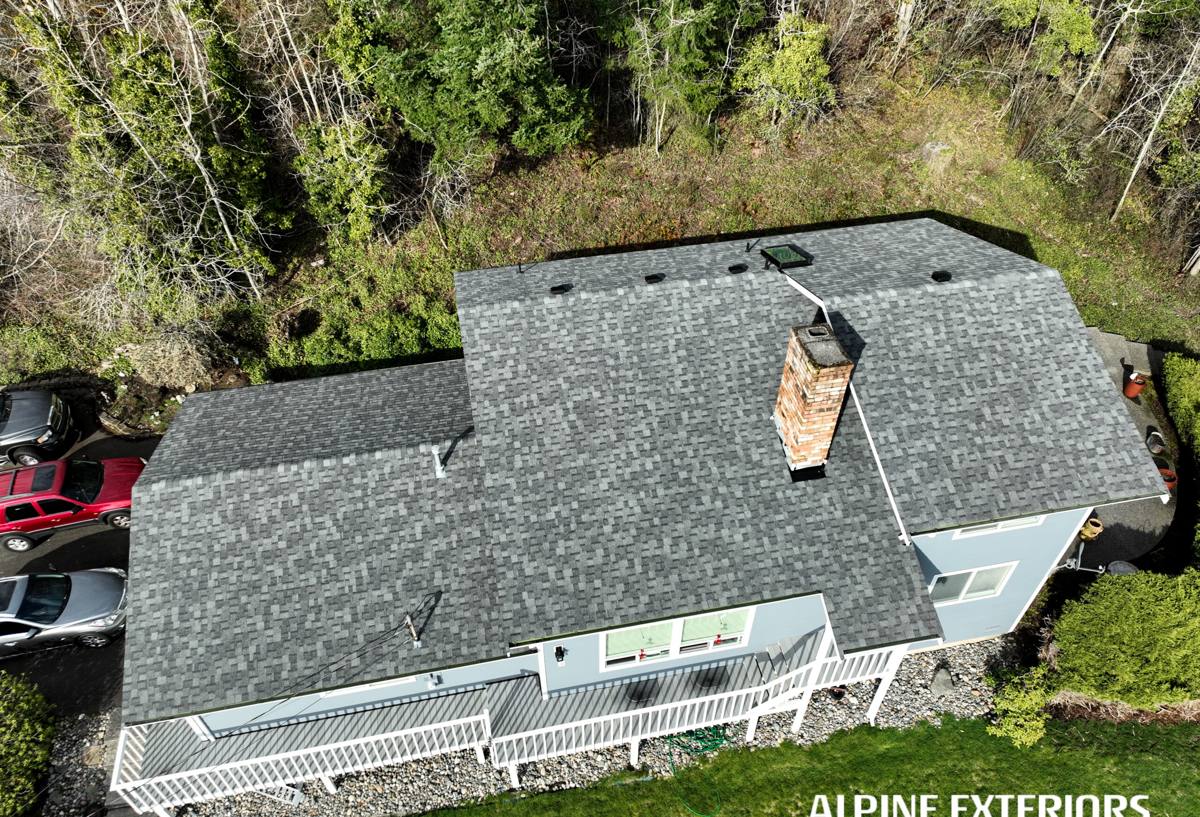
What Actually Counts as Storm Damage
Homeowners often picture storm damage as a tree limb through the roof, but most of what we repair after a windstorm or heavy rain event in La Conner is less dramatic and more common:
- Shingles lifted or creased by wind, even if they didn't blow off completely
- Flashing around chimneys, skylights, and roof-wall intersections knocked loose or bent
- Granule loss from wind-driven rain, which thins a shingle's protection over time
- Small punctures or tears from debris — branches, blown roofing from a neighboring structure, or hail in less common cases
- Gutter and downspout damage that redirects water onto fascia and siding instead of away from the house
- Moss mats that have been partially torn loose by wind, taking granules and sometimes shingle tabs with them
Some of this is visible from the ground if you know what to look for. A lot of it isn't, which is why a proper storm damage inspection means actually getting eyes on the roof surface, not just looking up from the driveway.
What Happens If You Wait
A lifted shingle or a loose piece of flashing doesn't leak every day. It leaks when the wind blows from a certain direction, or during a heavy rain event, or once moss has grown enough to hold water against the gap. That intermittent pattern is exactly why storm damage gets ignored — the problem seems to come and go.
Underneath, though, water intrusion is rarely intermittent once it starts. Sheathing can hold moisture and begin to soften. Insulation loses its effectiveness when wet. Framing near the leak point can start to show rot months before it's visible anywhere inside the house. In a climate like Skagit County's, where things don't dry out quickly between rain events, a small storm-damage repair that gets put off for a season can turn into a much larger sheathing or framing repair by the time it's addressed.
What a Correct Storm Damage Repair Involves
Inspection Before Anything Else
We start by identifying not just where the damage is, but why it happened — wind direction, a weak point in the original installation, moss buildup that trapped moisture, or simple material age. Repairing the visible symptom without understanding the cause is how the same leak comes back in two years.
Checking What's Underneath
Any time we pull damaged shingles or flashing, we check the decking and underlayment underneath before closing anything back up. If water has been getting in for a while, the repair isn't just shingles — it may include a section of sheathing or a re-run of underlayment in that area. We won't cover over a soft spot and call it done.
Matching Materials, Not Guessing
Storm repairs on an existing roof need to match the surrounding material in profile, color, and often manufacturer line as closely as possible — both for appearance and so the repaired section weathers at the same rate as the rest of the roof. When an exact match isn't available because a shingle line has been discontinued, we'll say so upfront and talk through the closest reasonable option rather than surprising you with a patch that stands out.
Flashing Done Right
A large share of the leaks we find in this area trace back to flashing, not shingles. Flashing that's been repaired with sealant alone tends to fail again — sealant is a short-term fix, not a permanent one. A correct repair re-forms or replaces the flashing itself and uses sealant only as a secondary layer, not the primary defense.
Common Storm Damage in La Conner: What We See and How We Handle It
| Damage Type | Typical Local Cause | Repair Approach | Relative Cost Factor |
|---|---|---|---|
| Wind-lifted or creased shingles | Channel wind gusts, aging adhesive strips | Replace affected shingles, reseal surrounding tabs | Low |
| Flashing failure at chimney or wall | Salt-air corrosion, movement over time | Re-form or replace flashing, integrate new underlayment | Low to Medium |
| Moss-lifted shingle edges | Shaded/north-facing slopes, prolonged damp season | Moss removal, shingle reset or replacement, treatment to slow regrowth | Low to Medium |
| Localized decking rot from a slow leak | Undetected damage left unrepaired over time | Cut out and replace affected sheathing, then re-roof that section | Medium to High |
| Debris puncture or tear | Wind-blown branches or loose material | Patch or shingle replacement, decking check underneath | Low |
| Widespread wind damage across multiple slopes | Severe storm event | Multi-section repair or partial re-roof depending on extent | Medium to High |
These are general categories, not a quote — every roof and every storm is different, and the only way to know what your repair actually needs is an on-roof look.
Our Process for Storm Damage Calls
- Initial conversation. We ask what you're seeing — a leak, missing shingles, visible damage after a wind event — and when it started.
- On-roof inspection. We get up on the roof (weather permitting) and check the damaged area plus the roof generally, since storms often loosen more than the one spot that's visibly leaking.
- Honest assessment. We tell you what's actually needed — a targeted repair, a larger section repair, or if there's decking involved. We don't upsell a full re-roof when a repair will genuinely hold.
- Documentation. If you're filing an insurance claim, we document the damage with photos and a written scope that your adjuster can work from.
- Repair. We complete the work with matched materials and correct flashing detail, not just a surface patch.
- Cleanup. Old material, debris, and fasteners are cleared from the roof and property before we consider the job done.
Storm Damage and Insurance: What to Know Going In
Wind and storm damage is often covered under standard homeowner's policies, but coverage details, deductibles, and what counts as "sudden damage" versus gradual wear vary by policy and insurer. We're not insurance agents and won't tell you what your policy covers — but we can document damage clearly enough that your adjuster has what they need, and we'll point out plainly if something looks more like long-term wear than storm damage, since that distinction matters for a claim. Being straight with you about that difference now saves a denied claim later.
Why a Crew That Already Works La Conner Matters
Roofing crews who mostly work inland don't always have a feel for how differently a water-adjacent roof in Skagit County ages compared to one a few miles east. Salt-air corrosion on flashing and fasteners, the specific wind patterns off the channel, and which slopes on a La Conner home tend to hold moss longest are things you learn by working on these roofs repeatedly, not by reading a spec sheet.
There's also a practical side to it. After a regional storm, response time matters — a lot of crews get backed up county-wide, and a roof with active water intrusion doesn't get better while it waits in a queue. Being based in and around Skagit County means we're not driving in from another region to reach La Conner, which matters when the forecast shows more rain coming behind the storm that caused the damage.
A Quick Post-Storm Checklist
After a wind or rain event, here's what's worth checking from the ground and inside the house before deciding whether you need a repair call:
- Look for granules collecting in gutters or at downspout outlets — a sign of accelerated shingle wear
- Scan the roofline from the ground (binoculars help) for shingles that look lifted, creased, or missing
- Check the attic, if accessible, for new water stains, damp insulation, or daylight showing through the roof deck
- Look at ceiling corners and around light fixtures on the top floor for discoloration
- Check that gutters and downspouts are still attached and draining away from the foundation
- Note any debris on the roof or in the yard that could indicate what caused the damage
- Avoid climbing onto the roof yourself, especially if it's wet, steep, or you're not equipped for it — a ground-level check is enough to know whether to call someone
Get a Straight Answer on Your Roof
If your La Conner home has visible storm damage, a leak you can't quite pin down, or you just want a roof checked after a rough stretch of weather, we're happy to take a look. The estimate is free, there's no pressure, and if the honest answer is "this doesn't need a repair yet," we'll tell you that too. Use the form below to get a local crew out to your property.