 Skagit County
 Why Asphalt Shingle Roofs in Alger Take More Punishment Than You'd Think
Alger sits in a stretch of Skagit County where three weather factors stack up on a roof at the same time: salt-laden air drifting in off the nearby bay waters, long stretches of driving, wind-pushed rain, and a moss season that can run eight months or more out of the year under the fir and cedar canopy so common here. Any one of these is manageable on its own. Together, they shorten the useful life of a roof that wasn't detailed correctly for this specific environment.
Salt air accelerates corrosion on exposed metal — nail heads, flashing, drip edge, vent stacks. Driving rain doesn't fall straight down here; it comes in at an angle during winter storms, which means water finds its way under shingles that are technically "installed" but not installed with wind-driven rain in mind. And moss doesn't just look bad — it holds moisture against the shingle surface, lifts tabs as it grows, and works its way under flashing over time. A roof built for a drier, calmer climate simply doesn't hold up the same way out here.
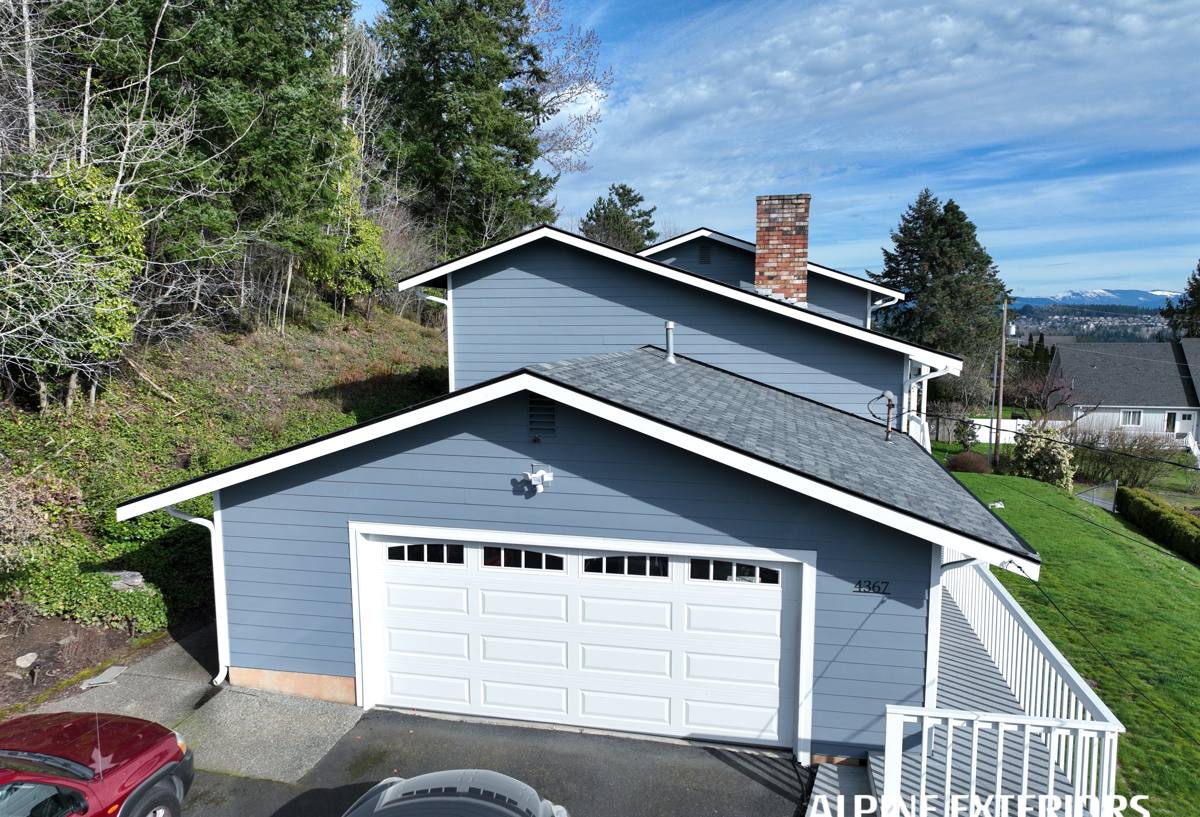
What a Correctly Built Asphalt Shingle Roof Needs in This Climate
We don't treat every asphalt shingle job the same way regardless of location. For homes in and around Alger, a handful of details matter more than they would in a milder climate, and skipping them is where most premature roof failures start.
Underlayment and Water Barrier
Standard felt underlayment is the minimum, not the standard, for this area. We use synthetic underlayment for its tear resistance and consistent water-shedding performance, and we install self-adhering ice-and-water shield at all the vulnerable points — eaves, valleys, around chimneys and skylights, and anywhere roof planes meet a wall. That second layer of protection is what keeps wind-driven rain from finding a path into the sheathing when it's blowing sideways off a winter storm system.
Ventilation That Actually Balances
Roofs in the Pacific Northwest fail from the inside as often as from the outside. Trapped moisture in an attic condenses on cold sheathing, and over a few seasons that leads to rot, mold, and a roof deck that won't hold a nail properly. We size intake and exhaust ventilation to balance — not just add a few extra vents and call it done — because unbalanced ventilation can actually pull moist air into places it shouldn't be.
Flashing and Metal Details
Given the salt air, we favor flashing and fasteners with corrosion resistance suited to coastal-influenced conditions rather than the bare minimum spec. Step flashing at walls, counter-flashing at chimneys, and properly lapped valley metal are all points where a rushed job shows up as a leak two or three winters later, not on day one.
Shingle Selection for Moss Resistance
Algae- and moss-resistant shingle lines use copper or zinc granules embedded in the shingle surface to slow biological growth. In a moss-heavy area like Alger, that's not a cosmetic upgrade — it's a practical one that extends the time between cleanings and reduces the chance of moss lifting tabs and creating entry points for water.
Signs Your Alger Roof Needs a Closer Look
Because moss and moisture damage build slowly, a lot of homeowners don't realize there's a problem until it shows up as a stain on a ceiling. Here's what we'd want you to watch for between inspections:
- Moss or dark streaking concentrated on the north-facing or shaded slopes of the roof
- Granules collecting in gutters or at downspout outlets, especially after a hard rain
- Shingle tabs that look curled, cupped, or lifted at the edges
- Soft or spongy feeling decking near valleys or eaves (best checked from the attic side)
- Rust streaking below metal flashing or vent stacks
- Daylight visible through the roof deck from inside the attic
- Higher-than-usual heating bills, which can point to attic moisture or ventilation problems
None of these mean you automatically need a full replacement — some are maintenance items, some are early warning signs worth a professional look before they become bigger repairs.
Our Asphalt Shingle Roofing Process
Whether we're doing a full replacement or a significant repair, the process for an Alger home generally follows the same order:
- On-site inspection. We look at the existing roof, attic ventilation, decking condition, and any moss or moisture patterns before recommending anything.
- Honest scope and estimate. You get a clear breakdown of what's being replaced or repaired, the materials involved, and a straightforward price — no vague allowances that turn into surprise add-ons.
- Tear-off and deck inspection. Old material comes off down to the deck, and we check the sheathing for soft spots or rot before anything new goes down. Bad decking gets replaced, not covered over.
- Water barrier installation. Synthetic underlayment plus ice-and-water shield at eaves, valleys, and penetrations.
- Ventilation correction if needed. If intake or exhaust airflow is out of balance, we address it as part of the job, not as a separate future project.
- Shingle installation. Installed to manufacturer spec for nailing pattern and exposure, with attention to proper flashing at every wall, valley, and penetration.
- Final walkthrough. We go over the finished roof with you, including gutter and downspout condition, before calling the job complete.
Comparing Asphalt Shingle Options for This Area
Not every shingle line is worth the upgrade cost in every situation, and we'll tell you honestly when a mid-tier product is the smarter choice for a given roof.
| Shingle Type | Typical Lifespan | Moss/Algae Resistance | Best Fit |
|---|---|---|---|
| 3-Tab Standard | 15-20 years | Low unless treated | Budget-focused projects, rentals, outbuildings |
| Architectural (Dimensional) | 25-30 years | Moderate, better with algae-resistant granules | Most primary residences in this climate |
| Premium Architectural | 30+ years | High, built-in algae/moss resistant granules | Homes with heavy tree cover or shaded roof planes |
For most Alger homes with significant tree cover, we steer people toward at least a mid-tier architectural shingle with algae-resistant granules. The upfront difference in cost is modest compared to the difference in how the roof looks and performs five or ten years down the road.
What Actually Drives the Cost
Every roof is different, and we're not going to quote a number without seeing the house, but these are the factors that move the price up or down on a typical asphalt shingle project in this area:
| Factor | Why It Matters |
|---|---|
| Roof pitch and complexity | Steep or cut-up rooflines with multiple valleys and dormers take longer and use more flashing |
| Decking condition | Rotted or soft plywood found during tear-off needs replacement before new shingles go down |
| Layers being removed | Multiple existing layers add tear-off time and disposal cost |
| Shingle tier selected | Standard vs. architectural vs. premium moss-resistant lines vary in material cost |
| Ventilation upgrades | Adding or correcting intake/exhaust venting is worth doing right the first time |
| Access and staging | Steep lots, long driveways, or limited equipment access can affect labor time |
Living With Moss: Maintenance That Actually Extends Roof Life
A well-installed roof still needs periodic attention in a climate like this. A few habits go a long way:
- Keep gutters clear so water isn't backing up under the lowest course of shingles
- Trim back overhanging branches to reduce shade and debris buildup, both of which feed moss growth
- Have moss physically removed rather than left to grow — scraping and low-pressure treatment, not power washing, which can strip granules
- Schedule a roof check every couple of years, even without visible problems, so small issues get caught early
- Watch attic ventilation year-round, not just in summer — winter condensation is often the bigger risk here
Why It Matters to Hire a Crew That Already Works in Alger
A roofing crew that mostly works drier, inland climates will often default to a generic install — standard felt, minimal ice-and-water shield, standard vent count — because that's what works where they usually build. That same approach on an Alger roof, under salt-influenced air and heavy seasonal rain, leaves gaps that show up as leaks, moss infestations, or premature granule loss a few years in.
Working roofs throughout Skagit County day in and day out means we're not guessing at what this environment does to a roof — we're building for it from the start. That includes knowing which slopes in this area tend to hold moss longest, how local wind patterns drive rain under poorly flashed valleys, and which shingle lines actually hold up under this specific combination of salt, rain, and shade.
Get a Straightforward Estimate
If your roof is showing moss, granule loss, or you're just not sure how much life is left in it, we're happy to take a look. We'll give you a clear, no-pressure assessment and an honest estimate for what your Alger home actually needs — nothing more, nothing padded. Use the form below to request your free estimate.