 Skagit County
 Why Avon's Climate Is Hard on Windows
Avon sits out on the flat farmland of the Skagit River delta, between Mount Vernon and Burlington, with wide open exposure across the fields and river valley. That open exposure matters more than most homeowners realize. There are fewer trees, fences, and neighboring structures to slow the wind down before it hits a house, so wind-driven rain arrives at windows nearly horizontal during a fall or winter storm instead of falling straight down. Add the marine air that moves inland off Puget Sound and the Salish Sea, and you get a steady dose of salt-laden moisture riding on the wind, even though Avon itself isn't waterfront. That salt air accelerates corrosion on anything metal — screws, hinges, balance hardware, and especially older aluminum frames.
Then there's the damp itself. Skagit County's marine west coast climate means long stretches of gray, wet weather where surfaces rarely get a chance to fully dry out. That's what locals mean by "moss season" — it isn't a few weeks, it's most of the year. Moss and algae don't just grow on roofs; they take hold on window sills, tracks, and any wood trim that stays damp too long. A window that isn't sealed and flashed correctly gives all of that moisture a path into the wall cavity, where it causes rot long before anyone sees a stain on the drywall.
None of this means Avon is an unusually harsh place to build. It means windows here need to be selected and installed with a specific set of problems in mind: constant low-level moisture, salt-tinged wind, and rain that hits the glass sideways more often than it falls on it.
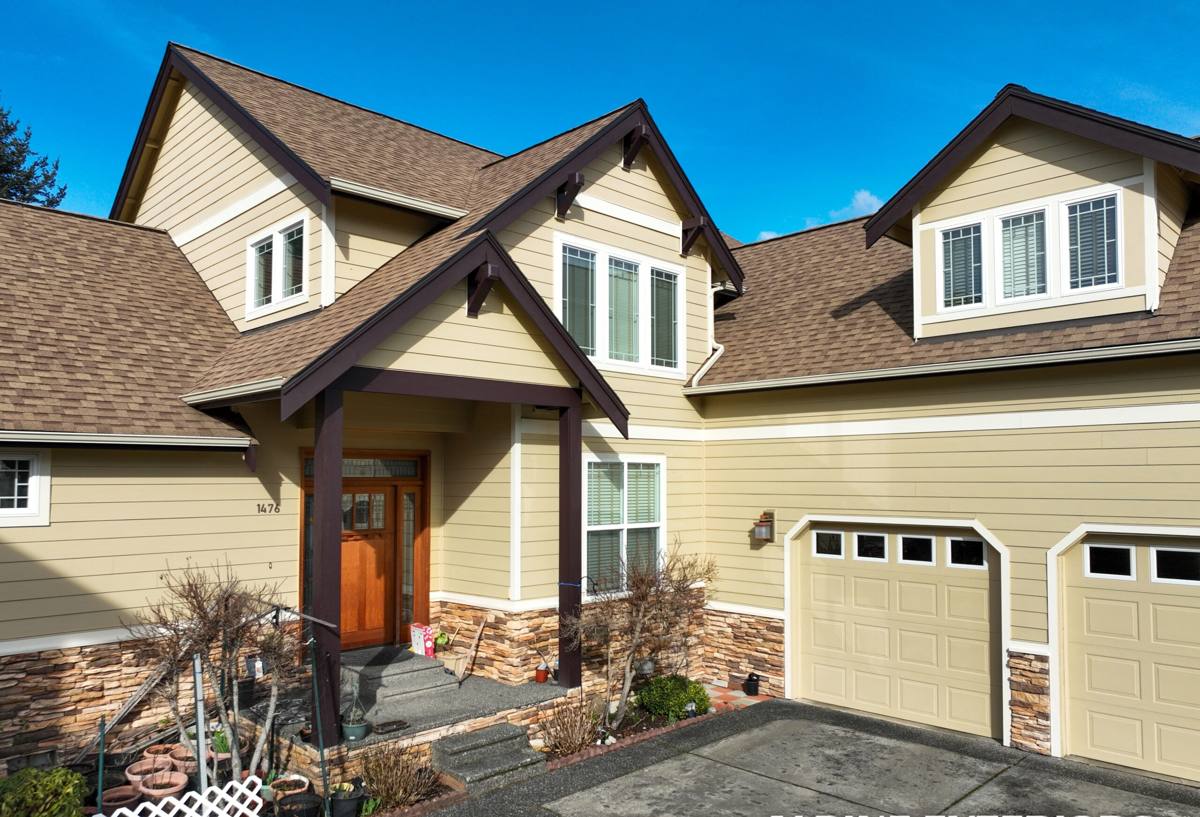
What "Energy-Efficient" Actually Means for a Skagit Valley Home
"Energy-efficient" gets used as a marketing word more than a technical one, so it's worth being specific about what it means for a house in this part of Washington. Western Washington is a heating-dominated climate — we spend far more days trying to keep heat in than trying to keep it out. That changes which window ratings actually matter for us.
- U-factor — measures how well the window resists heat loss. This is the number that matters most here. Lower is better, and it's the rating most directly tied to your winter heating bill.
- Solar Heat Gain Coefficient (SHGC) — measures how much solar heat passes through the glass. In a sunnier climate this is a big deal; in our cloud cover it's a secondary consideration, though it still matters on south- and west-facing walls.
- Air leakage rating — measures how much air sneaks through the frame and sash itself. A window can have great glass and still perform poorly if the frame leaks air around the moving parts.
- Condensation resistance — not always advertised, but important in a cold, damp climate where interior humidity plus a cold single-pane window is a recipe for fogged glass and, eventually, mold on the sill.
For most Avon homes, that points toward double- or triple-pane glass with an argon gas fill, a low-E coating tuned for a northern climate, and a warm-edge spacer between the panes. The spacer matters more than people expect — a cheap aluminum spacer conducts cold straight to the edge of the glass, which is exactly where condensation and eventually black mold start to form on the interior sill.
Signs Your Current Windows Are Underperforming
Most homeowners don't call about windows because they read an energy report — they call because something is bothering them day to day. Here's what that usually looks like in this climate:
- Condensation or fogging between the panes, which means the seal has failed and the gas fill is gone — no amount of cleaning fixes this, the sealed unit needs replacing.
- Soft or spongy wood trim around the window, or paint that keeps bubbling and peeling no matter how often it's redone — usually a sign water is getting behind the trim.
- A draft you can feel with your hand on a windy day, even with the window latched shut.
- Visible moss, algae, or black staining collecting in the corners of the frame or on the sill.
- Windows that are difficult to open, close, or lock — swollen wood or a warped vinyl frame from years of moisture cycling.
- A noticeably colder room near the window in winter compared to the rest of the house.
Any one of these on its own might just be a nuisance. Several of them together, especially combined with visible rot at the sill, usually means the window and the flashing behind it both need attention — not just new glass in the same frame.
Choosing the Right Frame and Glass for This Climate
There isn't one "correct" window brand or material for every house — it depends on the home's age, siding type, and budget. But some materials hold up better than others against constant damp and salt-tinged air. Here's how the common options compare for a Skagit County home:
| Frame Material | How It Handles Moisture & Salt Air | Maintenance | Typical Use Case |
|---|---|---|---|
| Vinyl | Doesn't rot or corrode; welded corners resist water intrusion well | Low — occasional cleaning | Most replacement projects; best value for performance |
| Fiberglass | Very stable in moisture and temperature swings; won't pit or corrode | Low | Higher-end replacements, larger openings, dark exterior colors |
| Wood (unclad) | Handsome but requires diligent upkeep — the weak point in our climate | High — repainting/sealing on a regular cycle | Historic or period-accurate homes where appearance is the priority |
| Wood-clad | Exterior cladding shields the wood from rain and salt air; interior stays wood | Moderate | Homeowners who want a wood interior look without exterior upkeep |
| Aluminum | Conducts cold and is prone to corrosion and pitting near salt-laden air | Moderate to high | Generally not our first recommendation for this climate |
For most Avon homes, vinyl or fiberglass with a quality double- or triple-pane unit is the practical choice. We're honest with clients about wood: it looks great, but it demands a maintenance schedule that a lot of busy households can't keep up with in a climate this wet, and a missed year of upkeep can mean real rot. If a client wants the wood look, wood-clad is usually the better trade-off — it keeps the maintenance burden on the exterior cladding rather than on bare wood exposed to the weather.
What Actually Drives the Cost of a Window Project
Every home is different, so we don't quote sight-unseen, but these are the main factors that move the price up or down on most Avon jobs:
| Factor | Why It Matters |
|---|---|
| Number and size of openings | More glass and larger units mean more material and labor |
| Frame material | Vinyl is typically the most budget-friendly; fiberglass and wood-clad cost more upfront |
| Glass package | Triple-pane, upgraded low-E coatings, and specialty tints add cost but also long-term comfort |
| Condition behind the existing window | Hidden rot at the sill or framing found during removal adds repair work before the new window can go in |
| Retrofit vs. full-frame replacement | A full-frame replacement with new flashing takes more labor than an insert into a sound existing frame |
| Access and site conditions | Second-story openings or tight access around outbuildings add time |
We'd rather find hidden rot during a walk-through estimate and price it honestly up front than uncover it mid-project and have to stop work. That's part of why we look closely at the sill and surrounding wall, not just measure the glass opening, before we ever write a number down.
How We Install Windows for Skagit County Weather
The window itself is only part of the job. In our experience, most window failures in this climate trace back to installation details, not the product. Here's what our process looks like on an Avon job:
1. Remove and inspect
We pull the old window and check the rough opening, sill, and surrounding framing for rot or moisture damage before anything new goes in. This is where hidden problems from years of wind-driven rain usually show up.
2. Repair the opening
Any soft or damaged wood gets cut out and replaced. Installing a new window into a compromised opening just traps the existing problem behind fresh trim — we won't do that.
3. Sill pan flashing
We install a sloped sill pan so that any water that does get past the window sheds back outside instead of pooling at the bottom of the opening. This one detail is arguably the single biggest factor in whether a window stays dry over the next twenty years in a climate like ours.
4. Weather-resistive barrier integration
Flashing tape and the house wrap get layered correctly — top piece over bottom, like shingles — so water is always directed outward and downward, never trapped behind the siding.
5. Set, shim, and fasten
The window gets shimmed square and plumb, fastened per the manufacturer's schedule, and checked for operation before it's sealed. A window that's slightly out of square will bind, leak air, and wear out its hardware early.
6. Insulate and seal
Low-expansion foam or backer rod fills the gap between the frame and the rough opening — enough to stop air movement without bowing the frame. Exterior sealant and trim finish the job, using fasteners rated to resist corrosion from salt-tinged air.
Installation Mistakes We Make a Point of Avoiding
A lot of window problems we get called out to fix started as a shortcut during installation. On every Avon project, we make sure to avoid:
- Skipping the sill pan and relying on caulk alone to keep water out
- Reusing old, warped exterior trim instead of replacing damaged pieces
- Setting a window out of square "close enough" instead of properly shimmed
- Overfilling the gap with high-expansion foam that bows the frame and causes the window to stick
- Taping flashing in the wrong order, so water gets directed behind the barrier instead of over it
- Using standard steel fasteners where corrosion-resistant hardware should be used near marine air
- Leaving weep holes blocked with sealant, which traps water inside the frame itself
None of these mistakes show up on install day. They show up two, five, or ten years later as a soft spot in the siding or a window that suddenly won't latch. That's exactly why we treat the install process as more important than which brand of window we're setting.
Replacement, Retrofit, or Full-Frame: Picking the Right Approach
Not every project needs the same approach, and part of doing this job honestly is not upselling a bigger scope than a home actually needs.
An insert replacement — a new window unit set into the existing, sound frame — makes sense when the original frame and surrounding wall are still dry and structurally solid. It's faster and less invasive, and for a lot of Avon homes with reasonably well-maintained siding, it's a perfectly good option.
A full-frame replacement removes the old frame down to the rough opening, which is necessary whenever there's rot, when the flashing needs to be redone from scratch, or when the new window's dimensions don't match the old one closely enough for an insert to fit properly. It costs more in labor, but it's the only real option once moisture has gotten into the wall.
We make this call after inspecting the actual opening, not from a photo or a phone description. On older Avon homes especially, we'd rather tell a homeowner they need a full-frame replacement on one problem window than sell an insert that looks fine for a year and then fails.
Why Working With a Local Skagit County Crew Matters
Window installation looks similar on paper everywhere, but the details that keep a window dry for decades are climate-specific. A crew that mostly works drier inland climates may not think twice about skipping a sill pan or using a standard fastener — and in a lot of places, they'd get away with it. In Avon, with wind off the delta, salt-tinged marine air, and a moss season that lasts most of the year, those shortcuts show up fast.
Working Skagit County regularly also means we're familiar with the kinds of homes out here — the mix of older farmhouses, mid-century houses, and newer construction spread across the valley — and the kind of exposure each faces depending on how open the surrounding land is. That local familiarity shapes real decisions: which sealants hold up to our humidity, which fastener finishes actually resist corrosion here, and where a given home is most likely to be taking on wind-driven rain.
It also means we're not going anywhere. If a question comes up two years after installation, we're still working in the same county, not halfway across the state.
Get a Straight Answer About Your Windows
If your windows are fogging, drafting, sticking, or just old enough that you're wondering whether they're costing you money every winter, we're glad to take a look. We'll give you a straightforward assessment of what's actually going on — no pressure, no inflated scope — and a written estimate for the work that makes sense for your home. Use the form below to request a free estimate and we'll get back to you to schedule a time to come out.