 Skagit County
 Clear Lake's Climate Puts Real Demands on Siding
Clear Lake sits inland from the saltwater shoreline that defines so much of Skagit County, but it doesn't escape the region's marine weather pattern. Moist air moves through the county nearly year-round, and Clear Lake's mix of open lakefront lots and heavily wooded parcels means many homes here sit in partial shade for long stretches of the day. That combination — high humidity, limited direct sun, and tree cover dropping needles and debris into gutters and wall cavities — is exactly the recipe for the long moss season Skagit County is known for.
Driving rain during fall and winter storms doesn't just wet the surface of a home's exterior. It drives moisture sideways into seams, laps, and fastener points, especially on walls facing open water or exposed to prevailing wind. Over years, siding that isn't engineered or installed to manage that kind of exposure starts showing it: swelling at butt joints, moss and algae staining on north- and shade-facing walls, soft spots where moisture has worked behind the cladding, and paint or coatings that fail years ahead of schedule.
None of this is unique to Clear Lake — it's the reality for most of western Skagit County. But shaded, tree-lined lots like the ones common around the lake tend to hold moisture longer after a storm than open, sun-exposed properties nearby. That's the specific problem a Clear Lake siding job has to solve.
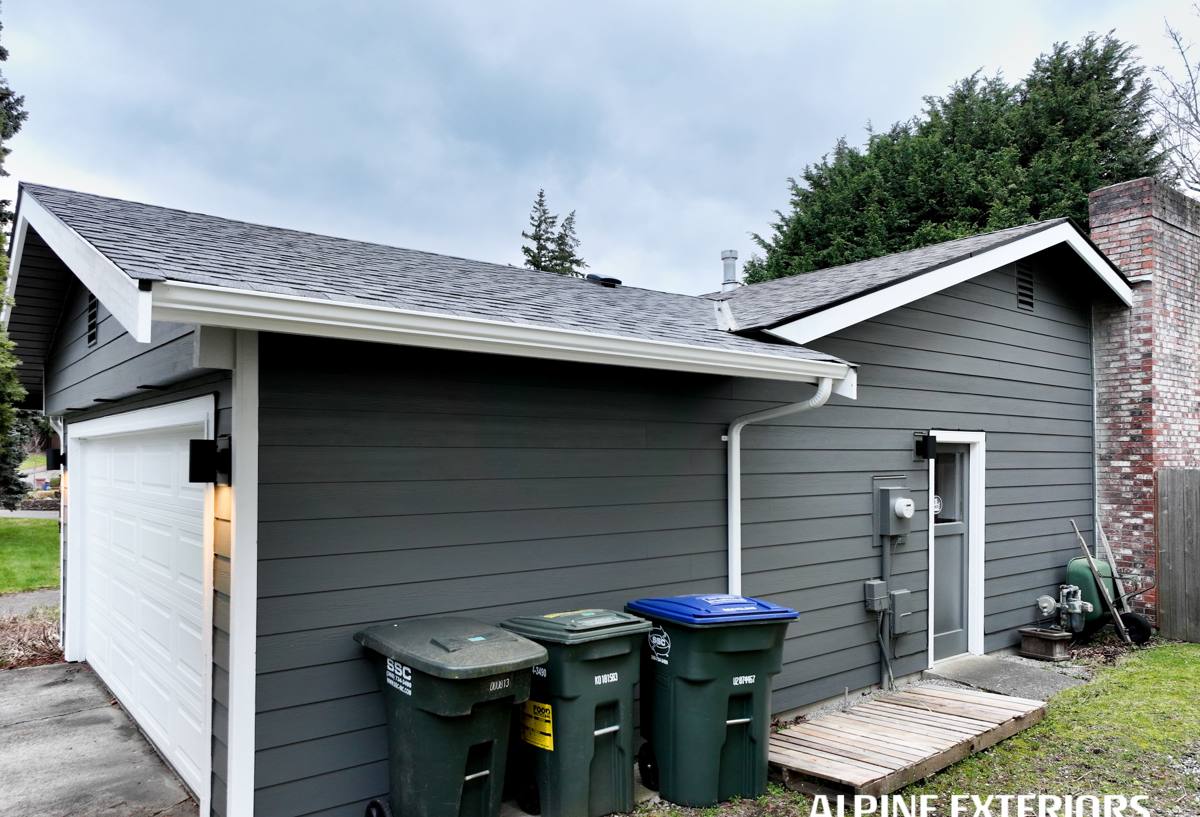
Why We Install Only James Hardie Fiber Cement
We don't install vinyl, LP SmartSide, primed spruce, cedar, or other fiber cement brands like Cemplank or Allura. That's a deliberate standard, not a sales pitch. Each of those products has legitimate strengths, but each also carries a trade-off — moisture sensitivity, coating durability, or long-term maintenance burden — that shows up faster in a climate like this one than it would in a drier part of the country.
James Hardie fiber cement is manufactured from cement, sand, and cellulose fibers, which makes it non-combustible and dimensionally stable in a way wood-based and vinyl products aren't. It doesn't absorb water the way engineered wood siding can, it doesn't warp or expand and contract with humidity swings the way vinyl can in temperature extremes, and its ColorPlus factory finish is baked on and warranted separately from the substrate — meaning the color layer is engineered for UV and moisture exposure rather than added as a field-applied afterthought.
Hardie also builds region-specific product formulations. Homes in western Washington fall under Hardie's HZ5 engineering zone, formulated for northern climates that see freeze-thaw cycles and sustained damp conditions — as opposed to the HZ10 formulation built for hot, humid southern climates. That distinction matters more than most homeowners realize: it's the difference between a product engineered for Skagit County's weather and one engineered for somewhere else entirely.
What This Means in Practice for Clear Lake
On a shaded, moisture-prone lot, the siding itself is only half the equation. The other half is whether the product resists moss and mildew staining on the surface without trapping moisture underneath. Hardie's factory finish sheds water and resists the kind of surface staining that gives shaded walls a permanently dirty look. It doesn't stop moss from forming on a wall that never sees sun — nothing does — but it makes that moss a surface-level cleaning issue rather than a sign the substrate is breaking down.
What a Correct Installation Actually Involves
Most siding failures we get called out to inspect aren't product failures — they're installation failures. Hardie publishes detailed installation specifications, and following them is what actually delivers the product's rated lifespan. Cutting corners here is how a good product turns into a callback.
Flashing and Moisture Management
Every window, door, and roof-to-wall transition needs proper flashing and a water-resistive barrier installed underneath the siding — not caulk used as a substitute for flashing. On a wet lot like Clear Lake, this is the single most important part of the job. Water finds the smallest gap in a wall system, and a house wrapped correctly will shed it before it ever reaches the sheathing.
Fastening, Clearances, and Gaps
Hardie specifies exact fastener types, spacing, and penetration depth, along with minimum clearances from grade, roof lines, decks, and other siding terminations. Panels and lap siding need consistent gapping at butt joints to allow for expansion, and that gapping has to be caulked with a product rated for exterior movement — not left to whatever caulk was on the truck that day.
Cutting, Sealing, and Finish Work
Any field cut into factory-primed or ColorPlus siding exposes raw fiber cement that needs to be sealed according to Hardie's spec, or it becomes the one spot on the wall that absorbs water and stains first. Trim, corners, and butt joints all need the same attention — these are the small details that separate a job that looks right on install day from one that still looks right in eight years.
Hardie Product Options for a Clear Lake Home
| Product | Common Use | Why It Fits This Climate |
|---|---|---|
| HardiePlank Lap Siding | Primary wall cladding | Most common choice; sheds driving rain well when lapped and flashed correctly |
| HardiePanel Vertical Siding | Accent walls, gables, modern designs | Fewer horizontal laps means fewer water-entry points on exposed elevations |
| HardieTrim | Corners, fascia, window/door trim | Matches the wall system's moisture resistance instead of mixing in wood trim that rots first |
| HardieShingle | Accent sections, dormers | Gives a cedar-shingle look without the maintenance burden shaded lots create for real wood |
How We Approach a Project in Clear Lake
- On-site walkthrough to assess current siding condition, sheathing exposure, tree cover, and drainage around the foundation
- Identify problem areas specific to the lot — shaded walls, gutter overflow points, low-clearance sections near grade or decks
- Full or partial tear-off, with sheathing inspected and repaired before any new material goes on
- Installation of water-resistive barrier, flashing at every penetration, and Hardie siding to manufacturer spec
- Finish work: caulking, trim, touch-up, and a walkthrough so you know what to watch for going forward
We don't skip the sheathing inspection step. On a lot with a lot of shade and moisture, what's underneath the old siding matters as much as what goes on top of the new siding — and it's the one thing you can't see once the job is closed up.
What It Costs and What Drives the Range
| Factor | Impact on Cost |
|---|---|
| Tear-off vs. install over existing siding | Tear-off costs more up front but is often necessary if sheathing has taken on moisture damage |
| Home size and wall complexity | More corners, dormers, and trim detail increase labor time |
| Product mix | Combining lap siding with panel accents or shingle detail adds cost over a single product |
| Sheathing repair | Rot or moisture damage found during tear-off adds cost but prevents a repeat failure |
| Access and site conditions | Tree-covered or sloped lots common around Clear Lake can add setup and staging time |
We give a written, itemized estimate after the on-site walkthrough — not a phone quote. On a shaded or older lot, that walkthrough is what tells us whether we're pricing a straightforward re-side or a job that needs sheathing repair first.
Living With Hardie Siding on a Shaded Lot
Even with the right product and a correct install, a shaded lot near the lake will still grow moss and collect organic debris faster than a sun-exposed property. That's a maintenance reality, not a defect. A simple annual routine keeps it from becoming a bigger issue:
- Rinse siding with a garden hose and soft brush once or twice a year, more often on walls that stay shaded
- Keep gutters clear so overflow doesn't run down the wall face and feed moss growth
- Trim back branches and shrubs that keep siding from drying out after rain
- Re-caulk any cracked or separated joints promptly rather than waiting for a full maintenance cycle
- Watch for soft spots or staining near ground level, which usually points to a drainage or clearance issue rather than a siding problem
Why Local Experience Matters for This Job
A crew that already works around Clear Lake and the rest of Skagit County knows which walls on a given lot orientation take the worst of the driving rain, how long moss takes to establish on a shaded elevation, and how local permitting and inspection expectations work. That's not something a crew driving in from outside the area picks up on the first job. It shows up in small decisions — where extra flashing attention goes, which walls get prioritized during a phased project, how installation timing works around this area's wet season — that add up to a siding job that actually holds up here.
If you're weighing a siding project for a Clear Lake home, we're glad to walk the property, look at what's there now, and give you a straight assessment — no pressure, no upsell, just what the house actually needs. Reach out for a free estimate using the form below.