 Skagit County
 Asphalt Shingle Roofing Built for Conway's Wet, Salt-Touched Climate
Conway sits low in the Skagit Valley, close enough to Skagit Bay and Puget Sound that salt-laden air is a routine part of the weather, and close enough to the river delta that ground-level humidity lingers longer here than it does a few miles inland. Add the long stretch of fall-through-spring rain that defines this part of Skagit County, and you get a set of conditions that are genuinely harder on a roof than the statewide average. An asphalt shingle roof in Conway needs to be built for that specific combination of salt air, driving wind-blown rain, and a moss season that can run eight months or longer — not just installed to a generic spec and hoped over.
This page covers what that actually means for a homeowner here: what the local climate does to shingle roofing over time, what a correctly built roof looks like in this environment, how our process works, and why hiring a crew that already works this part of the county matters more than it would somewhere drier.
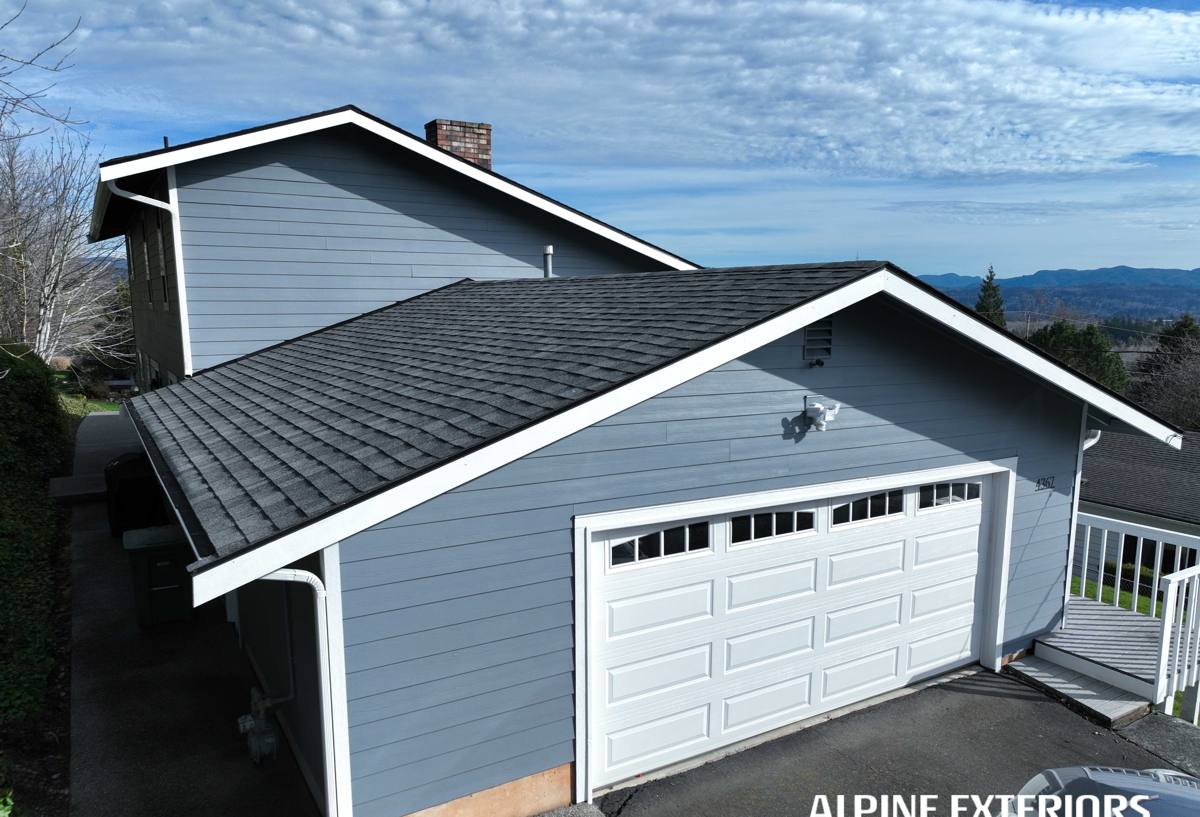
What Salt Air, Rain, and Moss Do to a Shingle Roof Over Time
Salt Air and Metal Components
Salt-carrying air doesn't damage the shingle mat itself as much as it accelerates corrosion on everything metal around it — flashing, drip edge, valley metal, exposed fasteners, and vent stacks. Once corrosion starts on a fastener or flashing seam, it opens a path for water long before the shingles themselves show any wear. This is why the metal details on a Conway roof matter as much as the shingles.
Driving, Wind-Blown Rain
Standard Pacific Northwest rain is manageable for any decent roofing system. The problem in this area is wind-driven rain during fall and winter storms, which pushes water sideways and uphill under shingle edges, around valleys, and against anything that penetrates the roof plane. A roof that performs fine under straight-down rain can still leak under driving rain if the underlayment, flashing, and shingle overlap weren't detailed for it.
Moss, Algae, and Shade
Low-lying, tree-shaded, and consistently damp — that's the moss recipe, and it describes a lot of property in and around Conway. Moss holds moisture against the shingle surface, lifts shingle edges as it grows, and works into nail heads and laps. Left unchecked over several seasons, it shortens the useful life of an otherwise sound roof and is one of the most common reasons we get called out to look at a roof that's only ten or twelve years old.
Signs a Conway Roof Needs Attention
Most roofing problems here don't show up as a dramatic leak — they show up as small signals that are easy to ignore for a season or two. Worth checking for:
- Granules collecting in gutters or at downspout outlets, which signals the shingle surface is wearing down
- Dark streaking or green-black patches, especially on north-facing or shaded slopes
- Moss visible at shingle edges, in valleys, or along the ridge
- Curling, cupping, or lifted shingle corners, particularly on older three-tab roofs
- Rust staining below nail heads, vent stacks, or flashing
- Soft spots, sagging, or discoloration on interior ceilings below the attic
- Daylight visible through the roof deck from inside the attic
Any one of these on its own isn't necessarily urgent. Several together, or any sign of interior water staining, is worth a proper inspection before the next storm season.
Choosing the Right Asphalt Shingle for This Climate
Not every asphalt shingle product is built the same way, and in a climate this demanding the difference matters more than it would in a drier region. The table below is a general guide, not a recommendation of one manufacturer over another — the right product depends on the roof's exposure, pitch, and budget.
| Shingle Type | Typical Lifespan Here | How It Handles Moss & Algae | Best Suited For |
|---|---|---|---|
| Three-tab | Shorter end of the range in this climate | No built-in algae resistance; moss takes hold faster | Budget-driven projects on simpler, less shaded roofs |
| Architectural / laminate | Noticeably longer with proper install | Better wind and lift resistance; algae-resistant options widely available | Most Conway homes, especially anything shaded or near the delta |
| Algae-resistant (copper/zinc-granule) laminate | Similar to standard laminate, with slower moss/algae regrowth | Granules actively slow moss and algae colonization | Shaded lots, north-facing slopes, properties with a history of moss |
| Impact-rated laminate | Comparable to standard laminate | No special moss resistance, but better resilience to debris and hail | Properties with overhanging trees or a history of storm debris |
For most homes in this area, we lean toward a mid- to upper-tier laminate shingle with algae-resistant granules, simply because the maintenance and lifespan payoff is real here in a way it isn't in a drier climate. That said, a well-installed three-tab roof can still be the right call on a budget-driven project with the right exposure and expectations.
What a Correct Installation Involves Here
The shingle brand printed on the wrapper is only part of what determines how a roof performs in Conway. The details underneath and around it matter just as much:
Underlayment and Water-Resistant Barrier
A synthetic underlayment rated for this climate, installed with proper overlap, is the roof's real second line of defense once wind-driven rain gets past a shingle edge.
Ice-and-Water Membrane at Vulnerable Points
Self-adhering membrane at eaves, valleys, and around penetrations gives the roof a sealed layer exactly where wind-driven rain and debris tend to find a way in.
Balanced Attic Ventilation
Intake and exhaust ventilation need to work together, not just exist. Poor ventilation traps moisture in the attic, which condenses on the underside of the roof deck and accelerates both shingle aging and moss growth from the inside out. This is an easy detail to get wrong and a common reason a roof underperforms its rated lifespan in a damp climate like this one.
Flashing and Metal Detailing
Step flashing, counter-flashing, valley metal, and drip edge should be sized and lapped correctly, not just caulked into place. Given how salt air treats exposed metal here, the quality and finish of these components deserves real attention, not an afterthought.
Nailing Pattern and Fastener Choice
Correct nail placement and count per shingle, driven flush without overdriving, is what actually keeps a roof attached in a wind event. Corrosion-resistant fasteners matter more here than in an inland climate.
Our Process, Start to Finish
We keep this straightforward on purpose:
- Inspection. We walk the roof (or use a lift where a walk-on inspection isn't safe), check the attic for ventilation and moisture issues, and document what we find.
- Honest assessment. If a repair genuinely solves the problem, we say so. If the roof is at the point where a repair is a short-term patch on a long-term problem, we explain why and lay out the replacement option plainly.
- Written estimate. Scope, materials, and price in writing before any work starts — no verbal-only agreements.
- Tear-off and deck inspection. Old material comes off down to the deck so we can actually see what's underneath, including any rot or soft spots that need repair before new roofing goes on.
- Installation. Underlayment, ice-and-water membrane, ventilation components, flashing, and shingles installed to the manufacturer's specification and the details above.
- Cleanup. Full site cleanup, including a magnetic sweep for stray fasteners around the house and driveway.
- Warranty documentation. Manufacturer warranty paperwork and our own workmanship coverage handed over in writing.
Cost Factors for a Conway Re-Roof
Every roof is different, and we don't quote a number until we've actually inspected the property. In general terms, the biggest cost drivers on a project like this are:
| Factor | Why It Moves the Price |
|---|---|
| Roof size and pitch | More surface area and steeper pitches both increase material and labor time |
| Number of existing layers | Tearing off multiple layers of old roofing takes longer and adds disposal cost |
| Decking condition | Rotted or soft decking found during tear-off needs to be replaced before new roofing goes on |
| Ventilation upgrades | Adding or correcting intake/exhaust ventilation is worth the modest added cost given how much it affects longevity here |
| Shingle tier | Algae-resistant and impact-rated products cost more per square than basic three-tab |
| Roof complexity | Valleys, dormers, skylights, and multiple penetrations all add flashing work and labor time |
As a rough starting point, a typical single-family asphalt shingle re-roof in this area often falls in the broad mid-to-upper four-figure to low five-figure range, with the final number set by the factors above. We'd rather give you an accurate number after seeing the actual roof than a broad range that doesn't reflect your house.
Maintenance That Actually Extends Roof Life Here
A well-installed shingle roof in Conway still needs some upkeep to hit its full expected lifespan. What actually moves the needle:
- Clean gutters and downspouts at least twice a year, more often under overhanging trees
- Address moss at the first sign of it rather than waiting for full coverage
- Trim back branches that overhang the roof to reduce shade, debris, and abrasion
- Have the attic checked periodically for moisture buildup or blocked ventilation
- Get a professional inspection after any major windstorm, not just on a fixed schedule
- Avoid pressure washing shingles directly — it strips granules and shortens shingle life
Why Hiring a Crew That Already Works Conway Matters
A roofing crew that only occasionally works in this part of Skagit County tends to treat it like anywhere else in Western Washington. A crew that regularly works Conway and the surrounding lower valley knows which shingle tiers actually hold up against the local moss and salt exposure, builds in the ventilation and flashing details this climate demands as standard practice rather than an upsell, and understands the tight weather windows that come with working this close to the water. That local familiarity shows up in fewer callbacks and a roof that performs the way it's supposed to for its full expected lifespan, not just for the first few dry summers.
If you're weighing a repair against a full replacement, or just want a straight answer on how much life is left in your current roof, we're happy to take a look. Reach out for a free, no-pressure estimate using the form below — we'll walk the roof, tell you honestly what we find, and give you a clear written quote with no obligation.