 Skagit County
 Building a Deck That Actually Holds Up in Mount Vernon
A deck in Mount Vernon does more work than a deck almost anywhere inland. It sits under a marine layer for months at a time, takes on driving rain off the Skagit Valley in the fall and winter, and spends a good chunk of the year damp enough to grow moss on anything that isn't sloped, sealed, or ventilated correctly. Salt-tinged air moving up from Skagit Bay and the Sound adds another layer of stress on fasteners and metal hardware that a deck fifty miles inland never has to deal with. None of that means you can't have a deck that looks good and lasts — it means the build has to account for those conditions from the framing up, not just at the finish coat.
We build custom decks for homeowners throughout Skagit County, and Mount Vernon projects follow the same rule every time: what's under the boards matters more than what's on top of them. A deck that looks right the day it's finished but wasn't detailed for this climate will show it within a year or two — soft spots, black streaking, corroded fasteners, or a substructure that's holding water it should be shedding.
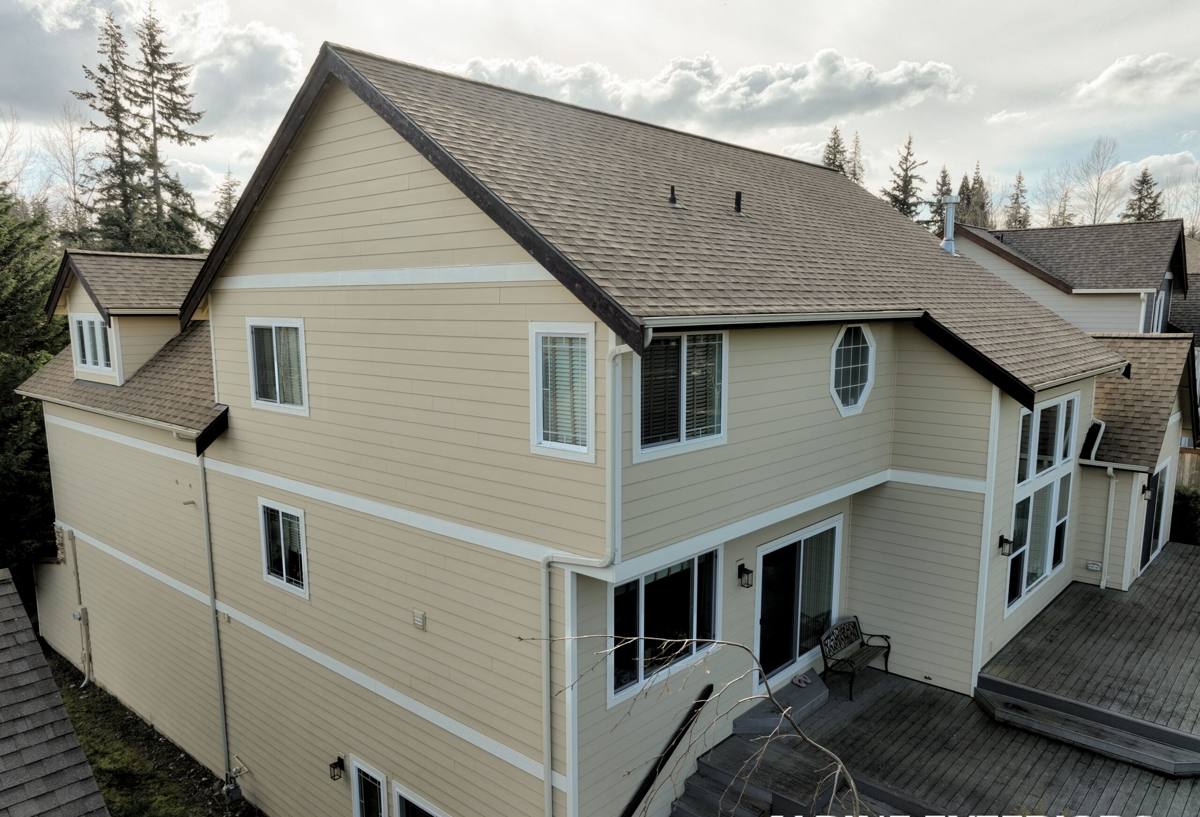
What Local Conditions Demand From a Custom Deck
Constant Moisture, Not Just Rain Totals
It isn't just how much rain falls here — it's how long everything stays wet. Low clouds, fog, and short winter days mean a deck surface and the framing underneath can stay damp for days between dry spells. Wood that would dry out fine in a drier climate can sit at elevated moisture content for weeks, which is exactly the environment mold, rot, and moss need.
Moss and Algae Growth
Any horizontal surface in Skagit County that doesn't get regular sun and airflow will eventually grow moss or algae — decks included. Moss isn't just cosmetic; it holds moisture against the decking surface and turns boards slick and dangerous underfoot in wet weather. Deck orientation, gaps between boards, and under-deck airflow all affect how fast this happens.
Salt Air and Corrosion
Homes closer to Skagit Bay and the broader Puget Sound corridor deal with salt-laden air that speeds up corrosion on anything that isn't rated for it — screws, joist hangers, post bases, and railing hardware. Standard interior-grade or even basic exterior fasteners can start rusting and staining decking within a couple of seasons in this environment.
What Goes Into a Correctly Built Deck Here
Framing and Footings
Everything starts below the decking boards. Footings need to be sized and set to local frost depth and soil conditions, ledger boards (where a deck attaches to the house) need proper flashing to keep water from tracking behind siding and into the wall assembly, and joists need to be spaced and sized for the actual load — not just what's fastest to frame. A ledger that isn't flashed correctly is one of the most common sources of hidden rot we find on older decks in this area, and it's completely preventable at the framing stage.
Decking Material
There's no single "best" decking material — there's a best fit for your budget, maintenance appetite, and how much sun the deck gets. We walk homeowners through the honest trade-offs rather than pushing one product line.
| Material | Upfront Cost | Maintenance | Moisture Performance |
|---|---|---|---|
| Pressure-treated wood | Lowest | Annual cleaning, periodic sealing/staining | Good if sealed consistently; poor if neglected |
| Cedar | Mid | Regular sealing to keep color and prevent graying/checking | Naturally decay-resistant but still needs upkeep in constant damp |
| Composite | Higher | Occasional washing, no sealing or staining | Excellent — doesn't absorb water or rot, resists moss staining better |
| PVC/capped polymer | Highest | Lowest — wash only | Best moisture and mold resistance of the group |
Composite and capped polymer boards have become popular in Skagit County specifically because they don't take on moisture the way wood does, which matters when a deck stays damp for weeks at a stretch. Wood decking still has a place — it's less expensive up front and some homeowners simply prefer the look — but it asks for more consistent maintenance to perform well here.
Fasteners and Hardware
We use stainless steel or coated, corrosion-rated fasteners and connectors rather than standard exterior-grade hardware, especially for anything closer to salt air influence. This is a small line item on a quote and one of the biggest factors in whether hardware is still sound — and rust-free-looking — a decade in.
Drainage and Airflow Underneath
Board spacing, deck height off grade, and under-deck ventilation all affect how fast a deck surface dries out between rain events. A deck built too close to grade, or without enough gap for air to move, holds moisture longer and grows moss faster — regardless of what material sits on top.
Permits and Local Requirements
Most raised decks in Mount Vernon and unincorporated Skagit County require a building permit, and requirements can differ slightly depending on whether the property is inside city limits or in the county's jurisdiction, deck height above grade, and whether it attaches to the existing structure. Guardrail height, baluster spacing, stair geometry, and footing depth are all inspected items, not optional details. We handle permit submittal and coordinate inspections as part of the build so homeowners aren't left navigating that process solo — and so the deck is actually signed off, not just built.
Our Process for a Mount Vernon Deck Project
- On-site assessment — we look at grade, drainage, sun exposure, existing structure (for attached decks), and how the space will actually be used before recommending a layout or material.
- Design and material selection — you get straight answers on cost, maintenance, and expected lifespan for each material option, sized to your budget.
- Permit submittal — we prepare and submit what's required for your jurisdiction and schedule inspections along the way.
- Demolition or prep — removal of an existing deck if applicable, and site prep including footing layout.
- Framing — footings, posts, beams, joists, and ledger flashing built to code and to the moisture conditions here, not the minimum.
- Decking, railing, and stairs — installed with corrosion-rated fasteners and correct spacing for drainage and airflow.
- Final walkthrough — we go over care and maintenance specific to the material you chose before we call it done.
Common Problems We See on Existing Mount Vernon Decks
- Ledger boards without proper flashing, letting water track behind siding into the wall
- Rusted or corroding fasteners staining the decking surface
- Moss buildup on boards with too little gap or airflow underneath
- Soft, spongy spots in wood decking from years without sealing
- Railings and stairs that no longer meet current spacing or height code
- Footings undersized or set too shallow for long-term stability
If any of that sounds familiar, it's often more cost-effective to address it as part of a rebuild than to keep patching an aging structure — we're glad to take a look and give you an honest read on repair versus replace.
Keeping a Skagit County Deck Looking Good Year-Round
- Sweep debris off the deck regularly so leaves and needles don't trap moisture against boards
- Rinse or lightly scrub moss and algae growth before it gets established, especially on shaded sections
- Reseal or restain wood decking on the schedule your specific product calls for — don't wait for visible graying
- Check railing and stair fasteners annually for corrosion or looseness
- Keep gutters and downspouts near the deck clear so runoff isn't draining directly onto or under it
- Trim back vegetation that's shading the deck and slowing dry-out time
Why Hire a Crew That Already Works Mount Vernon
A deck contractor who mostly works drier climates will build a structurally fine deck that still struggles here — not because the framing is wrong, but because the details that matter in Skagit County's moisture and salt-air conditions aren't second nature to them. Ledger flashing, fastener selection, board spacing for drainage, and material recommendations all shift when you're building for a place that stays wet this long, this often. We work in Mount Vernon and across Skagit County regularly, which means we're not guessing at how a given material or detail will hold up locally — we've already seen how it performs.
We're also familiar with the permitting process for this area, which keeps projects moving instead of stalling on paperwork or failed inspections from missed code details.
Get a Free Estimate
If you're planning a new deck or replacing one that's past its prime, we're happy to take a look and give you a straightforward, no-pressure estimate — including honest input on materials and what makes sense for your budget and how you'll use the space. Use the form below to get started.