 Skagit County
 Deck Repair in Burlington: Built for Skagit County Weather
Burlington sits in one of the wetter corners of a wet county. Between the marine air rolling in off the Sound, long stretches of driving rain through fall and winter, and a moss season that can run from October clear into May, decks here take a beating that decks in drier parts of the state simply don't. We repair a lot of decks in Burlington and across Skagit County, and the damage we see is rarely random — it follows a predictable pattern tied directly to how this climate behaves.
Salt-tinged air accelerates corrosion on fasteners and hardware. Prolonged dampness keeps wood fibers swollen longer than manufacturers ever designed for, which speeds up rot at joints, ledger boards, and anywhere water can sit instead of shed. And moss doesn't just look bad — it holds moisture against decking and framing like a wet sponge, long after the rain itself has stopped. A deck repair here has to account for all three, not just patch the visible problem.
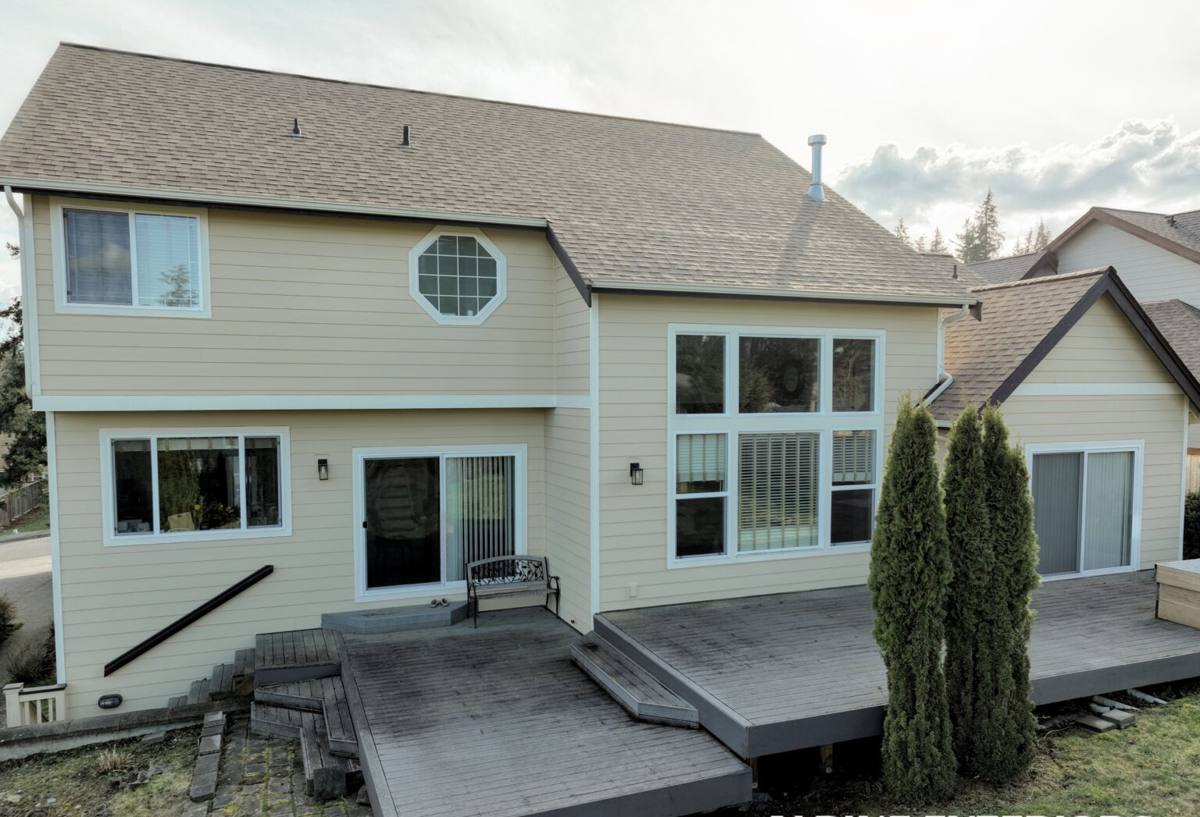
Signs Your Burlington Deck Needs Repair
Most deck problems start small and stay hidden until they're not. Catching them early is the difference between a repair and a rebuild.
- Soft, spongy, or bouncy spots underfoot, especially near stair landings or the house connection
- Boards that stay damp or dark long after the rest of the deck has dried out
- Visible moss or black-green staining on decking, especially on the north or shaded side
- Rust streaks below screw heads, joist hangers, or railing brackets
- Gaps opening up where the deck meets the house (a sign the ledger connection is moving)
- Railings or posts that flex or wobble when you lean on them
- Fasteners backing out or popping above the board surface
- A musty or earthy smell coming from underneath the deck
Any one of these on its own might be minor. Several together, especially near the ledger board or support posts, usually means it's time to have someone look underneath, not just at the surface.
What a Proper Deck Repair Involves
Structural Repairs
This is the part that actually matters for safety, and it's the part a surface-only repair skips. We check the ledger board connection to the house first, since that's the single most common failure point on older decks — especially ones built before current flashing standards were common practice. We also check joists, beams, and post bases for rot, checking, and fastener corrosion. If a joist has lost structural integrity, it gets sistered or replaced, not just capped over.
Surface & Board Repairs
Individual boards that are cupping, splitting, or rotting get pulled and replaced rather than flipped or patched, since a board that's failing on one side has usually already started failing underneath too. We match fastening patterns to the surrounding deck so repairs blend in rather than standing out as an obvious patch job.
Railing & Guard Repairs
Railings take a different kind of abuse — they get leaned on, they're more exposed to wind-driven rain, and their post connections are a common weak point. We check post-to-frame connections against current code requirements, not just how the original deck was built, since older railings are often under-built by today's standards even if they were fine when installed.
Repair vs. Replace: How We Help You Decide
Not every deck problem calls for a full rebuild, and not every deck is worth repairing indefinitely. We walk this decision with you honestly rather than defaulting to the bigger job.
| Condition | Usually Repairable | Usually Needs Replacement |
|---|---|---|
| Framing (joists, beams, posts) | Isolated rot, sound elsewhere | Widespread rot or undersized for current loads |
| Ledger connection | Loose fasteners, minor gap | Rotted rim joist behind the ledger |
| Decking boards | A handful of failing boards | Most boards cupping, splitting, or soft |
| Railings | Loose posts, damaged balusters | Undersized posts failing code minimums |
| Age of deck | Under 15-20 years, well-built | Original construction quality was poor |
When we're on-site, we'll tell you plainly which category your deck falls into and why — including if repair is the honest answer even though replacement would be the bigger job for us.
Materials We Use for Repairs
Matching materials matters more on a repair than new construction, since mismatched wood movement or fastener metals can create new problems right next to the old one. For framing repairs, we use pressure-treated lumber rated for ground contact where it's in contact with concrete or soil, and stainless or hot-dip galvanized fasteners and hardware given how much the salt air in this part of the county accelerates corrosion on lesser coatings. For decking, we'll match your existing material where reasonable — wood to wood, composite to composite — or talk through the trade-offs honestly if a full material swap makes more sense for a section that keeps failing.
We're candid about maintenance burden with any material we install. Wood decking needs periodic sealing to hold up to Skagit County's rain and moss cycle; composite needs less upkeep but costs more upfront and can be less forgiving to repair invisibly if it's damaged later. Neither is automatically the "right" answer — it depends on your budget, your deck's exposure, and how much upkeep you actually want to do.
Our Repair Process
- On-site inspection — we get underneath the deck, not just walk the surface, and check the ledger, framing, and post bases directly
- Written scope — you get a clear list of what's failing, what's sound, and what we recommend, with reasoning you can follow
- Repair work — structural fixes first, then surface and railing work, using materials matched to what's already there
- Walkthrough — we show you what was done and flag anything worth watching going forward
We don't upsell a full rebuild when a targeted repair will hold up. If a deck genuinely needs replacement, we'll say so and explain why — but that's not where every job ends up.
Moss, Mildew, and Salt Air: Living With Skagit County Weather
Even a freshly repaired deck will face the same climate that caused the original damage, so we talk maintenance with every repair we do. A few habits go a long way here: keeping decking swept clear of leaves and debris so moisture doesn't sit trapped against the boards, treating moss with an appropriate cleaner before it gets established rather than after, and keeping gutters and downspouts clear so runoff isn't dumping extra water directly onto or under the deck. None of this is glamorous, but it's the difference between a repair that lasts and one you're redoing in three years.
Why a Local Burlington Crew Matters
Deck repair done right depends on understanding how a specific climate attacks a specific structure over time, and that's knowledge you build by working the same ground repeatedly, not from a general playbook. Working across Skagit County means we see the same ledger failures, the same moss patterns, and the same corrosion issues on enough Burlington-area decks to know what to check first and what usually gets missed. A crew that's only passing through doesn't have that pattern recognition, and it shows up later as callbacks for problems that should have been caught the first time.
What Deck Repair Typically Costs
Costs vary a lot depending on what's actually wrong, so we'd rather give you honest factors than a number that doesn't apply to your deck.
| Factor | Why It Matters |
|---|---|
| Extent of framing damage | Isolated joist repair costs far less than rebuilding structural sections |
| Ledger board condition | Rot behind the ledger often means removing siding to access and repair the rim joist |
| Decking material | Composite and hardwood cost more per board than standard pressure-treated lumber |
| Deck size and height | Larger and taller decks take more labor and sometimes more access equipment |
| Railing scope | Bringing older railings up to current code can add meaningfully to a repair |
Most straightforward repairs — a handful of boards, a loose railing section, minor fastener work — land in a modest range you'd expect for a day or two of skilled labor and materials. Structural work involving the ledger or framing costs more because it involves more demolition, access, and rebuilding to do correctly.
If your deck in Burlington or anywhere else in Skagit County is showing soft spots, moss buildup, or railings that don't feel solid anymore, we'll come take a look and give you a straight answer on what it needs. The estimate is free, there's no pressure attached, and you'll know exactly what you're dealing with before you decide anything — just fill out the form below.