 Skagit County
 New-Construction Windows Built for Edison's Coastal Climate
Edison sits close enough to Padilla Bay and Samish Bay that the air carries salt, and close enough to the foothills and farmland that fog, drizzle, and shade linger longer than they do just a few miles inland. Building new here means the window package isn't just a spec on a plan set — it's the single biggest factor in whether the house stays dry and comfortable for the next 30 years or starts fighting moisture problems in year three. When we install new-construction windows in Edison, we're thinking about all three of those local pressures at once: salt-laden air working on metal components, wind-driven rain hitting the wall assembly sideways instead of straight down, and a long, damp moss season that keeps everything around the house wet longer than homeowners further inland ever have to deal with.
This page is specifically about new-construction window installation — meaning windows going into open framing before siding and interior finish work close things up, not windows being swapped into an existing wall. That distinction matters more than most homeowners and even some builders realize, and it's worth understanding before your framer calls for windows.
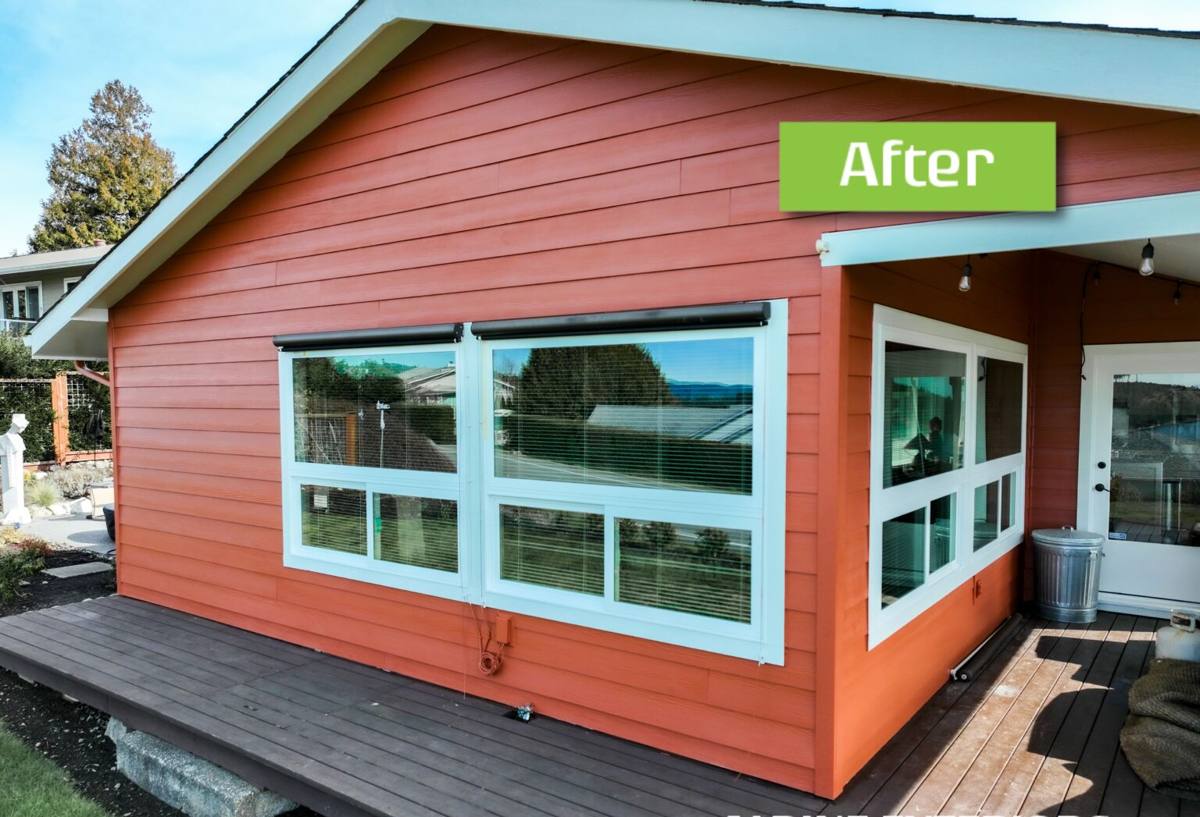
Why New Construction Is the Right Time to Get Windows Right
Replacement window work is always a compromise — you're working around existing siding, existing trim, and a wall assembly you can't fully see into. New construction removes almost all of that. The wall is open. The weather-resistive barrier (WRB) hasn't been covered yet. The rough openings can be framed to the exact dimensions the window manufacturer specifies, with proper header height, correct rough opening tolerances, and sill pans installed before the window ever goes in.
That's the opportunity — and it's also the risk. A window installed with a bad flashing sequence during new construction gets buried behind siding, trim, and insulation. Nobody sees the mistake until water starts showing up on a windowsill or in a wall cavity years later, and by then the fix means tearing into finished walls. In a climate like Skagit County's, where driving rain off Puget Sound and the Salish Sea hits walls at an angle instead of falling straight down, that margin for error is smaller than it is in drier parts of the state.
What Edison's Climate Actually Demands From a Window Installation
Salt Air
Homes in and around Edison get enough marine influence that salt-laden air is a real factor, even if the site isn't waterfront. Salt air accelerates corrosion on unprotected fasteners, cheap hinge hardware, and lower-grade aluminum components. It doesn't ruin a well-built window, but it does mean hardware quality and finish matter more here than they would on a build 40 miles inland. We pay attention to fastener material and window hardware specs specifically because of this — corrosion-resistant fasteners cost a little more up front and save a callback five years down the road.
Driving Rain
Skagit County doesn't get the heaviest rainfall totals in Western Washington, but it gets a lot of wind-driven rain, especially during fall and winter storms moving in off the water. Wind-driven rain doesn't just land on a windowsill — it gets pushed sideways and upward into any gap in the flashing sequence. This is the number one reason new-construction windows fail: not bad windows, but a flashing detail that assumed rain falls straight down.
Moss Season
Anyone who's lived in Skagit County through a wet winter knows how long moss and algae stay active on north-facing walls and shaded trim. That prolonged dampness doesn't just affect roofs and siding — it keeps window sills, trim boards, and the caulking joints around a window wet for extended stretches. Materials and sealants that dry out fine in a drier climate can stay saturated here long enough to break down faster than their rated lifespan suggests.
Flashing and Water Management: The Part That Actually Prevents Leaks
Most window problems aren't window problems — they're flashing problems. On new construction, the sequence matters as much as the product:
- Sill pan flashing installed first, sloped to drain outward, so any water that gets past the window has somewhere to go besides the framing
- Weather-resistive barrier integrated with the flashing using a proper shingle-lap sequence — each layer overlapping the one below it so water is directed out, never in
- Window nailing fin fully sealed to the WRB with compatible flashing tape, not just caulk alone
- Head flashing installed last, lapped over the WRB above the window so water draining down the wall goes over the window, not behind it
- Sealant compatibility checked — some sealants and tapes don't bond well to certain WRB or window frame materials, and a peeling seal is worse than no seal because it hides the gap
We follow this sequence on every new-construction install, not because it's unusual, but because skipping a step is the most common way a "brand-new" window ends up with a moisture problem inside five years. In a climate that gives wall assemblies less time to dry out between storms, there's no room to cut a corner here.
Choosing Window Products for New Construction
New construction gives you more flexibility in frame material than a replacement project does, since you're not constrained by an existing opening. Here's how the common options actually compare for a Skagit County build:
| Frame Material | How It Handles Local Climate | Maintenance | Typical Fit |
|---|---|---|---|
| Vinyl | Good moisture resistance, won't corrode from salt air; can expand/contract with wide temperature swings but our marine climate is fairly mild in that regard | Low — no painting, occasional cleaning | Cost-conscious builds, rentals, most new construction |
| Fiberglass | Excellent dimensional stability, handles moisture and salt air very well, holds paint longer than vinyl if color-matching is needed | Low to moderate | Higher-end new construction, homes wanting a painted trim look |
| Wood-clad (aluminum or vinyl exterior, wood interior) | Attractive interior finish but the cladding seams and exterior wood-to-clad transitions are more sensitive to moisture intrusion if flashing isn't precise | Higher — exterior clad protects the wood, but any breach needs prompt attention | Custom builds prioritizing interior wood trim appearance |
| Aluminum (uninsulated) | Conducts cold and can condense/corrode faster in salt-influenced, damp climates like ours | Moderate to high | Not something we typically recommend for Skagit County new construction |
We don't push one brand over another — what matters more than the label is whether the frame material and hardware are rated for coastal/marine exposure and whether the installation detailing around it is correct. A mid-range vinyl window installed with a clean flashing sequence will outperform a premium window installed sloppily, every time.
Our New-Construction Window Installation Process
- Rough opening check — verify framing dimensions, header height, and squareness against the window manufacturer's specs before anything gets installed
- Sill pan flashing — installed and sloped to drain, before the window ever goes into the opening
- Dry-fit and set — window set into the opening, checked for level, plumb, and square, and temporarily secured
- Fastening — corrosion-resistant fasteners driven per the manufacturer's schedule, not just "enough to hold it"
- Flashing integration — nailing fin taped to the WRB, jamb flashing applied, head flashing lapped over the top
- Interior and exterior sealant — backer rod and sealant where called for, with attention to compatibility between materials
- Final inspection — visual check of the full flashing sequence before siding crews close the wall over it
That last step matters more than people expect. Once siding goes up, the flashing work is invisible. We treat that pre-siding inspection point as the last real chance to catch a problem before it becomes a hidden one.
What Drives Cost on a New-Construction Window Package
| Factor | Why It Moves the Price |
|---|---|
| Frame material | Vinyl is typically the most economical; fiberglass and wood-clad cost more per unit |
| Window count and size mix | Larger openings, picture windows, and multi-unit combinations (like a bay or a grouped set) cost more per opening than standard single units |
| Performance glass package | Low-E coatings and gas-fill upgrades add cost but pay back in comfort and energy performance in our climate |
| Flashing and WRB complexity | Homes with more wall penetrations, dormers, or unusual rooflines take more flashing labor per window |
| Access and coordination | Working around other trades' schedules (framers, siding crews) on an active job site affects labor efficiency |
We give a written estimate that breaks these out rather than a single lump number, so you can see where the money is actually going.
Checklist: What to Ask Before Hiring a New-Construction Window Crew
- Do you install sill pan flashing on every window, or only when specifically requested?
- What flashing tape and sealant products do you use, and are they rated compatible with our WRB?
- Will someone inspect the flashing before the siding crew closes the wall?
- Are your fasteners rated for coastal/marine exposure?
- Can you coordinate scheduling directly with our framer and siding crew, or do we need to manage that handoff?
- What's the manufacturer's warranty, and does your installation meet the terms required to keep it valid?
If a crew can't answer the flashing and sequencing questions specifically — not just "we use good windows" — that's worth noticing before framing is closed up around their work.
Why Hire a Crew That Already Works in Edison
Window installation guidance from a manufacturer is written for a generic climate zone. It doesn't know that a wall in Edison faces prevailing wind off the water, or that a north-facing elevation under tree cover is going to stay damp for months at a time. A crew that already works throughout Skagit County has seen which details hold up here and which ones don't — not from a manual, but from callbacks and repeat jobs across enough houses in this specific climate to know the difference. That's not a marketing point; it's the practical reason local experience shows up in fewer problems five years after move-in, when the framing is long since covered and the only thing left is whether the wall stays dry.
If you're planning new construction in Edison and want the window package handled by a crew that treats flashing sequencing as seriously as the windows themselves, we're happy to walk the plans with you and put together a straightforward, no-pressure estimate — just fill out the form below.