 Skagit County
 Building Decks That Actually Hold Up in Hamilton
Hamilton sits in the Skagit River valley, tucked between forested hillsides that keep the air cool, shaded, and damp for a good chunk of the year. That setting is part of what makes the area beautiful, and it's also exactly why a deck built here needs to be built differently than one going up in a dry inland climate. Skagit County as a whole deals with a long wet season, marine-influenced humidity that lingers even away from the immediate shoreline, and driving rain that finds its way into every gap and seam a builder leaves behind. Add in tree cover, and you've got a recipe for moss, algae, and slow rot if the deck underneath wasn't built with that in mind from day one.
We've framed and finished decks throughout Skagit County long enough to know that "looks good the first summer" and "still looks good in year eight" are two very different standards. This page is about what it actually takes to build a custom deck for a Hamilton property — the decisions that matter, the materials that make sense, and the process we follow to get it right the first time.
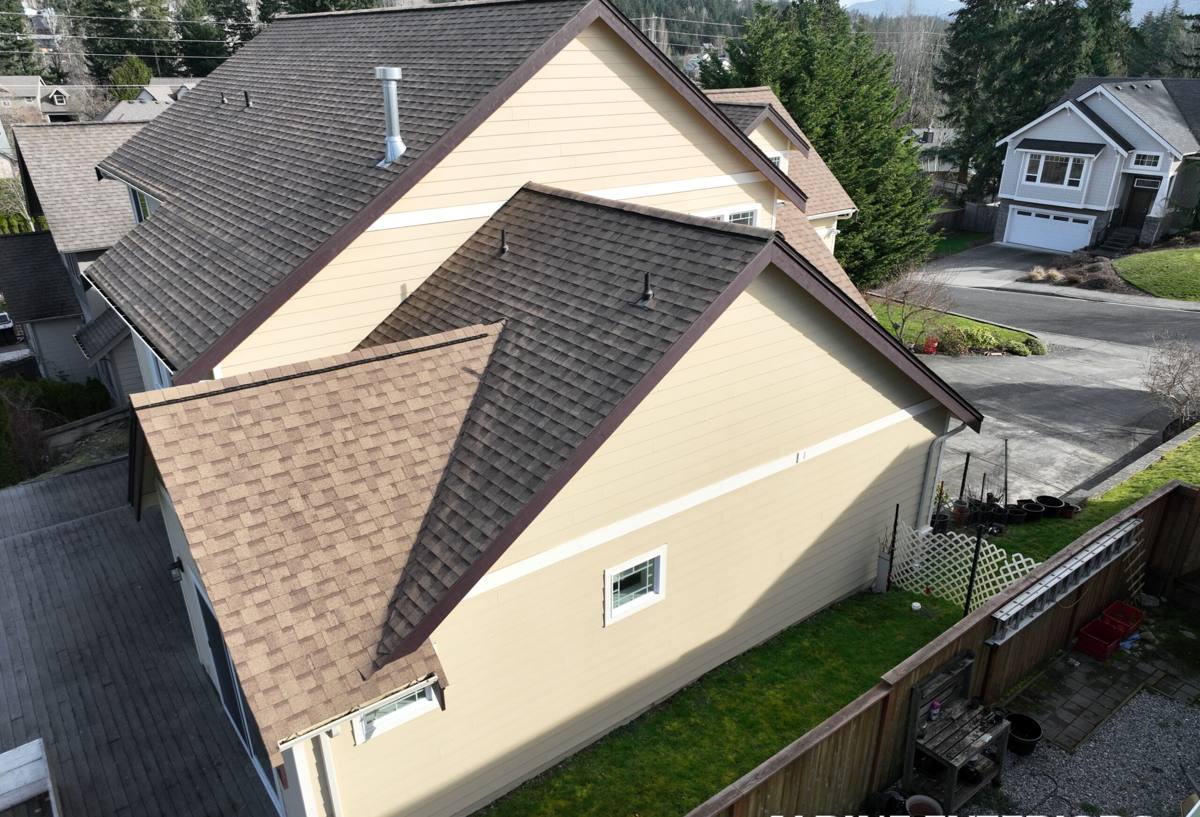
What Hamilton's Climate Does to an Unprotected Deck
A deck in Hamilton is dealing with more than just rain. It's dealing with prolonged dampness — the kind that doesn't dry out quickly because the sun doesn't reach every corner of a shaded yard for more than a few hours a day. That combination of moisture and shade is exactly what moss, algae, and mildew need to take hold.
The specific stresses we design around
- Standing moisture on horizontal surfaces that don't get enough sun to dry between rain events
- Moss and algae growth on decking boards, stair treads, and railings, which becomes a slip hazard as much as a cosmetic one
- Fastener and hardware corrosion from prolonged dampness and the county's marine-influenced air
- Wood movement — swelling and shrinking through wet winters and drier summers — that works screws loose and opens joints over time
- Debris buildup from surrounding trees, which traps moisture against boards and accelerates rot if it isn't cleared regularly
None of these are exotic problems. They're the same handful of issues we see on almost every older, failing deck we're called out to look at in this part of the county. The good news is that every one of them is solvable with the right materials and the right details at the framing stage — not with a coat of sealer applied after the fact.
Choosing Decking Material for a Shaded, Wet Site
There's no single "best" decking material for every project — it depends on budget, how much sun the site gets, and how much upkeep you actually want to do. What we won't do is put you on a material that's a poor match for a shaded, damp Hamilton lot just because it's cheaper up front. Here's how the common options actually perform in this climate.
| Material | Moisture & Moss Behavior | Maintenance | Typical Lifespan Here |
|---|---|---|---|
| Pressure-treated wood | Absorbs moisture readily; needs airflow and regular cleaning to resist moss | Annual cleaning, periodic sealing/staining | 15-20 years with upkeep |
| Cedar | Naturally rot-resistant but still surface-hosts moss in constant shade | Cleaning and re-oiling every 1-2 years to hold color and grip | 15-25 years with upkeep |
| Composite decking | Won't rot or absorb water into the board core; surface moss still needs occasional cleaning | Periodic rinsing/scrubbing; no staining or sealing | 25-30+ years |
| PVC/capped composite | Fully sealed surface, best resistance to moisture and moss staining | Lowest maintenance of the group | 25-30+ years |
For a heavily shaded Hamilton lot, we usually steer clients toward composite or capped composite decking, simply because it removes the moisture-absorption problem at the source. Wood can still be the right call if the site gets decent sun exposure and you're comfortable with the annual maintenance — it's a legitimate choice, not a compromise, as long as you go in with realistic expectations about upkeep.
Fasteners and hardware matter as much as the boards
We use stainless steel or coated, corrosion-rated fasteners and structural hardware on every deck we build, not just where it's visible. Standard galvanized hardware can start showing rust streaks within a few wet seasons in this climate, and once a fastener corrodes it weakens exactly where the board is under the most stress. This is a small line-item cost that has an outsized effect on how long a deck actually lasts.
Structural Details That Matter More in a Wet Climate
A deck that looks identical to one in a dry climate can perform very differently underneath if the framing details aren't adjusted for how much water this area actually sees. A few things we treat as non-negotiable:
Ledger flashing and house connection
Where a deck attaches to the house, water intrusion at the ledger board is one of the most common — and most damaging — failure points we see. Proper flashing, correctly lapped with the home's siding or weather barrier, keeps rain from working its way behind the ledger and into the wall framing. This detail is invisible once the deck is finished, which is exactly why it's worth asking about before work starts.
Footings below frost depth and on solid bearing
Footings need to be sized and set to local frost depth and soil conditions, not poured to the minimum just to pass inspection. On sites with poor drainage or soft soil — common enough in river valley terrain — that can mean larger footings or additional support posts.
Joist spacing and board gapping
Tighter joist spacing than the bare code minimum gives decking boards more support and less flex over time, which matters more when boards are absorbing and releasing moisture through the seasons. Correct gapping between boards lets water drain through instead of pooling on the surface.
Airflow underneath the deck
Low-to-the-ground decks with poor underside ventilation trap moisture against the framing. Where grading allows, we build in enough clearance and, where needed, ground-level moisture barriers to keep air moving under the structure.
How We Approach a Custom Deck Project in Hamilton
Every property is different, but the process we follow stays consistent because it's built around getting the details above right every time.
- On-site assessment. We walk the property, look at sun exposure, tree cover, drainage, and how the deck will tie into the house, and talk through how you actually want to use the space.
- Design and material selection. We put together a layout and material recommendation based on your budget, maintenance preferences, and the specific conditions of the site — not a one-size-fits-all package.
- Permitting. We handle the permit application and inspection scheduling required for the project, so you're not the one tracking down paperwork.
- Framing and structural work. This is where the ledger flashing, footings, joist layout, and hardware choices happen — the parts that determine how the deck ages, even though they're the least visible once it's done.
- Decking, railing, and finish work. Boards, railings, stairs, and any built-ins go in, with attention to consistent gapping and secure, corrosion-rated fastening throughout.
- Final walkthrough. We go over the finished deck with you, explain any maintenance specific to the material you chose, and make sure everything meets the standard we'd want on our own house.
Living With a Deck in a Moss-Prone Climate
Even a well-built deck needs some seasonal attention in a climate like this one. The goal of good construction is to make that maintenance simple, not to eliminate it entirely — no exterior surface in Skagit County is completely maintenance-free.
A realistic seasonal maintenance checklist
- Sweep debris (leaves, needles, seed pods) off the deck regularly, especially in fall
- Rinse or scrub composite/PVC decking once or twice a year to clear moss and algae film before it builds up
- Clean and re-oil or re-stain wood decking on the schedule appropriate to the product — typically every 1-2 years
- Check railings, stair treads, and high-traffic boards for slickness after long wet stretches
- Keep gutters and downspouts near the deck clear so runoff isn't dumping directly onto the structure
- Trim back overhanging branches where possible to improve sun exposure and airflow
- Inspect fasteners and structural connections annually for early signs of corrosion or loosening
Permits and Local Requirements in Skagit County
Most custom deck projects in and around Hamilton require a building permit, with requirements tied to deck height, attachment to the home, and guardrail specifications once a deck is a certain height above grade. Permit review also typically confirms footing depth and structural sizing are adequate for local conditions. We manage this process as part of the build so the project stays on schedule and passes inspection without surprises.
Why It Matters to Hire a Crew That Already Works This Area
A deck built to a generic spec sheet can pass inspection and still fail early in a climate like Skagit County's if the moisture details weren't accounted for. Working with a crew that already builds in Hamilton and the surrounding valley means the flashing details, material recommendations, and framing choices reflect what actually holds up here — not a generalized approach borrowed from a drier region. We've seen what goes wrong when those details get skipped, and we build to avoid it from the start rather than fixing it in five years.
If you're planning a new deck or replacing one that's showing its age, we're happy to come take a look at your property and talk through what makes sense for your site, your budget, and how you want to use the space. Reach out for a free, no-pressure estimate using the form below.