 Skagit County
 Metal Roofing Built for March Point's Coastal Exposure
March Point sits out on the water, and that location cuts both ways. The views are part of why people live there, but the same salt air and open exposure that make the setting appealing are hard on a roof. Homes here take a steadier dose of salt-laden moisture than properties further inland in Skagit County, and that changes what "the right roof" actually means. A metal roof that's rated and installed correctly can be one of the best-performing options for this stretch of shoreline. One that's installed with the wrong fasteners, the wrong flashing details, or a coating that isn't suited to a marine environment will show it early, usually in the form of rust streaks, loosening fasteners, or seams that start to fail years before they should.
We work on homes throughout Skagit County, and March Point's combination of salt air, driving rain off the water, and a long moss season is its own particular challenge. This page covers what that means for a metal roof specifically, what a correctly done job looks like, and how we approach it.
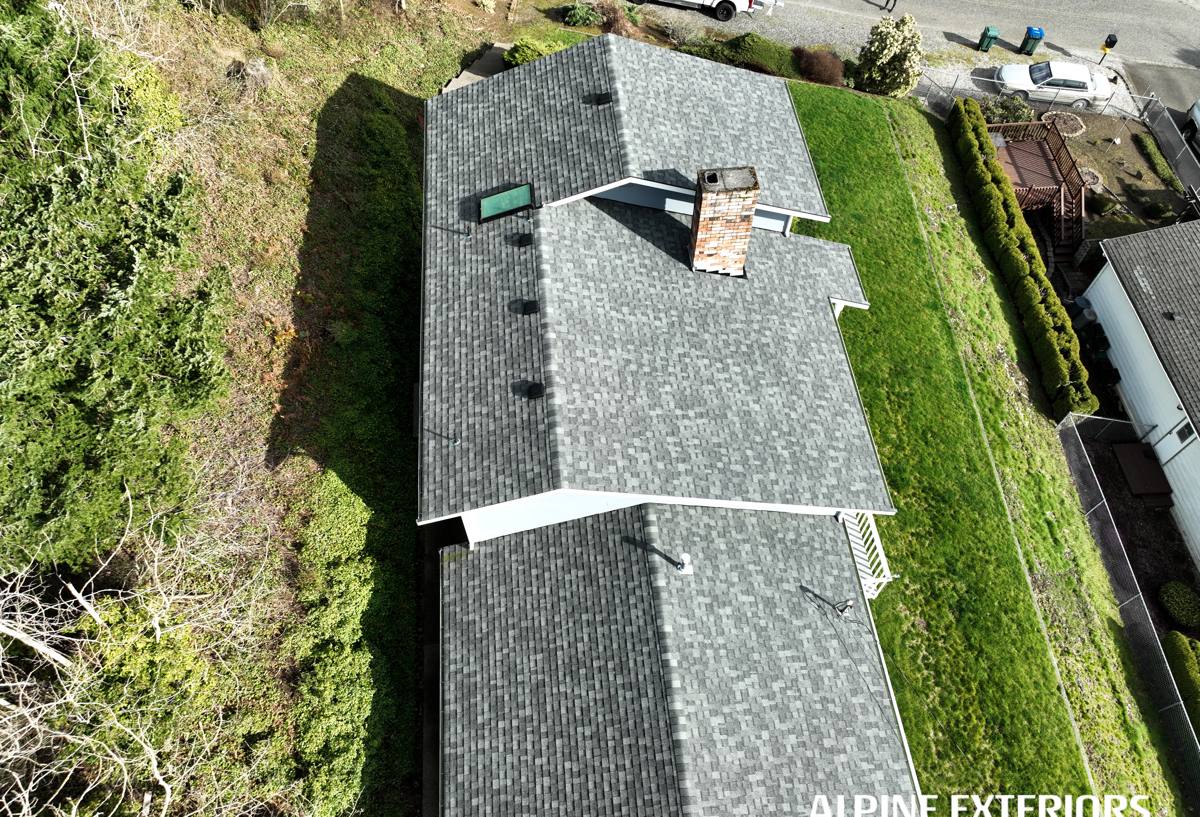
Why March Point's Climate Is Tougher on a Roof Than It Looks
Salt Air and Corrosion
Airborne salt doesn't need direct spray to do damage. It rides in on the wind and settles on every exposed surface, including fasteners, flashing, and cut edges. Steel and aluminum both resist corrosion well when they're coated and installed properly, but any break in that protection — an exposed cut edge, a fastener without a sealing washer, a scratch from careless installation — becomes a starting point for rust. On a shoreline property, that starting point gets exploited faster than it would a few miles inland.
Driving Rain
Wind off the water pushes rain sideways, not just down. That matters at every penetration, valley, and panel overlap on the roof. A roof that would shed water fine in a calm rain can leak under wind-driven rain if the underlayment, flashing laps, and fastening pattern weren't built with that in mind.
Moss and Organic Growth
Skagit County's damp, mild climate supports moss growth across most of the region, and a long moss season means more months where roofs stay wet and shaded surfaces stay green. Metal roofing resists moss far better than most other roofing materials, since there's no organic surface for it to root into, but moss and debris can still build up in valleys, at wall-to-roof transitions, and along the low edges of panels if those areas aren't cleaned periodically. Left alone, trapped moisture at those spots can undermine even a good metal roof over time.
What a Correct Metal Roof Install Actually Involves
Metal roofing has a reputation as a low-maintenance, long-lasting choice, and that reputation is earned — but only when the installation details are right. The material itself is rarely the point of failure; the installation is.
- Correct panel and fastener material matched to each other, to avoid galvanic corrosion between dissimilar metals
- Sealing washers on every exposed fastener, rated for the coastal environment
- Proper underlayment as a secondary water barrier beneath the panels, not just decorative
- Flashing details at every valley, wall, chimney, and penetration built for wind-driven rain, not just standard drainage
- Panel overlap and seam spacing that accounts for thermal expansion and contraction
- Ventilation planned into the system so trapped moisture doesn't sit against the underside of the panels
- Edge and eave detailing that sheds water cleanly instead of letting it wick back under the panel
Skip any one of these and the roof can still look right for a while. The problems that show up from a shortcut usually take a few years to surface, which is part of why it's worth asking a contractor to walk through these details before work starts rather than after.
Standing Seam vs. Exposed-Fastener Metal Panels
Both systems have a place, and the right one depends on the home, the roof pitch, and the budget. Here's how they compare for a property in a coastal exposure like March Point:
| Factor | Standing Seam | Exposed-Fastener Panel |
|---|---|---|
| Fasteners | Concealed under the seam, not exposed to weather | Visible screws through the panel face, sealed with washers |
| Corrosion resistance | Higher — fewer penetration points for salt and moisture to reach | Good, but washer seals need periodic checking and eventual replacement |
| Upfront cost | Higher | More affordable |
| Maintenance | Very low | Low, but includes checking fastener seals over time |
| Best fit | Homes with direct water exposure or where lowest long-term maintenance matters most | Homes on a tighter budget, or less directly exposed to salt spray and wind |
For homes closer to the shoreline in March Point, we lean toward recommending standing seam more often, simply because fewer exposed penetration points means fewer places for salt air to find a foothold. That's not a knock on exposed-fastener systems — they're a solid, proven product — it's a matter of matching the system to the exposure.
Coatings and Finishes That Matter Here
Not every metal roofing finish is built for a marine environment, and this is one area where it pays to ask specifically. A finish rated for general residential use inland isn't always the same finish you want thirty feet from open water.
- Galvanized steel — a zinc coating that protects the steel underneath; solid performance but more sensitive to coastal exposure than other options
- Galvalume steel — a zinc-aluminum coating that generally holds up better against salt air than standard galvanized
- Aluminum panels — naturally corrosion-resistant and often the strongest choice for direct coastal exposure, at a higher material cost
- Painted finishes — look for coatings specifically rated for coastal or marine use; standard paint systems can fade or chalk faster under salt exposure and UV
We'll walk through which finish makes sense for your specific spot on the property, since exposure can vary even across one roof depending on which direction faces the water and prevailing wind.
Our Process for a March Point Metal Roof
1. On-Site Assessment
We look at the roof's current condition, pitch, exposure direction relative to the water, and any existing problem areas — valleys holding moss, flashing that's already showing wear, ventilation that's inadequate for the space below.
2. System Recommendation
Based on that assessment, we recommend a panel type, gauge, and finish suited to the exposure level of your specific property, not a one-size-fits-all package.
3. Tear-Off or Overlay Decision
In some cases metal panels can go over an existing roof deck with the right underlayment; in others a full tear-off is the better call, especially if there's existing moisture damage. We'll be straight with you about which one your roof actually needs.
4. Installation
Correct fastener spacing, sealed penetrations, proper flashing at every transition, and attention to the details that matter most in a coastal setting — this is where most of the roof's long-term performance gets decided.
5. Final Walkthrough
We go over the finished roof with you, including what routine upkeep looks like — mainly periodic debris clearing in valleys and around penetrations, especially heading into the wetter months.
Maintenance That Actually Matters on a Metal Roof Here
Metal roofing needs far less upkeep than most materials, but "low-maintenance" isn't "no-maintenance," particularly this close to the water.
- Clear debris and moss buildup from valleys and low edges once or twice a year
- Keep gutters clear so water isn't backing up against roof edges
- Have flashing and fastener seals checked periodically, especially after a hard windstorm
- Trim back overhanging branches that keep sections of the roof shaded and damp
- Rinse off heavy salt buildup near the shoreline if you notice visible residue after storms
Why Local Experience Matters for This Job
Metal roofing installers who mostly work inland don't always think in terms of salt exposure, wind-driven rain, or the specific moss patterns you get on a Skagit County waterfront property. Those aren't exotic problems, but they're details that change fastener choice, flashing design, and finish recommendations — and they're easy to miss if you're not used to building for them. We work across Skagit County and understand how a March Point roof's exposure differs from a job a few miles inland, and we build the installation plan around that from the start rather than treating it as an afterthought.
If you're weighing a metal roof for your March Point home, we're happy to take a look and talk through what makes sense for your specific property — no pressure, no obligation. Reach out using the form below to set up a free estimate.