 Skagit County
 Skyline sits up on the bluff on the west side of Anacortes, catching wind and weather straight off the water for most of the year. That exposure shapes everything about how a roof performs there. Asphalt shingles are the most common roofing material in this part of Skagit County, and for good reason — they're a proven, cost-effective system when they're specified and installed correctly for the conditions a bluff-facing home actually sees. When they're not, the same salt air, driving rain, and long moss season that makes Skyline such a striking place to live will find every shortcut in the system within a few years instead of a few decades. This page covers what asphalt shingle roofing specifically needs to hold up on a Skyline home, what correct installation involves, and how we approach roofing work in this neighborhood.
What Skyline's Climate Does to an Asphalt Shingle Roof
A roof on a bluff lot in Skyline deals with a different, harder combination of conditions than a roof a few blocks inland. Direct exposure to wind off the water, salt-laden air, and shade from mature trees on many lots all interact with an asphalt shingle roof in specific ways that are worth understanding before you choose materials or a contractor.
Salt Air and Metal Fatigue
Salt-laden air moving off the water accelerates corrosion on every piece of exposed metal on a roof — flashing, drip edge, vent stacks, and fasteners. Asphalt shingles themselves aren't directly damaged by salt the way metal is, but a roof is only as watertight as its metal components, and corroded flashing or fasteners fail long before the shingles above them wear out. On a Skyline roof, metal components need to be rated for coastal exposure from day one, not upgraded later after the first signs of rust show up.
Wind-Driven Rain and Flashing
Rain on an exposed bluff lot rarely falls straight down. Wind pushes it sideways and up under shingle edges, into valleys, and around any penetration in the roof deck — chimneys, vent pipes, skylights. That's a much heavier moisture load on flashing details than a simple rainfall total suggests, and it's exactly where a shortcut taken during installation shows up first as a leak, usually well after the crew that cut the corner has moved on.
A Long Moss Season
Shaded, north-facing roof slopes and roofs under tree cover — common on Skyline lots — stay damp longer than open, sun-exposed roofs. Over a few wet seasons that turns into visible moss and algae growth, which holds moisture against the shingle surface, works into shingle edges, and can lift or loosen roofing if it's left unaddressed. Skagit County's mild, wet climate gives moss a growing season that runs longer than in drier parts of the state, so it's a recurring maintenance issue rather than a one-time problem.
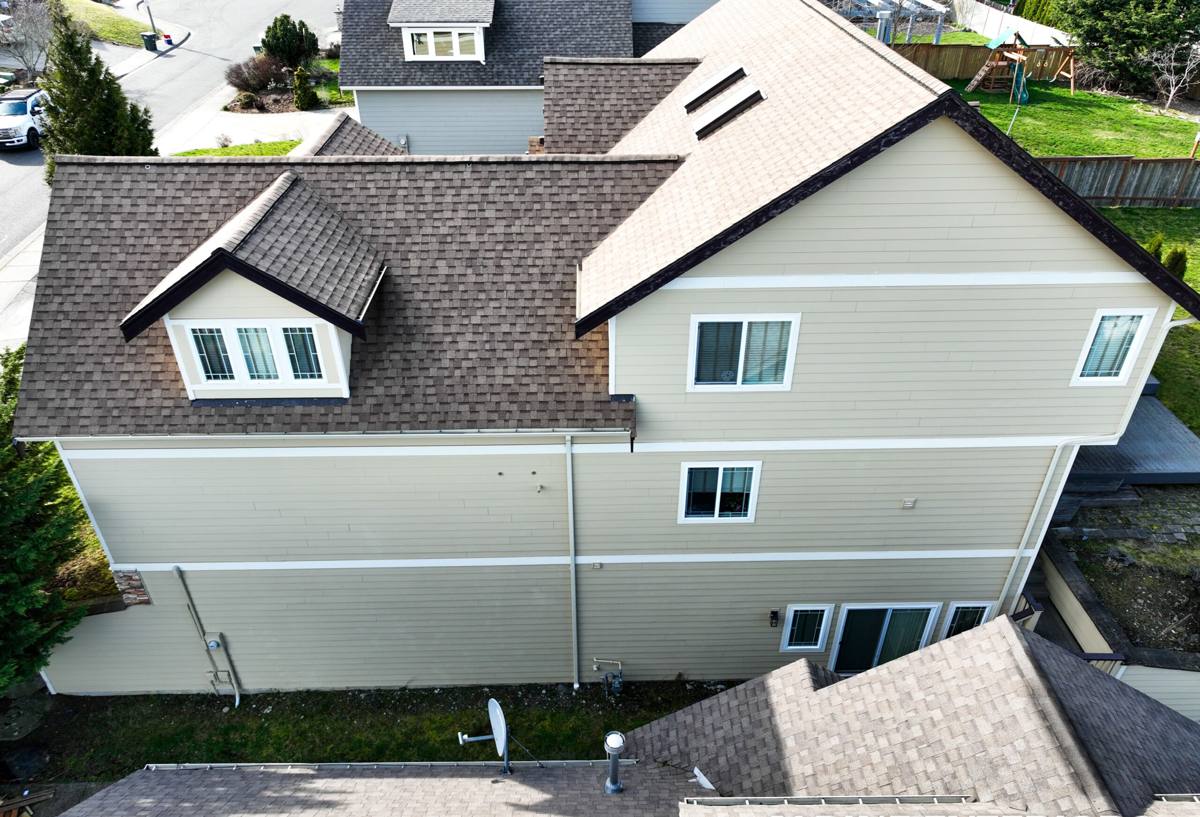
Choosing the Right Asphalt Shingle for a Skyline Home
Not all asphalt shingles are built the same, and the differences matter more on an exposed bluff lot than they would on a sheltered, inland property. Wind rating, algae resistance, and overall shingle weight and construction all affect how long a roof actually holds up in this specific setting.
| Shingle Type | Wind Rating | Moss & Algae Resistance | Best Fit |
|---|---|---|---|
| Standard 3-tab | Lower, typically rated to 60-70 mph | Varies; algae-resistant granule options limited | Budget projects on sheltered, low-exposure roofs |
| Architectural (laminate) | Higher, typically rated to 110-130 mph | Often available with algae-resistant granules | Most Skyline homes — better fit for direct wind and rain exposure |
| Impact-rated (Class 4) | High wind rating plus impact resistance | Available with algae-resistant granule options | Homeowners prioritizing long-term durability and possible insurance benefits |
We generally recommend architectural shingles for Skyline roofs. They're heavier, rated for higher wind exposure, and most manufacturers offer them with algae-resistant granules built in — a meaningful advantage on a lot that stays shaded and damp longer than most. Three-tab shingles cost less upfront, but on a bluff lot that takes direct wind-driven rain, the wind rating and moisture performance gap between the two products is worth the difference in price for most homeowners planning to stay in the house for a while.
What a Correct Asphalt Shingle Installation Involves
The shingle brand matters less than what's underneath it and around it. Most of the roof failures we get called out to inspect in this area trace back to a detail in the installation, not a defect in the shingle itself.
- Synthetic underlayment rated for sustained moisture exposure, installed with proper overlap
- Ice-and-water shield at eaves, valleys, and around every penetration — the spots where wind-driven rain collects
- Flashing correctly lapped and sealed at chimneys, vent pipes, skylights, and roof-to-wall transitions
- Corrosion-resistant fasteners and metal components rated for coastal, salt-air exposure
- Balanced intake and exhaust ventilation so the roof deck can dry out between wet spells instead of trapping moisture
- Shingle nailing pattern matched to the manufacturer's high-wind specification, not the minimum code requirement
None of these add much to the overall cost of a roofing job relative to the shingles themselves, but skipping any of them is how a twenty-five-year roof turns into a fifteen-year roof on an exposed lot like this one.
Signs a Skyline Roof Needs Repair or Replacement
- Moss or algae streaking that returns quickly after cleaning, especially on shaded slopes
- Granules collecting in gutters or at the base of downspouts
- Curling, cupping, cracking, or missing shingles, especially after a windstorm off the water
- Water staining on interior ceilings near exterior walls, chimneys, or skylights
- Flashing that looks lifted, rusted, or stripped of sealant
- Soft spots or noticeable give when the roof deck is walked
- Daylight visible through the roof deck from inside the attic
Any one of these is worth a professional look before the next storm season. On a bluff lot, small problems tend to get worse faster because there's less shelter to slow the damage down.
Repair or Replace? How We Help You Decide
We don't default to recommending a full replacement just because a roof has a problem. We look at the roof's age relative to its rated lifespan, how much surface area is affected, whether the underlying deck has moisture damage, and how many repairs the roof has already had. A localized leak on an otherwise sound roof is usually a straightforward repair. A roof nearing the end of its service life with moss-related wear spread across multiple slopes, or a deck with soft spots from long-term moisture, is usually more honestly addressed with a replacement than another round of patching. We'll explain what we find during an inspection and why, and lay out the real trade-offs rather than pushing toward whichever option pays better.
Cost Factors for an Asphalt Shingle Roof in Skyline
We don't publish blanket pricing because it wouldn't be an honest number — the real cost of a roofing project depends on the specific house. The factors that move a project's cost up or down, though, are consistent enough to explain plainly.
| Factor | How It Affects Cost |
|---|---|
| Roof size and pitch | Steeper roofs and larger surface areas require more material, time, and safety setup |
| Number of valleys, penetrations, and transitions | Each one needs individual flashing work, which adds labor time |
| Existing deck condition | Rot or soft spots found during tear-off add repair scope before new roofing goes on |
| Shingle class chosen | Architectural and impact-rated shingles cost more upfront than standard 3-tab |
| Access and site conditions | Tree cover, steep driveways, and bluff-lot access can affect staging and labor time |
Why a Skagit County Crew That Knows Skyline Matters
Skagit County's coastal microclimates aren't uniform, and Skyline's particular mix of elevation, direct water exposure, and tree shade is something you learn from working on roofs here repeatedly, not from a general spec sheet. We know which slopes on a Skyline roof take the worst of a winter windstorm, which north-facing valleys are going to hold moss no matter what gets done to the rest of the roof, and which flashing details are worth the extra time on install day rather than the code minimum. That local pattern recognition shapes how we scope a roofing job before a single shingle goes down.
It also means someone local is reachable years later if a warranty question comes up or a flashing detail needs a second look, instead of chasing down a crew that's since moved on to another region. We also handle siding, windows, and decks, so if a roof inspection turns up moisture damage at a wall-to-roof transition, we can address it as part of the same conversation instead of sending you to find a second contractor.
Keeping an Asphalt Shingle Roof Performing After Installation
Even a correctly installed roof benefits from basic seasonal attention on an exposed lot like this. Clearing gutters and downspouts ahead of the wet season keeps water moving off the roof instead of backing up under the eaves. Checking shaded, north-facing slopes for early moss growth and addressing it before it spreads keeps moisture from sitting against the shingles longer than it should. A quick visual check after any major windstorm — looking for lifted or missing shingles — catches wind damage before the next rain finds its way in through the gap. None of this is a heavy lift, and a contractor who installed the roof correctly should be able to tell you exactly what to watch for on your specific house.
- Clear gutters and downspouts before the wet season starts
- Check shaded and north-facing slopes for early moss growth each fall
- Walk the property after major windstorms and look up for missing or lifted shingles
- Watch for granule buildup in gutters, a sign the shingle surface is wearing
- Have the roof professionally inspected every year or two, especially as it ages past the ten-year mark
Get a Free, No-Pressure Estimate
If you're dealing with an aging asphalt shingle roof, storm damage, or persistent moss on a Skyline home, we're happy to take a look and give you a straight read on what it actually needs. Reach out using the form below for a free, no-pressure estimate — we'll walk the roof with you and explain exactly what we see.