 Skagit County
 Asphalt Shingle Roofing Built for the Skagit Valley
Mount Vernon sits low in the Skagit Valley, close enough to Skagit Bay and the broader Puget Sound system to pick up salt-tinged air, and flat enough that moisture doesn't drain away or dry out the way it might on a hillside or in a drier inland town. Add in Pacific storm fronts that push rain sideways as often as they drop it straight down, and you've got a climate that asks more of an asphalt shingle roof than a national average spec sheet accounts for. Asphalt shingles remain one of the most practical roofing choices for this area — they're proven, repairable, and reasonably priced — but only when the product, the installation details, and the maintenance plan are all matched to what this valley actually does to a roof year after year.
This page is specifically about asphalt shingle roofing for homes in and around Mount Vernon: what the climate does to it, what a correct installation looks like, and how to tell when a roof needs attention before a small problem becomes a big one.
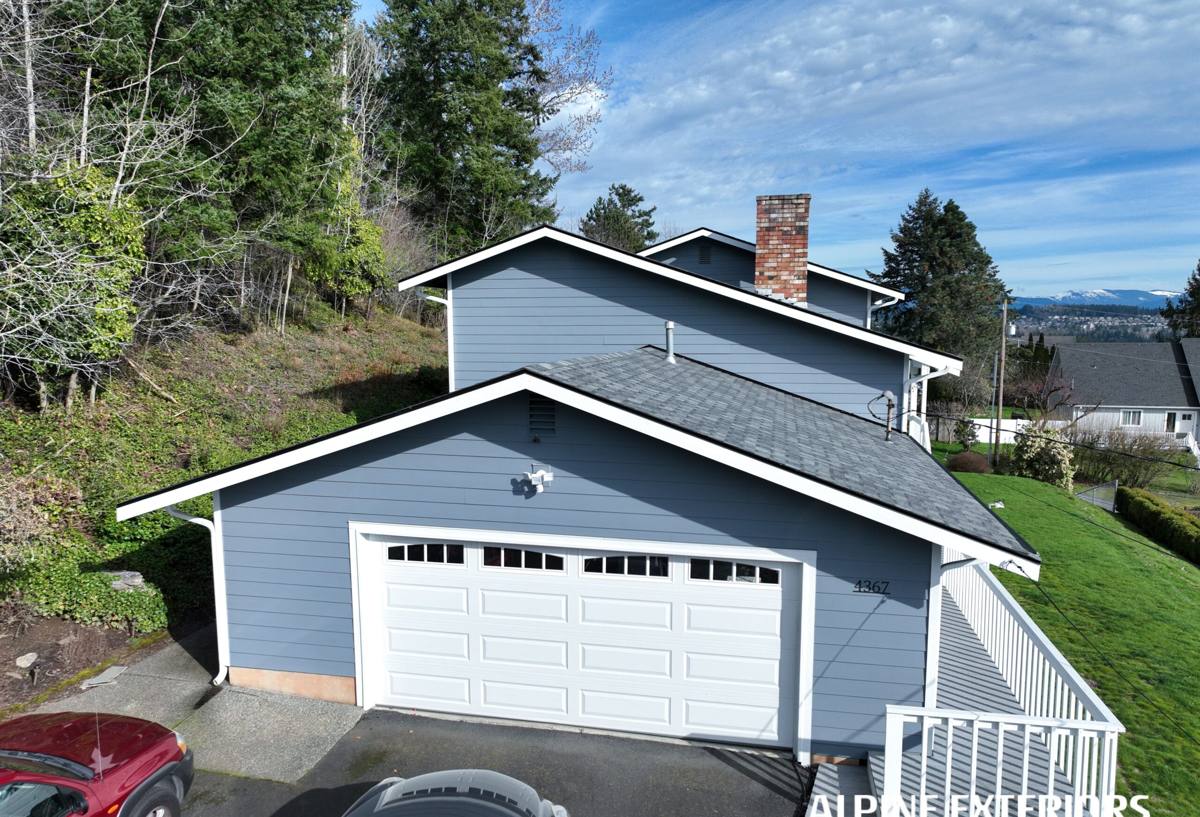
What Skagit Valley Weather Does to an Asphalt Shingle Roof
Salt Air and Corrosion
Homes closer to Skagit Bay and the Sound pick up airborne salt that accelerates corrosion on metal roofing components — flashing, drip edge, fasteners, and vent boots. It's a slower, quieter form of wear than storm damage, but over years it's exactly the kind of thing that turns a minor flashing detail into a leak. Roofs further inland in the valley see less of this than waterfront properties do, but it's rarely zero given how open the Skagit Valley is to marine air.
Wind-Driven Rain
Rain here doesn't fall straight down as often as people assume. Storm systems moving through push it at an angle, driving water into roof valleys, up under shingle tabs, and around penetrations like plumbing vents and chimneys. That's a different, more aggressive moisture load than a simple annual rainfall number suggests, and it's precisely where under-lapped shingles, minimal flashing, and thin underlayment fail first.
A Long Moss Season
The Skagit Valley doesn't get the extended dry stretches that keep moss in check further east. Shaded roof planes, north-facing slopes, and anything under tree cover stay damp long enough for moss and algae to take hold and spread across most of the year. Moss isn't just cosmetic — it holds water against the shingle surface, works into tab edges, and can lift or loosen roofing if it's left unaddressed for a few seasons.
Choosing the Right Asphalt Shingle for This Climate
Not all asphalt shingles are built the same, and the difference matters more here than in a drier region. The two broad categories — three-tab and architectural (also called dimensional or laminated) — perform differently under sustained moisture and wind.
| Factor | Standard Three-Tab | Architectural / Dimensional |
|---|---|---|
| Wind resistance | Lower rated; more prone to lifting in gusts | Higher rated; layered construction resists uplift better |
| Moisture and moss resistance | Adequate, but thinner profile holds less margin | Thicker mat and heavier granule bed hold up longer under sustained damp |
| Algae-resistant (AR) granules | Available on some product lines | Widely available; worth specifying for shaded roof planes |
| Realistic lifespan in this climate | 15-20 years | 25-30 years, sometimes longer with attentive maintenance |
| Upfront cost | Lower | Moderately higher, usually justified by lifespan and wind rating here |
For most Mount Vernon homes, we recommend architectural shingles with algae-resistant granules, especially on any roof plane that sits in shade for part of the day. The extra cost over three-tab shingles is modest relative to the total job, and the added wind resistance and moisture tolerance matter in a climate that doesn't give a roof many dry stretches to recover in.
Algae-Resistant Granules: What They Actually Do
Algae-resistant shingles use copper- or zinc-infused granules woven into the surface layer. As rain washes across the roof, trace amounts of that metal inhibit algae and blue-green streaking from taking hold. It doesn't make a roof moss-proof — nothing does in a climate this wet — but it slows the staining and buildup that would otherwise show up faster on a shaded valley roof than the same shingle would in a drier region.
What Correct Installation Actually Involves
Most shingle roof failures we see in this area don't come from bad shingles. They come from shortcuts underneath the shingles that don't show up as a problem until years later, usually right when a homeowner least expects it. On every asphalt shingle job, that means:
- Underlayment rated for sustained moisture exposure, applied with correct overlap at every seam
- Ice-and-water shield at eaves, valleys, and other spots where water and debris collect
- Properly lapped and sealed flashing at every valley, chimney, skylight, and roof-to-wall transition
- Balanced attic and roof deck ventilation so trapped moisture has somewhere to go
- Manufacturer-specified nailing pattern and fastener placement, not a shortcut pattern that voids warranty coverage
- Drip edge and starter strip installed to shed wind-driven rain rather than invite it under the first course
None of this adds significant cost relative to the shingles themselves. Skipping it is what turns a roof rated for twenty-five years into one that's leaking at fifteen.
Signs a Mount Vernon Roof Needs Attention
- Moss buildup in valleys or on shaded slopes that comes back quickly after cleaning
- Granules collecting in gutters or piling up at the base of downspouts
- Curling, cupping, or missing shingles, especially after a windstorm
- Water staining on interior ceilings near exterior walls, chimneys, or skylights
- Daylight visible through the roof deck from inside the attic
- Soft spots or noticeable sagging when the roof is walked
- Flashing that looks lifted, rusted, or stripped of sealant
Any single item on that list is worth a professional look. Several of them together, especially on a roof past the middle of its expected lifespan, usually mean it's time for a real conversation about repair versus replacement.
Repair or Replace: How We Help You Decide
We don't default to recommending a full replacement just because it's the bigger job. We look at the roof's age, how much of the surface is affected, whether the deck underneath shows moisture damage, and how many repairs it's already had. A localized leak on an otherwise sound roof is usually a straightforward repair. A roof nearing the end of its rated life, with moss-related wear spread across multiple planes or a deck that's gone soft from years of trapped moisture, is more honestly addressed with a replacement than another round of patchwork that won't hold through the next wet season. Either way, we'll walk you through exactly what we find and why, so the decision is yours to make with real information.
How the Process Works
- Inspection and assessment — a walk of the roof surface, valleys, flashing points, and attic to identify the actual condition, not just the visible symptoms.
- Honest recommendation — repair, partial replacement, or full tear-off, explained in plain terms along with the reasoning behind it.
- Material selection — shingle line, wind rating, and algae-resistant granule options matched to your roof's pitch and sun/shade exposure.
- Installation — tear-off (if needed), deck inspection and repair, underlayment, flashing, ventilation, and shingle installation done to manufacturer spec, not a shortcut version of it.
- Final walkthrough — a review of the finished roof and what to watch for going forward, specific to your home's exposure.
Why a Local Skagit County Crew Matters
A crew that works roofs across the Skagit Valley through every season sees how moss, wind-driven rain, and salt air actually behave on real houses over years, not just how a shingle performs on a manufacturer's data sheet. That translates into practical decisions on your roof: which planes need extra attention because of tree shade, how much ice-and-water shield a given valley genuinely needs, and which flashing details are worth the extra time on install day so you're not fielding a callback two winters later. It also means someone local is reachable if a warranty question comes up years down the road, rather than tracking down a crew that's moved on to another region.
Maintaining an Asphalt Shingle Roof in This Climate
Even a correctly installed roof benefits from basic seasonal attention in a valley climate like this one. Keeping gutters and downspouts clear ahead of the wet season prevents water from backing up under the eaves. Checking shaded, north-facing roof planes for early moss growth and addressing it before it spreads keeps moisture from sitting against the shingle surface for months at a stretch. A visual inspection once a year, ideally in fall before the heaviest rain arrives, plus a check after any major windstorm, catches small issues — a lifted shingle, a gap in flashing sealant — while they're still cheap to fix. None of this is a heavy lift, but it's real, and it's the difference between getting the full rated life out of a roof and replacing it early.
Get a Free, No-Pressure Estimate
If your Mount Vernon roof needs an inspection, a repair, or you're weighing a full replacement, we're glad to take a look and give you a straightforward read on what it actually needs. Reach out using the form below to schedule a free estimate — no pressure, no upsell script.