 Skagit County
 Why Cedardale Roofs Wear Differently
Cedardale sits close enough to Puget Sound and the tidal waters around Skagit County that homes here deal with a mix most inland Washington roofs never see: salt-laden air, long stretches of driving rain off the water, and a moss season that can run most of the year in shaded, north-facing yards. None of these factors alone is unusual for Western Washington. Together, on the same roof, year after year, they add up to faster wear than a generic installation is built to handle.
Salt air accelerates corrosion on exposed metal — fasteners, flashing, drip edge, vent caps. Driving rain finds every gap in flashing and underlayment that a calmer climate would never expose. And moss doesn't just look bad; it holds moisture against the shingle surface and works its way under tabs and around fasteners, which is how a cosmetic problem turns into a leak. A new roof installed in Cedardale needs to be specified and installed with all three in mind, not just built to code minimums.
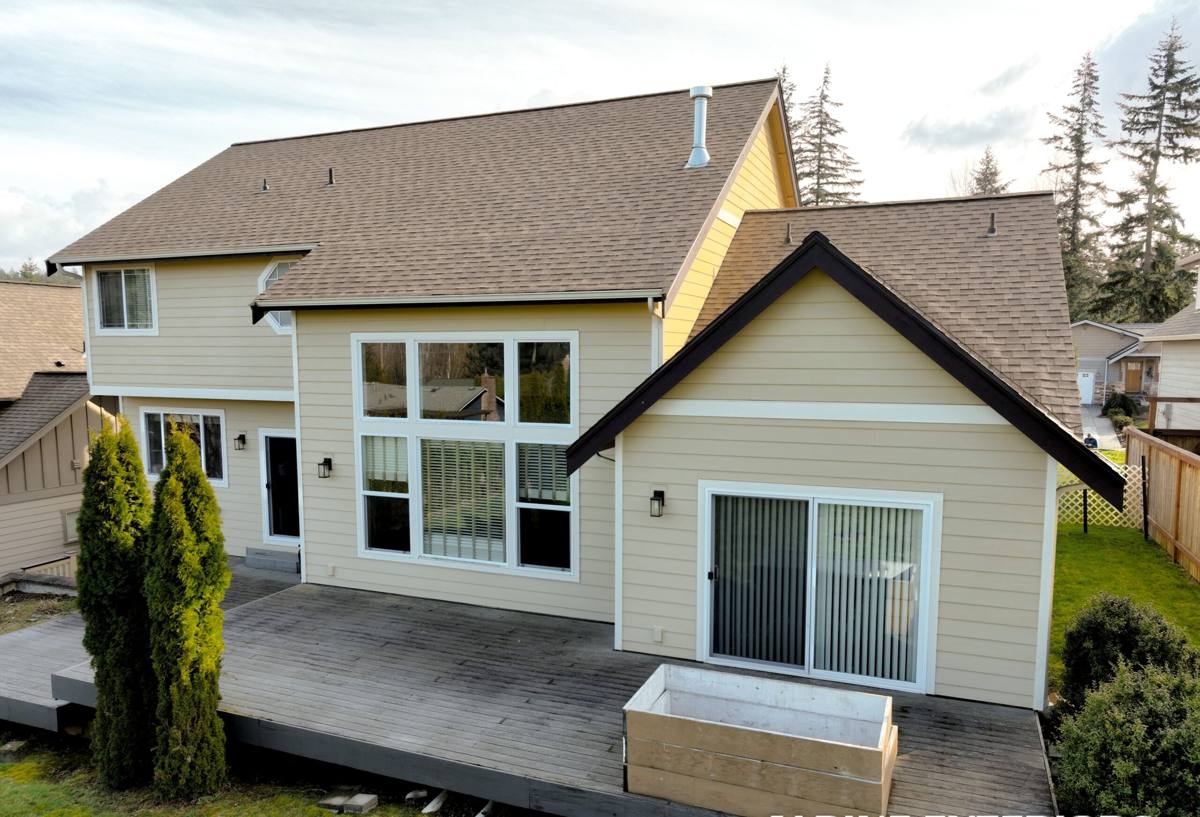
Signs a Cedardale Home Needs a New Roof, Not Another Repair
Most homeowners call us after a repair, or after they've had a repair done more than once in the same area. Repairs have their place, but there's a point where patching a roof costs more over time than replacing it. Here's what tells us a full new roof installation is the right call rather than another patch:
- Granule loss heavy enough that you're finding shingle grit in gutters or at downspout outlets every season
- Moss or algae staining that keeps returning within a year or two of cleaning
- Curling, cupping, or cracked shingles across large sections rather than one isolated spot
- Soft spots or sagging in the roof deck, which usually means water has already gotten into the sheathing
- Flashing around chimneys, skylights, or valleys that's rusted, lifted, or was never properly step-flashed to begin with
- A roof at or past 20-25 years old on standard asphalt shingles, especially with heavy tree cover or shade
- Daylight visible through the roof deck from inside the attic, or insulation that's damp or matted
If a roof is only showing one of these signs in a small area, a repair is often the honest answer and that's what we'll recommend. When several of these show up together, patching becomes a short-term fix on a roof that's already failing underneath.
What a Correct Installation Involves in This Climate
Underlayment and Water Protection
In a driving-rain climate, the underlayment matters as much as the shingle on top of it. We install synthetic underlayment rather than older felt products, because synthetic holds up better to the wind-driven rain that comes through Skagit County off the water and doesn't degrade as quickly if a roof sits open partway through a install day. At eaves, valleys, and any roof-to-wall transition, we run self-adhering ice-and-water membrane — not because Cedardale gets heavy ice buildup, but because that same membrane is the best defense against wind-driven rain forcing its way up under the first courses of shingles, which is the most common leak point we find on older roofs in this area.
Flashing Done Right the First Time
Flashing failures cause more leaks than worn-out shingles do. Step flashing at walls and chimneys, proper valley flashing, and correctly lapped drip edge at eaves and rakes are not optional details — they're the difference between a roof that sheds Skagit County's rain and one that slowly lets it in. Because salt air corrodes exposed metal faster here than it does further inland, we use flashing and fasteners rated for coastal exposure rather than standard-grade materials.
Ventilation That Fights Moss and Moisture Together
A roof deck that stays cool and dry sheds moss more slowly and lasts longer, full stop. Balanced intake and exhaust ventilation keeps the underside of the roof deck from holding moisture, which reduces the conditions moss and algae need to take hold, and also protects the deck itself from the rot that comes with trapped humidity. On a lot of older Cedardale homes we open up, the ventilation was undersized or blocked entirely, which shortened the life of the roof that was there before ours.
Material Options for Cedardale Homes
There's no single "best" roofing material — the right choice depends on budget, how much shade and moss exposure the roof gets, and how long you plan to be in the home. Here's how the common options compare for a coastal Skagit County property:
| Material | Typical Lifespan | Moss/Algae Resistance | Coastal Notes |
|---|---|---|---|
| Standard asphalt composition shingle | 20-25 years | Fair, improves with algae-resistant granules | Most affordable; needs regular moss treatment in shaded areas |
| Algae-resistant (AR) composition shingle | 25-30 years | Good | Worthwhile upgrade in shaded, damp Cedardale lots |
| Standing seam metal | 40-50+ years | Very good — sheds moss more easily | Use coastal-rated fasteners and coatings to manage salt exposure |
| Synthetic/composite shingle | 30-50 years | Good | Higher upfront cost; low maintenance long term |
For most Cedardale homes we recommend at minimum an algae-resistant asphalt shingle if budget calls for composition roofing — the upgrade cost is modest and the payoff shows up directly in fewer moss treatments and a longer-looking roof. Metal is worth a serious look for homeowners planning to stay long-term or who are tired of moss maintenance altogether, but it's a bigger upfront investment and the fastener and coating details need to be right for coastal air.
Our Installation Process
- On-site assessment. We inspect the existing roof, deck condition, ventilation, and flashing details, and walk the property with you to talk through what we're seeing.
- Written estimate and material selection. You get a clear scope of work and a choice of materials suited to your budget and how much moss/shade exposure the roof gets.
- Tear-off and deck inspection. We remove the old roofing down to the deck and check for soft spots or rot before anything new goes down — this is where hidden water damage from old flashing failures usually shows up.
- Deck repair as needed. Any damaged sheathing gets replaced before underlayment goes on; we don't install new roofing over a compromised deck.
- Underlayment and ice-and-water membrane. Installed per manufacturer spec at eaves, valleys, and penetrations.
- Flashing installation. New step flashing, valley flashing, and drip edge sized and lapped correctly for this climate.
- Shingle or material installation. Installed to manufacturer nailing patterns and exposure specs — this is what protects the warranty.
- Ventilation check and adjustment. We confirm intake and exhaust venting is balanced for the attic space.
- Final walkthrough and cleanup. Magnetic sweep for stray fasteners, gutter check, and a walkthrough with you before we consider the job done.
What to Expect: Permits and Timeline
Most residential re-roofs in Skagit County require a building permit, and we handle that as part of the job rather than leaving it to the homeowner. A typical single-family roof installation takes one to three days depending on size, roof complexity, and weather — and weather is the real variable in this part of Washington. We schedule around forecasted rain where we can, but Skagit County's rain patterns mean flexibility is part of doing this work honestly rather than rushing a roof onto a house between storms.
How to Get Your Home Ready
- Move vehicles out of the driveway and away from the house for the days of installation
- Clear items from the attic if you're storing anything directly under the roof deck we'll be repairing
- Take down wall art or fragile items in upstairs rooms — tear-off and nailing does cause vibration
- Let us know about any skylights, solar panels, or attic fans so we can plan flashing and access around them
- Keep pets inside or away from the work area during active tear-off
Why a Crew That Already Works Cedardale Matters
A roofing crew that works across Skagit County regularly sees how this specific stretch of coastline treats a roof over time — which flashing details fail first, which north-facing lots need heavier moss prevention, and which fastener grades actually hold up to salt air instead of just meeting a spec sheet. That's different from a crew that installs mostly inland roofs and treats every job the same way. It shows up in the small decisions: which underlayment to run at a valley, whether a lot's shade pattern calls for algae-resistant shingles as standard rather than upsell, and how ventilation gets balanced for a specific roof rather than installed to a generic rule of thumb.
It also matters for follow-through. A crew that's local knows the permitting process for the county, shows up for warranty questions without a long drive, and has a reputation in the community worth protecting — which is a real incentive to do the flashing right the first time.
Ready for an Estimate?
If your Cedardale roof is showing its age, or you just want an honest read on whether it's a repair or a replacement, we're glad to come take a look. The estimate is free, there's no pressure, and you'll get a straight answer about what your roof actually needs — use the form below to get started.