 Skagit County
 Sedro-Woolley sits inland from the saltwater but doesn't escape what Skagit County's climate does to a house. Salt air still moves up the valley off Skagit Bay and Puget Sound, Pacific storm fronts still drive rain sideways into wall assemblies rather than straight down, and the tree cover common on lots around town keeps north- and east-facing walls damp enough to grow moss for most of the year. If you're planning a siding installation on a Sedro-Woolley home, the product and the workmanship both need to be chosen with that combination in mind, not with a generic, one-size-fits-all approach. This page covers what that means in practice.
What Sedro-Woolley's Climate Asks of Siding
A siding installation here has to handle three things at once, continuously, for decades: sustained moisture from a long wet season, wind-driven rain that gets pushed into seams and joints rather than just running off a wall, and shaded, damp conditions that support moss and mildew growth on the sections of a house that don't get much direct sun. None of these are dramatic events — a single storm rarely does visible damage. It's the cumulative effect of years of that exposure that separates a siding job that's still solid at twenty years from one that's already showing rot, cracking, or discoloration at ten.
That's why the choice of siding material matters as much as the installation itself. A product engineered for a national-average climate — drier, sunnier, less sustained rainfall — is being asked to perform outside the conditions it was designed for the moment it goes up on a Sedro-Woolley wall. The gap between "works fine in most of the country" and "works fine here" is exactly where premature failures tend to start.
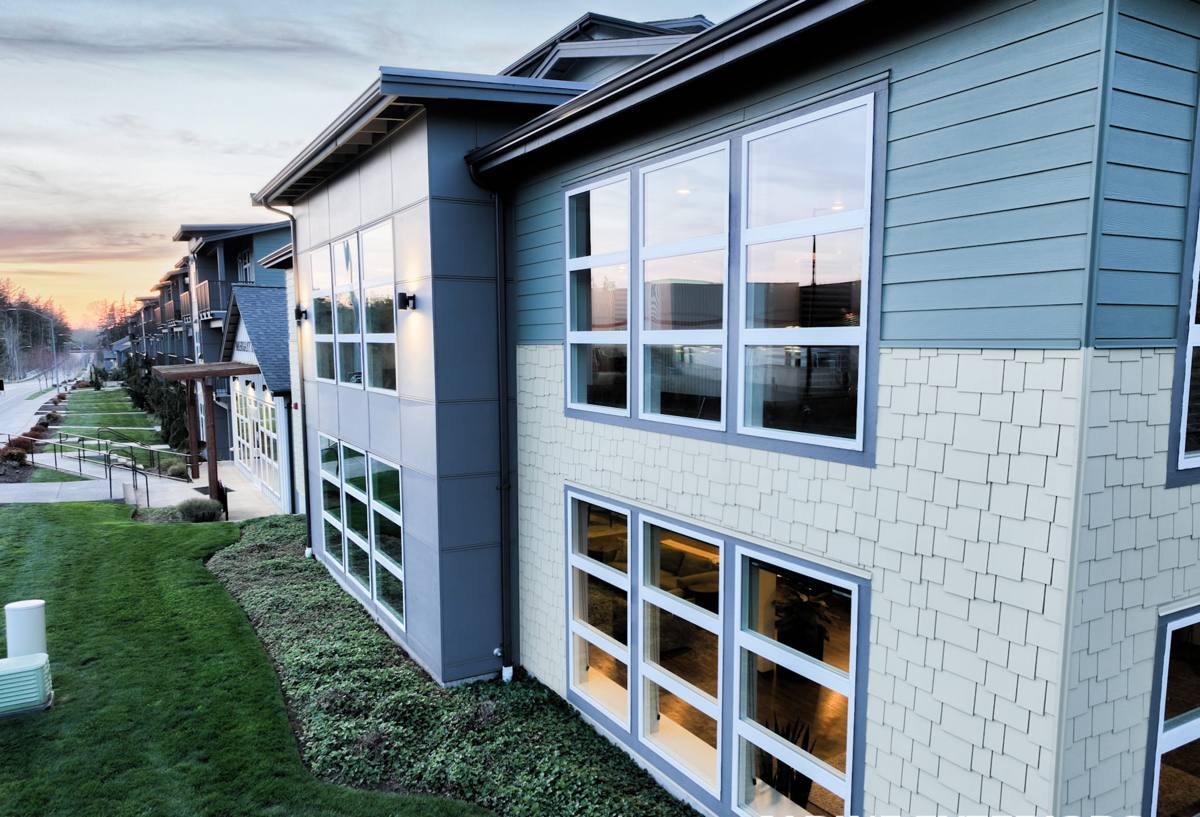
Why We Install Only James Hardie Fiber Cement
We install one siding product on every job: James Hardie fiber cement. We don't offer vinyl, LP SmartSide, Cemplank, Allura, primed spruce, or cedar. That's a professional standard we hold to, not a narrow product lineup we settled on by default. Each of those alternatives does something well — vinyl is inexpensive, engineered wood installs quickly and takes paint well, cedar has real natural character — but each also carries a trade-off that we don't think holds up over the long run in this specific climate.
Vinyl can warp, fade, and grow brittle with temperature swings, and its seams and J-channels are exactly the kind of gap that wind-driven rain finds its way into over time. Wood-based products, even when factory-treated, still have an organic core that depends on every field-cut edge being primed and every joint being sealed correctly — a standard that has to hold across an entire crew, on every job, for the full life of the siding, in a place that doesn't offer much of a dry season for a missed step to recover in. Cedar is genuinely attractive, but it's also organic and asks for ongoing refinishing, sealing, and moss control to keep performing.
Fiber cement sidesteps that core problem because it isn't organic to begin with. There's no wood substrate for moisture to work into at a cut edge or seam, and it doesn't feed moss and mildew growth the way wood-based siding can. James Hardie also builds HZ product lines specifically engineered for regions with sustained moisture and coastal exposure, rather than one generic formulation sold everywhere in the country. Paired with a factory-applied ColorPlus finish — baked on under controlled conditions rather than painted on-site after installation — it holds color and resists cracking longer than field-applied finishes typically manage through repeated wet seasons.
What a Correct Installation Actually Involves
Fiber cement's long-term performance depends almost entirely on how it's installed, not just on the material itself. A correct Hardie installation on a Sedro-Woolley home means proper clearance from grade, decks, and rooflines; flashing that's integrated into the wall assembly at every window, door, and penetration rather than caulked over as an afterthought; fastening patterns matched to the specific Hardie product line; and joint treatment that accounts for which walls sit in shade and which get regular sun. Skip any one of those details and you've built in a weak point that won't show up as a problem for a year or two — and then shows up as a callback nobody wanted.
- Correct clearance from grade, patios, and decks so the bottom edge stays out of standing moisture
- Flashing integrated at every window, door, and roofline transition, not applied as a surface patch
- Fastener spacing and pattern matched to the specific Hardie product and local wind exposure
- Joint and caulk treatment adjusted for shaded, moss-prone walls versus sun-exposed ones
- Factory-finished color matched cleanly at trim, corners, and touch-up points
- A tear-off and inspection of the existing wall assembly for hidden moisture or rot before new siding goes up
Why Hiring a Crew That Already Works Sedro-Woolley Matters
Siding installation isn't just a product choice — it's a set of field judgment calls that a crew makes on every wall of every house, and those calls are better when the crew already understands the conditions a Sedro-Woolley home actually faces. A crew that mostly works drier, sunnier regions may not think twice about a north-facing wall under tree cover, because in their normal working conditions that wall doesn't behave much differently from any other. Around here, that same wall needs different joint treatment and a more careful look at moisture history before new siding goes over it.
Local familiarity also shows up in smaller, practical ways: knowing which lots tend to sit under heavier tree cover and moss exposure, understanding how wind direction off the valley affects which walls take the most driving rain, and having already seen what happens on houses in the area when flashing details were rushed or skipped. That kind of pattern recognition doesn't come from a spec sheet — it comes from doing the work here, repeatedly, and paying attention to what holds up and what doesn't.
Comparing Approaches to a Sedro-Woolley Siding Project
| Factor | National-Average Approach | Skagit-Specific Approach |
|---|---|---|
| Siding material | Whatever's cheapest or most common, regardless of climate | James Hardie HZ product lines engineered for sustained moisture and coastal exposure |
| Flashing detail | Standard, one-size-fits-all approach | Sized to wind-driven rain and a long wet season |
| Finish | Field-applied paint on a recoating schedule | Factory-baked ColorPlus finish, less ongoing field maintenance |
| Moss and shade exposure | Not factored into product or joint choices | Considered wall-by-wall based on tree cover and sun exposure |
| Crew familiarity | General exterior experience, not region-specific | Crew that already works Sedro-Woolley homes and knows the local failure patterns |
Signs a Sedro-Woolley Home May Need New Siding
Some of these show up gradually enough that homeowners live with them for a while before deciding to act. Worth flagging early rather than waiting for the problem to spread.
- Persistent moss or dark staining on north- or east-facing walls that keeps returning after cleaning
- Soft spots, bubbling, or visible swelling anywhere on the current siding, especially near ground level or at trim joints
- Caulked joints that have opened up, cracked, or pulled away from the siding edge
- Paint that's peeling or blistering rather than just fading evenly
- Visible gaps or warping at seams and corners
- Rising energy bills that suggest the wall assembly isn't sealing the way it used to
Our Installation Process
We start with an on-site inspection of the existing siding and wall assembly, checking for hidden moisture or rot before anything is priced. From there, we walk through product line, color, and trim options, and lay out a clear scope and cost before work begins. During installation, tear-off includes a check of the sheathing and framing underneath — a step that matters in a climate where problems can be developing behind siding that still looks fine from the street. Flashing, clearances, and fastening are handled to Hardie's specification on every wall, not just the ones easiest to access, and shaded or moss-prone walls get the same attention to joint treatment as sun-exposed ones. We walk the finished job with the homeowner before calling it done.
Cost Factors for a Sedro-Woolley Siding Project
We don't publish blanket pricing because it wouldn't be an honest number — the real cost drivers are specific to the house in front of us. The factors below are the ones that consistently move a project's cost up or down.
| Factor | How It Affects Cost |
|---|---|
| Existing wall condition | Hidden moisture or rot found during tear-off adds repair scope before new siding goes up |
| Home size and wall complexity | More corners, gables, and penetrations mean more flashing and labor time |
| Siding profile and trim detail | Board-and-batten or heavier trim packages run higher than standard lap siding |
| Access and site conditions | Tree cover, tight lot lines, or difficult staging can add labor time |
| Tear-off vs. install over existing | Full tear-off costs more upfront but lets us verify what's happening behind the old siding |
If you're weighing a siding project for a home in Sedro-Woolley, we're glad to take a look at your specific property — sun exposure, moss risk, and current siding condition all factor into an honest recommendation. Reach out for a free, no-pressure estimate.
```